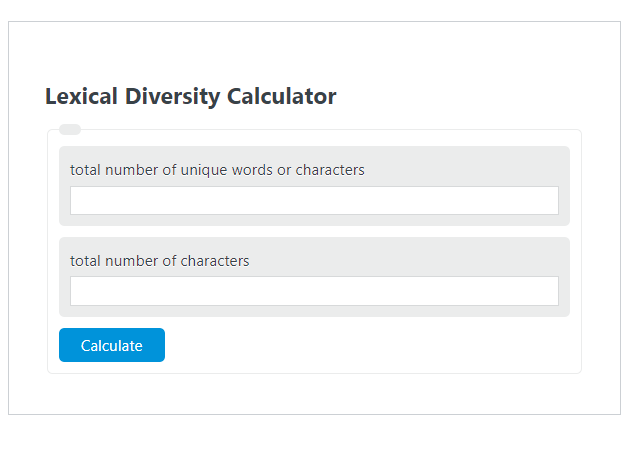
Calculate lexical diversity, unique word count, or total words from any two values using the type-token ratio formula for text analysis.
- All Statistics Calculators
- Lexical Density Calculator
- GWAM (Gross Words Per Minute) Calculator
- Speech Length Calculator
Understanding Lexical Diversity
Lexical diversity measures how varied the vocabulary is in a passage of text. It compares the number of distinct words used to the total number of words used. A higher value generally indicates more vocabulary variation, while a lower value indicates more repetition. This calculator expresses the result as a percentage, which is the percentage form of the type-token ratio.
Lexical Diversity Formula
| Symbol | Meaning |
|---|---|
| LD | Lexical diversity expressed as a percentage |
| UW | Total number of unique words, also called types |
| TW | Total number of words, also called tokens |
| TTR | Type-token ratio in decimal form |
How to Use the Calculator
- Count the total number of words in the passage. This is the number of tokens.
- Count how many different words appear at least once. This is the number of types.
- Enter both values into the calculator.
- The calculator returns the lexical diversity percentage.
If a text contains 1,000 total words and 250 distinct words, the lexical diversity is:
What Counts as a Unique Word?
The accuracy of lexical diversity depends on how the text is prepared before counting. The same text can produce different results depending on the rules used. For consistent analysis, define your counting method before comparing documents.
- Case sensitivity: Decide whether Word and word are treated as the same type.
- Punctuation: Remove punctuation if you want word counts only.
- Contractions: Decide whether forms like don’t remain one token or are split.
- Numbers and symbols: Choose whether dates, percentages, and symbols count as tokens.
- Lemmatization or stemming: Some analyses group forms like run, runs, and running; others count them separately.
- Hyphenated terms: Be consistent about whether they are one word or multiple words.
How to Interpret the Result
There is no single “good” lexical diversity score for every context. A result is most meaningful when it is compared to other texts of similar length, genre, and preprocessing rules.
| Result Pattern | General Meaning | What to Check |
|---|---|---|
| Higher LD | More varied vocabulary and less repetition | Whether the text is very short, which can inflate the score |
| Lower LD | More repeated vocabulary or narrower word choice | Whether the subject matter naturally repeats key terms |
| Similar LD across texts | Comparable vocabulary variety | Whether tokenization and text length were standardized |
Why Text Length Matters
Simple type-token ratio is sensitive to passage length. As a text gets longer, repeated words usually accumulate faster than brand-new words, so lexical diversity often decreases even if the writing remains sophisticated. This means short texts frequently appear more diverse than long texts.
For better comparisons:
- Compare samples with similar word counts.
- Use the same cleaning and tokenization rules for every text.
- Be cautious when comparing a paragraph to a full article or chapter.
- For advanced research, consider segment-based or corrected lexical diversity measures.
Lexical Diversity vs. Lexical Density
Lexical diversity and lexical density are related but different measurements:
| Measure | What It Evaluates | Main Focus |
|---|---|---|
| Lexical Diversity | How many different words are used | Vocabulary variation |
| Lexical Density | How much of the text is made up of content words | Information load |
A text may be lexically dense but not highly diverse if it repeats many technical terms. Likewise, a text may be diverse without being especially dense if it uses many different everyday words.
Common Applications
- Writing analysis: evaluate repetition and vocabulary range in essays, blogs, and reports
- Language learning: track vocabulary growth over time
- Education: compare drafts, assignments, or reading responses
- Corpus linguistics: examine stylistic variation across authors or genres
- Speech and discourse analysis: study spoken vocabulary variety
- NLP and text mining: use as a descriptive feature in language datasets
Best Practices for Reliable Comparison
- Use samples of similar length.
- Apply the same normalization rules to every text.
- State whether the result is reported as a decimal ratio or a percentage.
- Do not interpret the score in isolation; consider subject matter, genre, and audience.
- When analyzing specialized texts, expect repeated terminology to lower the score naturally.
Frequently Asked Questions
- Can lexical diversity be more than 100%?
- No. The number of unique words cannot exceed the total number of words, so the percentage stays between 0% and 100%.
- Is a higher score always better?
- Not necessarily. A higher score means more variation, but effective writing often repeats important terms for clarity, cohesion, and emphasis.
- What is the difference between types and tokens?
- Tokens are all words in the text, including repeats. Types are the distinct words counted once each.
- Should I remove stop words before calculating?
- That depends on your goal. Keeping stop words reflects the full text as written. Removing them may highlight content vocabulary more clearly.
- Why do two tools give different lexical diversity values?
- They may handle punctuation, capitalization, contractions, numbers, or stemming differently. Consistent preprocessing is essential for fair comparison.