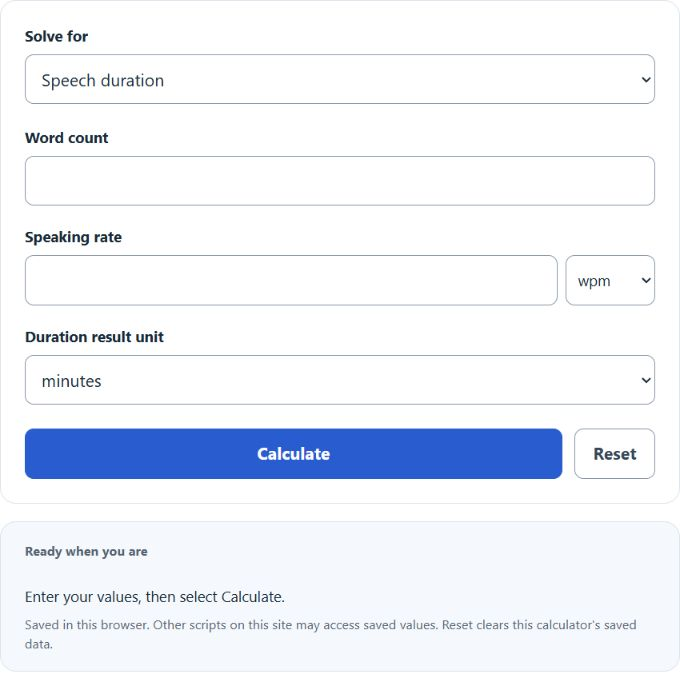
Calculate speech length from word count and speech rate in wpm or wps, or find the duration needed for a speech of any length in seconds or minutes.
- All Unit Converters
- GWAM (Gross Words Per Minute) Calculator
- Speech Rate Calculator
- Words to Minutes Calculator
- Presentation Time Calculator
- Script Length Calculator
Speech Length Formula
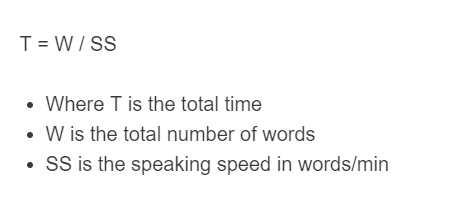
The length of a speech is found by dividing the total number of words by the speaking rate. If your rate is entered in words per minute, the result is in minutes. If your rate is entered in words per second, the result is in seconds.
- T = total speech duration
- W = total word count
- SS = speaking speed
The same relationship can be written in unit-specific form:
How to Use the Speech Length Calculator
- Count the words in your script, outline, or notes.
- Enter your speaking speed in words per minute or words per second.
- Calculate the missing value to see the estimated speech duration.
- Rehearse once out loud and compare your real speaking pace with the estimate.
- Adjust your draft if you need to fit a fixed time slot.
This calculator is especially useful for presentations, wedding speeches, class talks, sales pitches, eulogies, debate prep, podcasts, video voiceovers, and any event with a strict time limit.
Estimate Word Count From a Target Time
If you already know how long you are allowed to speak, reverse the formula to find how many words you should write.
That makes planning easier before drafting. For example, a 5-minute speech at 130 WPM supports about 650 words, while a 10-minute speech at the same pace supports about 1,300 words.
Typical Speaking Rate Ranges
Different speech styles use different pacing. A slower pace improves emphasis and clarity, while a faster pace covers more material in less time.
| Delivery Style | Common Pace | Best Use |
|---|---|---|
| Deliberate | 100-120 WPM | Ceremonies, serious topics, heavy emphasis, complex explanations |
| Conversational | 120-150 WPM | Most presentations, meetings, classroom speaking, general public speaking |
| Fast-paced | 150-180 WPM | Energetic talks, familiar material, informal delivery, time-compressed segments |
If you are unsure which rate to use, start with a moderate conversational value and then refine it after one full rehearsal.
Quick Timing Reference
The table below gives rough speech times for common word counts at several speaking rates.
| Word Count | 120 WPM | 140 WPM | 160 WPM |
|---|---|---|---|
| 300 words | 2 min 30 sec | 2 min 09 sec | 1 min 53 sec |
| 500 words | 4 min 10 sec | 3 min 34 sec | 3 min 08 sec |
| 750 words | 6 min 15 sec | 5 min 21 sec | 4 min 41 sec |
| 1,000 words | 8 min 20 sec | 7 min 09 sec | 6 min 15 sec |
| 1,500 words | 12 min 30 sec | 10 min 43 sec | 9 min 23 sec |
Why Actual Delivery Can Be Longer Than Script Time
The calculator gives a strong baseline estimate, but live speaking often takes longer than reading straight through a script. Common reasons include:
- Pauses for emphasis
- Audience laughter or applause
- Slide transitions or demonstrations
- Improvised comments
- Intentional slowing on important points
- Questions, interruptions, or room setup delays
When timing matters, add a planning buffer to your rehearsal result.
A small buffer helps prevent running over time, especially in formal speaking settings.
Examples
A 900-word speech delivered at 135 words per minute lasts about 6.67 minutes.
An 8-minute speaking slot at 125 words per minute allows about 1,000 words.
Practical Tips for Better Timing
- Time your speech out loud, not silently.
- Practice at the same pace you plan to use in front of an audience.
- Mark optional lines or stories you can cut if time gets tight.
- Use shorter sentences if you tend to speak too quickly.
- Leave room for opening remarks, transitions, and conclusion pauses.
- For slide presentations, rehearse with the actual slides visible.
FAQ
What is a good speech rate for most presentations?
A moderate conversational pace is usually the safest starting point because it balances clarity, emphasis, and total time.
Should I use my reading speed or my speaking speed?
Use your actual speaking speed. Reading silently or reading aloud from a page is often faster than delivering naturally to an audience.
Why does my real speech take longer than the calculator result?
Live delivery includes pauses, eye contact, transitions, and emphasis, all of which add time beyond a straight word-count estimate.
Can I use this calculator to plan a script from scratch?
Yes. Start with your time limit, choose a realistic speaking rate, calculate the target word count, and draft to that limit.