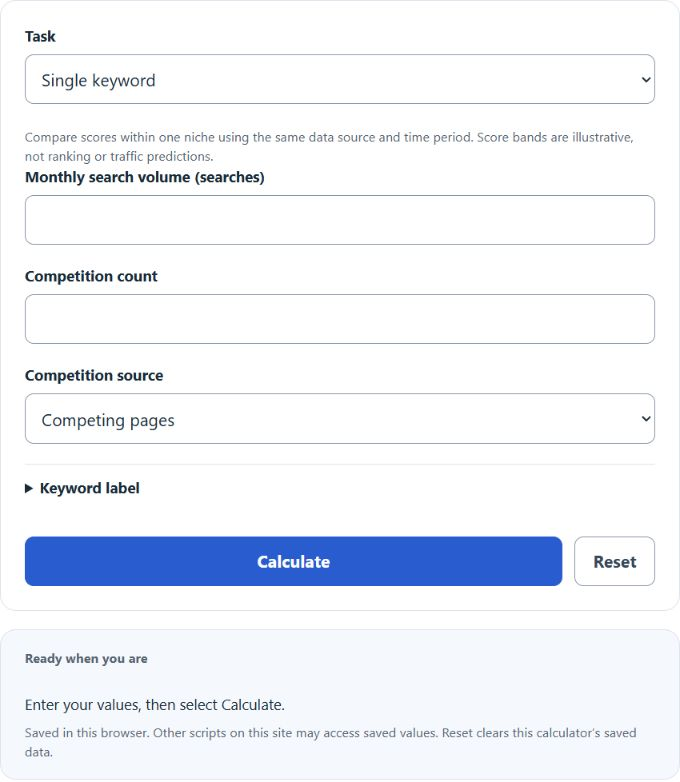
Calculate Keyword Effectiveness Index from monthly search volume and competition, or rank multiple keywords by KEI for SEO planning.
Keyword Effectiveness Index Formula
This calculator uses the traditional squared-volume KEI formula as a relative screening score. KEI definitions and scales can differ across tools.
- KEI = Keyword Effectiveness Index score
- Monthly Search Volume = average monthly searches for the keyword
- Competition = number of competing pages, allintitle results, or app/store listings
In Single keyword mode, you enter one keyword with its volume and competition number. The calculator squares the volume, divides by competition, and returns a single score with an illustrative band label.
In Compare keywords mode, you paste a comma-separated list (keyword, volume, competition) and the calculator runs the same formula on each row, then sorts the list from highest to lowest KEI. Invalid rows must be corrected before the list can be ranked. Quote keyword labels containing commas and use ungrouped counts. Only compare scores that use the same competition source, since allintitle counts produce much smaller denominators than broad page counts and inflate the KEI.
Reference Tables
The score bands below are illustrative conventions retained from this page, not universal opportunity thresholds. Compare scores within the same niche and data source. Use the source table to keep your competition numbers consistent.
| KEI Score | Interpretation | Action |
|---|---|---|
| Below 10 | Low opportunity | Assess intent and relative niche scores |
| 10 to below 20 | Borderline | Compare against other candidates |
| 20 to below 100 | Promising | Review alongside intent and actual results |
| 100 to below 1000 | Strong | Compare with relevant niche candidates |
| 1000+ | Very strong | Verify the competition number first |
| Competition Source | How to get it | Typical scale |
|---|---|---|
| Competing pages | Plain Google search result count | Thousands to millions |
| allintitle | allintitle:”keyword” search | Hundreds to tens of thousands |
| App/store listings | App Store or Play Store result count | Tens to thousands |
Example and FAQ
Example. A keyword has 1,200 monthly searches and 45,000 competing pages.
KEI = 1,200² ÷ 45,000 = 1,440,000 ÷ 45,000 = 32. That falls in this page’s illustrative promising band; assess intent and the actual search results before choosing a target.
Why is the volume squared? Squaring weights demand more heavily than supply. Doubling searches quadruples this score at the same competition level. This mathematical weighting does not prove that traffic or conversions will quadruple.
Can I compare a KEI from allintitle to one from broad pages? No. The denominators differ by orders of magnitude. Stick to one source per comparison set.
What competition number should I use for app store keywords? Use the listing count returned for that exact phrase in the relevant store. Keep the same store across all keywords you rank.
Is a higher KEI always better? Not always. A high score can come from a tiny competition number that is unreliable. Check the search intent and the actual results page before committing to a keyword.