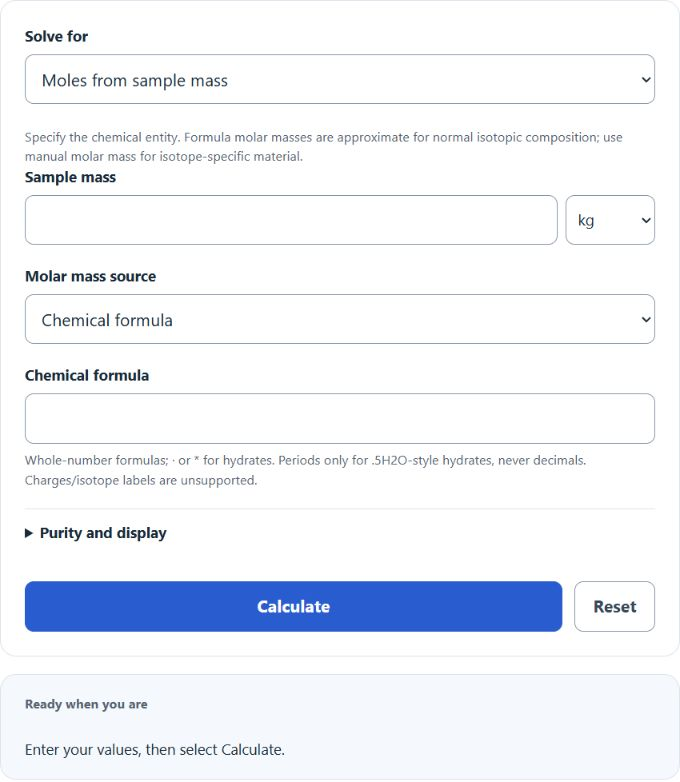
Calculate moles from a mass in kilograms using a chemical formula or molar mass, or solve for mass or molar mass, with purity and particle count.
- All Chemistry Calculators
- Grams to Moles Calculator
- Molarity To Moles Calculator
- Volume To Moles Calculator
Calculator Functions
| Function | What it does | What it requires |
|---|---|---|
| Moles from sample mass | Converts a mass in kilograms to the amount of a substance in moles | Requires the sample mass and the molar mass, given as a chemical formula, a substance from the list or a typed value |
| Sample mass from moles | Converts an amount in moles to the mass of sample in kilograms | Requires the amount of substance and the molar mass, given as a chemical formula, a substance from the list or a typed value |
| Molar mass from pure mass and moles | Finds the molar mass of a pure substance from a weighed mass and a known amount | Requires the mass of pure substance and the moles of that same substance |
Mass can be entered in kg, g, mg, tonnes, lb or oz, the amount in mol, mmol or kmol, and a typed molar mass in g/mol or kg/mol. The first two functions take an optional mass purity, which counts as 100% when blank, and every function has a setting for decimal places. Each result also shows the molar mass used, the mass of pure substance, the amount in mmol and kmol, and the number of molecules, atoms or formula units. A chemical formula adds a table of each element’s share of the molar mass.
kg to Moles Formulas
| n | Amount of substance (mol) |
| m | Mass of the pure substance (kg) |
| M | Molar mass of the substance (g/mol) |
| 1,000 | Grams in one kilogram |
Molar mass is defined as the mass of a substance divided by its amount, M = m ÷ n [1], so the amount is the mass divided by the molar mass. Molar masses are tabulated in grams per mole, which is why the kilograms are first multiplied by 1,000. There is no fixed number of moles in a kilogram: the answer depends on which substance it is.
Moles from sample mass
p is the mass purity as a fraction, so 90% is 0.9. One kilogram of water, H2O, at 18.015 g/mol is 1,000 ÷ 18.015 = 55.509 mol. One kilogram of salt that is 90% NaCl by mass, at 58.44 g/mol, holds 1,000 × 0.9 ÷ 58.44 = 15.400 mol of NaCl.
For a chemical formula, the molar mass is the sum of the standard atomic weights of its atoms [2]: water is 2 × 1.008 + 15.999 = 18.015 g/mol. Formulas can use brackets and hydrate water, such as Ca(OH)2 or CuSO4·5H2O. Charges, isotope labels and decimal atom counts are not accepted.
| Substance | Molar mass (g/mol) | Moles in 1 kg |
|---|---|---|
| Hydrogen gas, H2 | 2.016 | 496.03 |
| Helium, He | 4.0026 | 249.84 |
| Carbon, C | 12.011 | 83.257 |
| Methane, CH4 | 16.043 | 62.332 |
| Water, H2O | 18.015 | 55.509 |
| Nitrogen gas, N2 | 28.014 | 35.696 |
| Oxygen gas, O2 | 31.998 | 31.252 |
| Carbon dioxide, CO2 | 44.009 | 22.723 |
| Iron, Fe | 55.845 | 17.907 |
| Sodium chloride, NaCl | 58.44 | 17.112 |
| Platinum, Pt | 195.08 | 5.1261 |
| Gold, Au | 196.97 | 5.0769 |
For any other mass, multiply the last column by the number of kilograms: 20 kg of water is 20 × 55.509 = 1,110.2 mol.
Sample mass from moles
This turns moles into kilograms. Two moles of NaCl weigh 2 × 58.44 ÷ 1,000 = 0.1169 kg. If the salt on hand is only 80% NaCl, 0.1169 ÷ 0.8 = 0.1461 kg of it is needed to supply the same two moles. The result also lists the mass in g, mg, lb and oz.
Molar mass from pure mass and moles
One kilogram of a pure substance that amounts to 55.509 mol has a molar mass of 1,000 ÷ 55.509 = 18.015 g/mol. The result is also shown in kg/mol. An amount of zero moles is rejected, and no purity is applied, so the mass entered has to be the pure substance alone.
How to Convert kg to Moles
Multiply the kilograms by 1,000 to get grams, then divide by the molar mass of the substance in g/mol. For 2.5 kg of carbon dioxide, 2,500 g ÷ 44.009 g/mol = 56.807 mol. To go from moles back to kilograms, multiply the moles by the molar mass and divide by 1,000.
kg/mol and g/mol
Both are units of molar mass. The SI unit is kg/mol [1], and 1 kg/mol equals 1,000 g/mol, so a value in g/mol is divided by 1,000 to give kg/mol: water is 18.015 g/mol or 0.018015 kg/mol. With the molar mass in kg/mol, moles are simply kilograms divided by molar mass, with no factor of 1,000. mol/kg is the inverse, the number of moles in each kilogram, and is the figure in the last column of the table above. A kilomole (kmol) is 1,000 mol, so 1 kg of a substance contains 1 ÷ M kmol when M is in g/mol.
Limits of This Estimate
- Formula molar masses use standard atomic weights rounded to about five significant figures, for elements with their normal mix of isotopes [2]. Isotope-enriched material needs a typed molar mass.
- Purity is a percentage by mass of the exact formula entered, including any hydrate water. It is not a mole fraction or a percentage by volume.
- The calculator accepts any formula it can read, whether or not that compound exists, and it does not work out the makeup of mixtures or solutions.
- The count of particles is n × 6.02214076 × 10²³ [3]. It counts whole molecules or formula units, not the separate atoms or ions inside them.
Sources
- NIST, Guide for the Use of the International System of Units (SP 811), Section 8.6.4: molar mass as mass divided by amount of substance, with the unit kg/mol
- IUPAC Commission on Isotopic Abundances and Atomic Weights, Abridged Standard Atomic Weights 2024: atomic weights used for formula molar masses
- NIST, CODATA Value: Avogadro constant: 6.02214076 × 10²³ per mole, an exact value