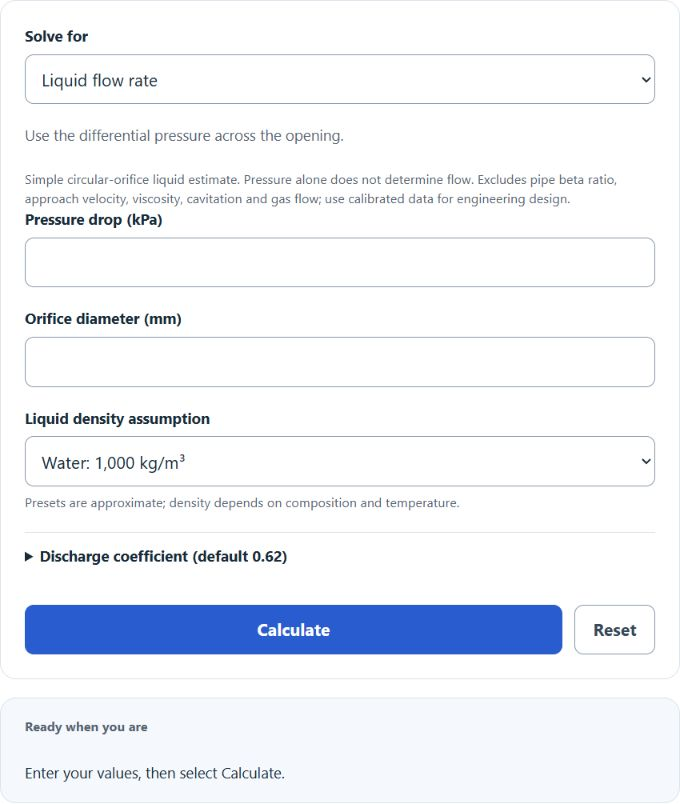
Calculate liquid flow in litres per second from kPa pressure drop, or solve pressure drop or orifice diameter using density and discharge coefficient.
| kPa to L/s | L/s to kPa |
|---|---|
| 1 kPa = 0.0689 L/s | 0.05 L/s = 0.5272 kPa |
| 2 kPa = 0.0974 L/s | 0.10 L/s = 2.1087 kPa |
| 3 kPa = 0.1193 L/s | 0.15 L/s = 4.7445 kPa |
| 5 kPa = 0.1540 L/s | 0.20 L/s = 8.4346 kPa |
| 7 kPa = 0.1822 L/s | 0.25 L/s = 13.1791 kPa |
| 10 kPa = 0.2178 L/s | 0.30 L/s = 18.9780 kPa |
| 15 kPa = 0.2667 L/s | 0.35 L/s = 25.8311 kPa |
| 20 kPa = 0.3080 L/s | 0.40 L/s = 33.7386 kPa |
| 25 kPa = 0.3443 L/s | 0.50 L/s = 52.7165 kPa |
| 30 kPa = 0.3772 L/s | 0.60 L/s = 75.9118 kPa |
| 40 kPa = 0.4355 L/s | 0.75 L/s = 118.6122 kPa |
| 50 kPa = 0.4869 L/s | 0.80 L/s = 134.9543 kPa |
| 60 kPa = 0.5334 L/s | 0.90 L/s = 170.8016 kPa |
| 75 kPa = 0.5964 L/s | 1.00 L/s = 210.8661 kPa |
| 100 kPa = 0.6886 L/s | 1.25 L/s = 329.4784 kPa |
| 125 kPa = 0.7699 L/s | 1.50 L/s = 474.4488 kPa |
| 150 kPa = 0.8434 L/s | 1.75 L/s = 645.7776 kPa |
| 200 kPa = 0.9739 L/s | 2.00 L/s = 843.4646 kPa |
| 250 kPa = 1.0888 L/s | 2.50 L/s = 1317.9134 kPa |
| 300 kPa = 1.1928 L/s | 3.00 L/s = 1897.7953 kPa |
| Formula: Q = Cd·A·√(2ΔP/ρ). This table assumes d = 10 mm, Cd = 0.62, ρ = 1000 kg/m³. | |
kPa To Litres Per Second Formula
The following circular-orifice model estimates steady incompressible liquid flow from differential pressure, opening diameter, liquid density and a discharge coefficient. Pressure alone cannot determine flow.
Variables:
- Q is flow in m³/s in the equation; multiply by 1,000 for litres per second
- ΔP is the pressure difference in Pa; multiply entered kPa by 1,000
- Cd is the dimensionless discharge coefficient; A is circular opening area in m², d is diameter in m, and ρ is liquid density in kg/m³
Calculate the circular area, then multiply it by Cd and √(2ΔP/ρ). This simple-orifice estimate excludes pipe beta ratio, approach velocity, viscosity, cavitation and compressible gases. Use calibrated data for engineering design.
How to Calculate Flow Rate?
The following steps outline how to calculate the flow rate.
- First, determine the pressure drop ΔP across the opening in kilopascals.
- Next, measure the circular orifice diameter d in millimetres.
- Next, choose a liquid density and an appropriate discharge coefficient. Preset densities and Cd = 0.62 are approximate assumptions.
- Finally, convert pressure to Pa and diameter to m, then calculate Q = Cd × (πd²/4) × √(2ΔP/ρ). Multiply m³/s by 1,000 for L/s.
- After inserting the values and calculating the result, check your answer with the calculator above.
Example Problem :
Use the following variables as an example problem to test your knowledge.
Pressure drop ΔP = 100 kPa
Orifice diameter d = 10 mm
For ρ = 1,000 kg/m³ and Cd = 0.62, Q ≈ 0.6886 L/s. This is an orifice-flow estimate, not a direct pressure-to-flow unit conversion.