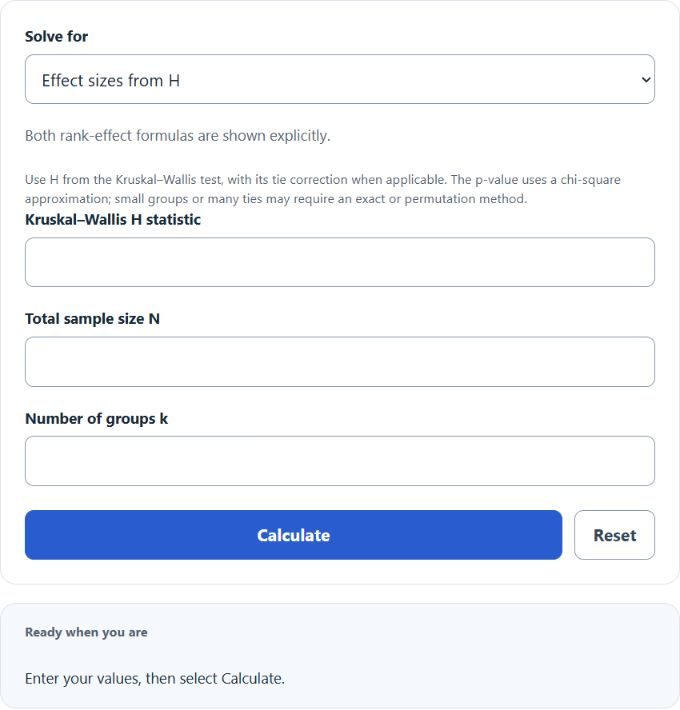
Calculate Kruskal-Wallis epsilon squared and eta squared from H, N, and groups, estimate the chi-square p-value, or reverse-solve H for a target effect.
Kruskal-Wallis Effect Size Formulas
There are several naming conventions for rank effect sizes. The calculator preserves two explicit formulas, estimates an upper-tail chi-square p-value with df = k − 1, and can algebraically solve either raw effect formula for H. This inverse is not power or sample-size planning; actual attainable H values depend on group sizes, ranks and ties. For a zero-truncated eta target of zero, every H from 0 through k − 1 maps to zero, so that inverse is not unique. The usual chi-square guideline is at least five observations in every group, which N and k alone cannot establish. References: rstatix formulas, effectsize implementation, and SciPy test assumptions.
Rank Epsilon-Squared (Unadjusted)
This calculator calls H/(N − 1) rank epsilon-squared ε²R. Naming varies across sources, so report the formula. Use the tie-corrected H and complete-case N from the same test; higher values indicate stronger rank association with group membership, rather than an effect in the original measurement units.
Eta-Squared (Group-Adjusted)
This version adjusts for the number of groups k and is used by rstatix. Its raw estimate may be negative when H < k − 1. The calculator reports max(0, raw η²H) as its main eta estimate and also shows the raw value, matching current rstatix and effectsize implementations. A truncated zero does not prove absence of an effect.
Epsilon-Squared
The displayed expression simplifies exactly to H/(N − 1), since (N² − 1)/(N + 1) = N − 1. It is therefore the same unadjusted rank formula above, not a more conservative alternative. These formulas are related to rank-based ANOVA effect measures; they do not describe a percentage of raw-score variance explained.
Effect Size Interpretation Benchmarks
The table below summarizes the conventional thresholds used to classify effect magnitude. These benchmarks originate from Cohen’s guidelines for behavioral sciences and have been adapted for rank-based analyses. Rigid application of cutoffs is discouraged in modern statistical practice; context and domain knowledge should always inform interpretation.
| Reference band | Adjusted η²H |
|---|---|
| Small | 0.01 to < 0.06 |
| Medium | 0.06 to < 0.14 |
| Large | 0.14 or greater |
Treat the η²H bands as descriptive reference conventions, not universal thresholds. No automatic ε²R cutoff is applied here. For example, an adjusted rank estimate of 0.09 lies in the medium reference band; its practical meaning depends on the outcome, study design and field.
Alternative Effect Size Measures
Beyond eta-squared and epsilon-squared, several other effect size statistics are used with the Kruskal-Wallis test, each offering a different interpretive lens.
Freeman’s Theta is another rank association measure. It is not computed by this calculator and cannot generally be recovered from H, N and k alone.
Vargha and Delaney’s A is a pairwise probability-of-superiority measure, counting ties as half. A = 0.50 indicates no directional superiority, not identical distributions. With more than two groups, report the relevant pairwise comparisons and their direction; there is no single A determined by the omnibus H alone.
Cliff’s Delta is related to pairwise Vargha–Delaney A by d = 2A − 1, with ties counted consistently. It ranges from −1 to 1. Its absolute value equals the two-group form of Freeman’s theta; that equivalence should not be generalized to an omnibus comparison with more groups.
When to Use the Kruskal-Wallis Test
The Kruskal-Wallis H test is the non-parametric counterpart to one-way ANOVA. Choosing between them depends on the characteristics of your data and whether the assumptions of ANOVA are tenable.
Use Kruskal-Wallis when: a rank-based comparison of independent groups answers the study question, including ordinal outcomes. A normality-test result alone does not determine the appropriate analysis. Check independence, the sampling design, group sizes and the interpretation required.
Consider staying with ANOVA when: your data are continuous and approximately symmetric, sample sizes per group are at least 15 to 20, or distributions have similar shapes even if they are not perfectly normal. One-way ANOVA is surprisingly robust to moderate departures from normality, and simulation studies show it maintains its nominal Type I error rate across many non-normal distributions when group sizes are roughly equal.
Kruskal–Wallis can detect distributional differences. A location or median interpretation requires additional shape assumptions; unequal spreads or shapes may drive a result. Welch’s ANOVA targets means under unequal variances, while a permutation procedure needs assumptions appropriate to its design. Choose the method for the scientific question rather than treating these as interchangeable tests.
Post-Hoc Testing After a Significant Result
A statistically significant Kruskal-Wallis result tells you that at least one group differs from the others, but it does not identify which specific groups differ. Post-hoc pairwise comparisons are needed to localize the effect.
Dunn’s Test is the most widely used post-hoc procedure for the Kruskal-Wallis test. Unlike running multiple Mann-Whitney U tests, Dunn’s test preserves the original ranking of all observations across all groups rather than re-ranking within each pair. This maintains consistency with the omnibus test and avoids distortion of the rank structure. P-values from Dunn’s test are typically adjusted using the Bonferroni correction or the Benjamini-Hochberg procedure to control the familywise error rate or false discovery rate, respectively.
Conover’s Test is another rank-based post-hoc procedure using a t reference distribution and pooled rank variance. Its operating characteristics depend on the design and adjustment method; greater power or a higher Type I error rate is not universal.
Pairwise Mann-Whitney U tests with a Bonferroni or Holm correction are sometimes used, but they re-rank observations within each pair and therefore do not maintain strict consistency with the original Kruskal-Wallis analysis. They remain acceptable when the goal is to compare two specific groups using an independent ranking.
How to Report Kruskal-Wallis Results
When writing up Kruskal-Wallis results for publication, include the test statistic, degrees of freedom, p-value, and an effect size measure. The degrees of freedom for the Kruskal-Wallis test equal k – 1, where k is the number of groups.
For a hypothetical complete-case N = 106 and k = 3, H = 14.32 gives adjusted η²H = (14.32 − 3 + 1)/(106 − 3) ≈ 0.1196 and an approximate chi-square p ≈ 0.000777. A report could state: “H(2) = 14.32, approximate p < .001, adjusted η²H = .12.” Report any post-hoc method, multiplicity correction and actual pairwise findings separately.
Always specify which effect size formula was used (eta-squared, epsilon-squared, etc.), the correction method applied to post-hoc p-values, and whether medians or mean ranks are being reported as measures of central tendency.
Limitations of Rank-Based Effect Sizes
Interpreting eta-squared or epsilon-squared as “percentage of variance explained” requires caution when applied to rank data. In parametric ANOVA, eta-squared directly reflects the proportion of total variance in the dependent variable accounted for by group membership. In the Kruskal-Wallis context, the “variance” being partitioned is rank variance, which captures relative ordering rather than absolute magnitude of differences. Two datasets with identical rank orderings but vastly different raw-score spreads will produce the same effect size. This means the effect size reflects how well group labels predict rank order, not how large the actual differences in the measured variable are.
Additionally, eta-squared and epsilon-squared are sensitive to the number and size of groups. With many small groups, even moderate rank separation can produce inflated effect sizes. Conversely, with very large samples, trivially small rank differences can be statistically significant while the effect size remains near zero. This is precisely why reporting effect size alongside the p-value is considered essential in contemporary statistical practice.