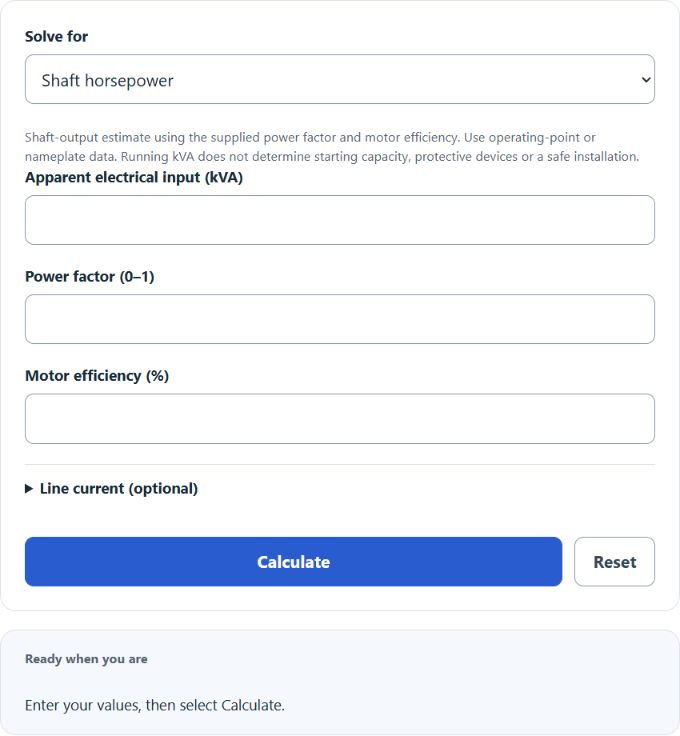
Convert motor supply kVA to shaft horsepower with power factor and efficiency, or reverse-size kVA, losses, and phase-aware line current.
kVA to hp Formula
The calculator converts total apparent motor input (kVA) to mechanical shaft horsepower using the entered power factor and motor efficiency, or solves the same relationship for running kVA. Optional RMS voltage supplies a line-current output. There is no volts-and-amps input mode.
For reference, these separate equations derive kVA from RMS voltage and current (the three-phase equation assumes a balanced system):
- hp – mechanical (shaft) horsepower output
- kVA – apparent power in kilovolt-amperes
- PF – power factor, between 0 and 1
- η – motor efficiency in percent
- 0.7457 – kilowatts per mechanical horsepower
- V, A – line-to-line voltage and line current for three-phase; supply voltage and current for single-phase
Set efficiency to 100% if you only want to convert electrical kW to hp without motor losses. Use 1.00 for power factor when you are working with a purely resistive load or when kVA already equals kW.
Reference Tables
The following figures are illustrative source ranges, not substitutes for nameplate or measured operating-point data. Motor efficiency and power factor vary with size, design and load. A resistive heater has no mechanical shaft output; its 100% entry is only an ideal electrical-power equivalent. A generator’s apparent rating alone does not determine shaft horsepower. See the U.S. Department of Energy motor-system guide.
| Load type | Typical PF | Typical efficiency |
|---|---|---|
| Resistive heater | 1.00 | 100% |
| Induction motor, fully loaded | 0.85 – 0.90 | 88 – 95% |
| Induction motor, half loaded | 0.70 – 0.80 | 82 – 90% |
| Small fractional-hp motor | 0.60 – 0.75 | 60 – 75% |
| Generator (apparent rating) | 0.80 | n/a |
| kVA | hp at PF 0.80, η 90% | hp at PF 1.00, η 100% |
|---|---|---|
| 1 | 0.97 | 1.34 |
| 5 | 4.83 | 6.71 |
| 10 | 9.66 | 13.41 |
| 25 | 24.14 | 33.53 |
| 50 | 48.28 | 67.05 |
| 100 | 96.55 | 134.10 |
Worked Example and FAQ
Example: A 10 kVA supply feeds a motor at PF 0.85 and 90% efficiency.
- Input kW = 10 × 0.85 = 8.5 kW
- Output kW = 8.5 × 0.90 = 7.65 kW
- hp = 7.65 ÷ 0.7457 ≈ 10.26 hp
Why is there no fixed kVA-to-hp ratio? kVA and hp are different units, so their numerical values cannot be compared as “lower” or “higher” power. Real electrical input is kVA × PF in kW; shaft output is that input multiplied by motor efficiency. Power factor accounts for the apparent-to-real relationship; motor losses then reduce shaft output.
Should I use 0.7457 or 0.746? Both are common. The calculator uses approximately 0.7456998715822702 kW per mechanical horsepower, derived from 550 ft·lbf/s. See the NIST mechanical-horsepower conversion. For metric (PS) horsepower, divide by 0.7355 instead.
What if I only know kW? Set PF to 1.00 and enter kW as kVA. The result is kW ÷ 0.7457, adjusted by the efficiency you enter.
Single-phase or three-phase? The selected phase changes the optional current output. Enter line-to-line RMS voltage for balanced three-phase current, or supply RMS voltage for single-phase. The hp formula uses total kVA and is the same in both cases. This running-load estimate does not establish starting capacity, generator or transformer sizing, circuit protection or installation compliance.