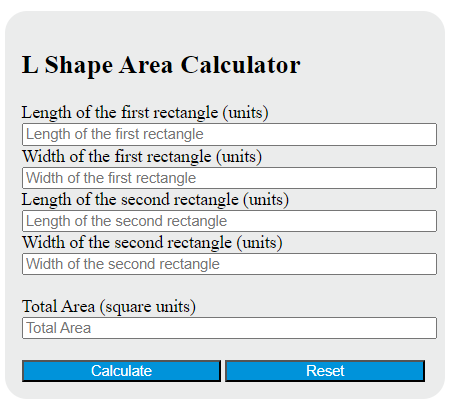
Calculate the area and perimeter of an L-shaped room, floor, lot, or slab from outer dimensions and a corner cutout, with metric and imperial units.
Related Calculators
- Reverse Area Calculator
- Lateral Area of a Prism Calculator
- Edge Length Calculator
- Apothem Calculator
- All Math and Numbers Calculators
L Shape Area Formula
The standard formula decomposes the L-shape into two non-overlapping rectangles:
Where A is total area in square units, l1/w1 are the first rectangle’s dimensions, and l2/w2 are the second’s. This works because any L-shape splits along its inner corner into exactly two rectangles with zero overlap.
Subtraction Method
An equivalent approach treats the L-shape as a large rectangle with a notch removed: A = (L_outer * W_outer) – (L_cutout * W_cutout). This is faster when you know overall room dimensions and the missing corner size.
Perimeter Formula
The perimeter of an L-shape with outer bounding dimensions L_outer by W_outer is P = 2*(L_outer + W_outer). This holds regardless of where the inner corner falls, because the two interior edges exactly replace the exterior edges they cut into.
What Is an L-Shaped Area?
An L-shaped area is a six-sided rectilinear polygon where every interior angle is either 90 or 270 degrees. It is the simplest compound shape formed by joining two rectangles along one edge, or by cutting a rectangular notch from a larger rectangle’s corner. The shape appears in floor plans, lot surveys, sheet metal fabrication, and structural cross-sections.
L-shapes belong to the broader family of orthogonal polygons (T-shapes, U-shapes, step patterns). They have exactly one concave vertex at 270 degrees and five convex vertices at 90 degrees. All edges are axis-aligned, so every measurement can be taken with a tape measure parallel to a wall.
Key Geometric Properties
Centroid. The centroid does not lie at the bounding rectangle’s midpoint. Compute it as the area-weighted average of each sub-rectangle’s centroid: x_c = (A1*x1 + A2*x2)/(A1+A2). In structural engineering, the centroid determines where a load must act for pure axial compression without bending.
Moment of inertia. For structural L-sections (angle iron, concrete beams), the second moment of area uses the parallel axis theorem. Each sub-section contributes its own centroidal inertia plus A*d^2. The principal axes are rotated relative to geometric axes, so L-sections resist bending asymmetrically.
Diagonal span. The longest straight line across an L-shape spans the bounding rectangle’s opposite corners: d = sqrt(L_outer^2 + W_outer^2). Builders use this to verify squareness during layout.
Practical Applications
Flooring. Add a 10% to 15% waste factor to the computed area for cuts and pattern matching. A 200 sq ft room needs 220 to 230 sq ft of material. Diagonal tile layouts use the higher waste figure.
Paint. One gallon of latex paint covers 350 to 400 sq ft. L-shaped room wall area is typically 5% to 12% less than the equivalent full rectangle because interior-corner walls are shorter.
Concrete. Multiply area by slab thickness (4 in for patios, 6 in for driveways). One cubic yard covers 81 sq ft at 4 in or 54 sq ft at 6 in. Order 5% to 10% extra.
Carpet. Standard rolls are 12 ft wide. Orient along the longer wing to minimize seams. Add 3% to 5% for underlayment overlaps.
Structural footings. L-shaped footprints need strip footings along the perimeter. The centroid locates zero eccentricity for uniform soil pressure under column loads.
Typical Residential L-Shape Dimensions
| Room Type | Wing 1 (ft) | Wing 2 (ft) | Area (sq ft) |
|---|---|---|---|
| Kitchen | 10 x 8 | 8 x 6 | 128 |
| Living room | 16 x 12 | 12 x 10 | 312 |
| Master bedroom | 14 x 12 | 8 x 6 | 216 |
| Studio | 20 x 12 | 12 x 8 | 336 |
| Garage | 20 x 12 | 12 x 12 | 384 |
Based on standard U.S. building modules (2, 4, and 8 ft). Actual dimensions vary by builder and code.
Measurement Tips
Start at the concave corner and measure outward to each wall. If walls bow, measure at floor and waist height and use the larger value. For baseboards, measure above the baseboard face (thickness is typically 0.5 to 0.75 in). A laser measurer is preferred beyond 25 ft, as tape sag introduces roughly 1/8 in error per 10 ft of unsupported span.