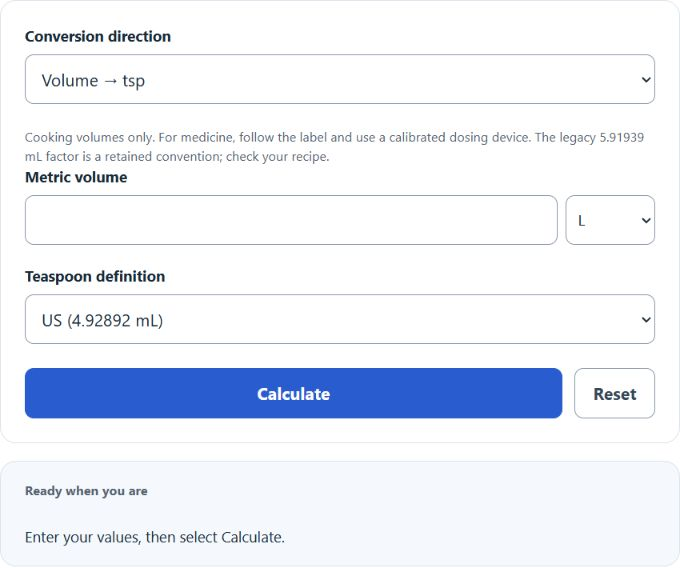
Convert liters, milliliters, and teaspoons using US, metric, and the page’s legacy teaspoon convention with results in cups and tablespoons for cooking.
L to Tsp Formula
- tsp = teaspoons in the chosen standard
- L = volume in liters
- mL_per_tsp = milliliters per teaspoon for the standard you pick
Use 4.92892 mL for a US teaspoon, 5 mL for a metric teaspoon, or the retained 5.91939 mL legacy convention. To go the other way, multiply teaspoons by mL_per_tsp and divide by 1000 to get liters.
Reference Tables
Teaspoon size depends on the standard. Pick one and stick with it for the whole recipe; medication requires a calibrated dosing device and the medicine label’s units.
| Standard | mL per tsp | tsp per liter |
|---|---|---|
| US | 4.92892 | 202.884 |
| Metric | 5.00000 | 200.000 |
| Legacy convention | 5.91939 | 168.936 |
| Liters | US tsp | Metric tsp | Legacy tsp |
|---|---|---|---|
| 0.1 | 20.29 | 20.00 | 16.89 |
| 0.25 | 50.72 | 50.00 | 42.23 |
| 0.5 | 101.44 | 100.00 | 84.47 |
| 1 | 202.88 | 200.00 | 168.94 |
| 2 | 405.77 | 400.00 | 337.87 |
Worked Examples and FAQ
Example 1. Convert 0.75 L to US teaspoons. 0.75 × 1000 = 750 mL. 750 ÷ 4.92892 = 152.16 US tsp.
Example 2. Convert 300 metric tsp to liters. 300 × 5 = 1500 mL = 1.5 L.
Which teaspoon should you use? Use US for American recipes, metric for European recipes and most measuring spoons sold today, and the legacy option only when your source explicitly specifies 5.91939 mL per teaspoon.
Are kitchen measuring spoons exact? Actual capacity varies by measure and fill level. Use a calibrated measuring tool and check its stated volume; household cutlery is not a precision measure.
Does this work for medicine? Use a marked oral syringe or dosing cup in mL for medication. Kitchen teaspoons are not accurate enough for dosing.