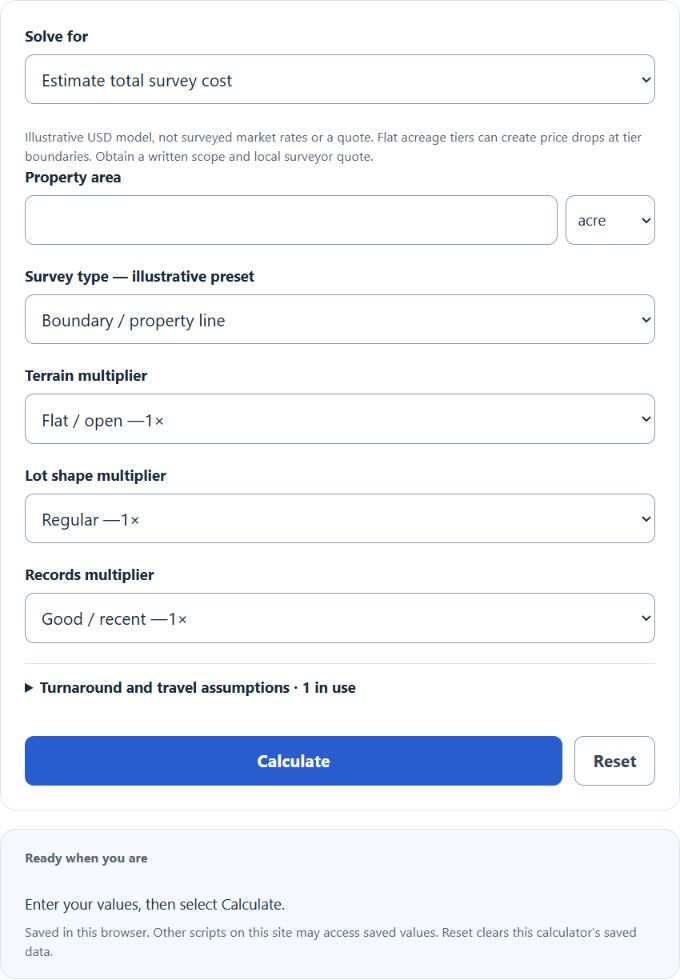
Explore an illustrative land-survey cost model by acreage and survey type, or calculate cost per acre from a known quote. Model prices and multipliers are assumptions, not surveyed market rates.
Land Survey Cost Formula
This illustrative model uses preset base fees, one flat per-acre rate applied to the entire parcel, and assumption multipliers for site conditions. It is not a standard survey pricing schedule.
TC = (B + R * A * F) * (Te * Sh * Re * Ru) + T
To find the cost per acre from a known total, divide:
CPA = TC / A
- TC = total survey cost (USD)
- B = base fee for the chosen survey type
- R = rate per acre, set by a tiered scale that falls as acreage rises
- A = property size in acres
- F = survey type factor (more complex surveys cost more per acre)
- Te = terrain and vegetation multiplier
- Sh = lot shape multiplier
- Re = records quality multiplier
- Ru = rush multiplier
- T = travel or mobilization fee (USD)
- CPA = cost per acre (USD/acre)
The base fee and type factor are set by the survey type you pick, so a boundary survey starts lower than an ALTA or topographic survey. The per acre rate is tiered: small lots pay a high rate per acre and large parcels pay much less per acre, which is why the cost per acre falls as the property grows. The terrain, shape, and records multipliers each raise the cost when the job is harder, and they stack together. The selected turnaround multiplier and entered travel fee apply even when their expandable section is closed. When you solve for cost per acre, the calculator divides a total you already know by the acreage. When you solve for budget, it checks all six flat-rate tiers and selects the largest mathematically affordable acreage. Price drops at tier boundaries mean affordability is not monotonic; the result does not promise a surveyor will cover that acreage.
Illustrative Land Survey Costs
The following retained price ranges are illustrative examples, not verified current national prices. Obtain a written local quote with an agreed scope.
| Survey type | Illustrative price range |
|---|---|
| Boundary / property line | $500 – $1,000+ |
| Mortgage / location | $200 – $700 |
| Corner staking / fence | $300 – $1,000 |
| Subdivision / plat | $800 – $5,000+ |
| Topographic | $2,000 – $6,500 |
| ALTA / NSPS | $2,000 – $10,000 |
The model applies one flat rate to all acres: up to1, then over1 through5, over5 through10, over10 through50, over50 through100, and over100. It creates artificial price drops at the boundaries. The budget calculation solves every tier directly, without the former0.05-acre scan or1000-acre cap.
| Property size | Model rate per acre |
|---|---|
| Up to 1 acre | $500 |
| 1 to 5 acres | $300 |
| 5 to 10 acres | $200 |
| 10 to 50 acres | $120 |
| 50 to 100 acres | $80 |
| Over 100 acres | $60 |
Example Problems
Example 1. You need a boundary survey on a 1.5 acre lot that is flat and open, regularly shaped, with good records, on a standard turnaround and no travel fee. The boundary base fee is $400 with a type factor of 1.0. At 1.5 acres the per acre rate is $300, so the acreage cost is 300 x 1.5 x 1.0 = $450. The multipliers are all 1, so the total is (400 + 450) x 1 = $850.
Example 2. You need a topographic survey on a 5 acre parcel with a moderate slope (1.2), an irregular shape (1.15), and good records (1.0). The topographic base fee is $1,000 with a type factor of 1.8. At 5 acres the per acre rate is $300, so the acreage cost is 300 x 5 x 1.8 = $2,700. The subtotal is (1,000 + 2,700) = $3,700, and the combined multiplier is 1.2 x 1.15 = 1.38, giving 3,700 x 1.38 = $5,106.
Frequently Asked Questions
Why does the cost per acre drop for larger properties?
A surveyor has fixed costs on every job, such as research, equipment setup, and travel. On a small lot those costs are spread over a single acre, so the rate per acre is high. On a large parcel the same fixed work is spread over many acres, so fixed costs may be spread over more acres. The illustrative flat-tier model can also decrease total cost at a boundary; it does not model a continuous quote schedule.
What makes a survey more expensive?
Heavily wooded or steep terrain, irregular lot shapes with many corners, and missing or disputed records all raise the price because they add field time and research. A rush turnaround and a long drive to the site add cost on top of that. The calculator applies each of these as a separate multiplier or fee so you can see how they stack up.
Is this estimate the same as a real quote?
No. This is an illustrative scenario using preset assumptions, not an estimate calibrated to national rates. Local labor costs, demand, and the specific condition of your property records can move the real price up or down, so use the result to set a budget and then get a written quote from a licensed surveyor.