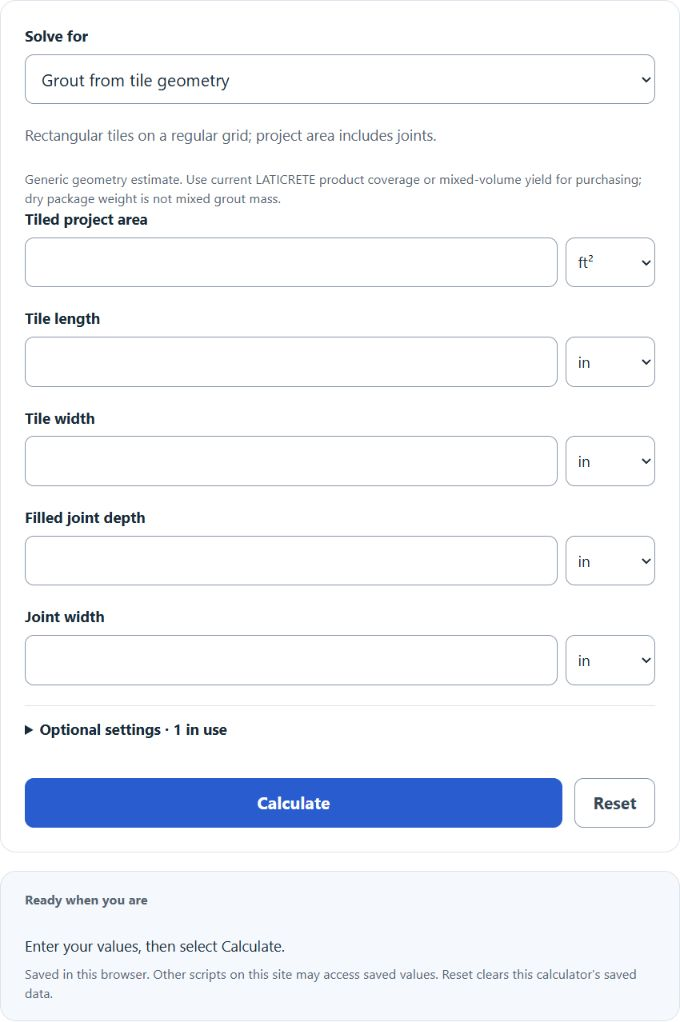
Estimate how much LATICRETE grout you need from your area, tile size and joint width, or work out packages from the product’s published coverage.
Related Calculators
- Ceramic Weight Calculator
- Waste Factor Calculator
- Grout Volume Calculator
- Grout Usage Calculator
- Tiles Per Square Meter Calculator
- Self Leveling Coverage Calculator
- All Construction Calculators
Laticrete Grout Formula
For rectangular tiles on a regular grid, estimate filled joint volume from project area, tile length L, tile width W, joint width J and filled joint depth D:
A is project area including joints, w is the waste percentage, and all dimensions must use consistent units. With A in m² and lengths in m, V is in m³; multiply by 1,000 for liters. Mixed mass equals V times entered mixed density. Purchase packages from ceil(area × waste factor / current coverage per package), or from ceil(liters / actual mixed-volume yield per package). Dry package weight is not mixed grout mass. Verify current product coverage with LATICRETE’s estimator.
What is a Laticrete Grout?
Laticrete grout is a high-quality, professional-grade product used for filling the gaps between tiles in flooring, walls, and other tiling projects. The range includes cement, epoxy and ready-to-use products; preparation and application depend on the selected product. Laticrete grout is known for its durability, resistance to cracking, and ability to withstand harsh conditions, making it suitable for both indoor and outdoor use.
It comes in a variety of colors to match or contrast with the color of the tiles, and it can be sanded or unsanded depending on the size of the grout lines. Laticrete also offers epoxy grouts that are stain and chemical resistant, ideal for areas like kitchens and bathrooms where the grout may be exposed to substances that could cause discoloration or damage.
How to Calculate Laticrete Grout?
The following steps outline how to calculate the Laticrete Grout:
- First, choose tile geometry or current manufacturer coverage for your exact product and package.
- Enter the project area, including joints, and choose its unit.
- For geometry, enter tile length, width, filled joint depth and joint width. For coverage mode, enter the current coverage per package for that configuration.
- Optionally add waste, mixed density, actual mixed-volume yield per package or package cost where applicable, then select Calculate.
- After inserting the variables and calculating the result, check your answer with the calculator above.
Example Problem :
Use the following variables as an example problem to test your knowledge.
For example, 100 ft² with 10% allowance requires 110 ft² of nominal coverage.
At an entered coverage of 55 ft² per package, ceil(110/55) = 2 packages. This is an arithmetic example, not product coverage data.