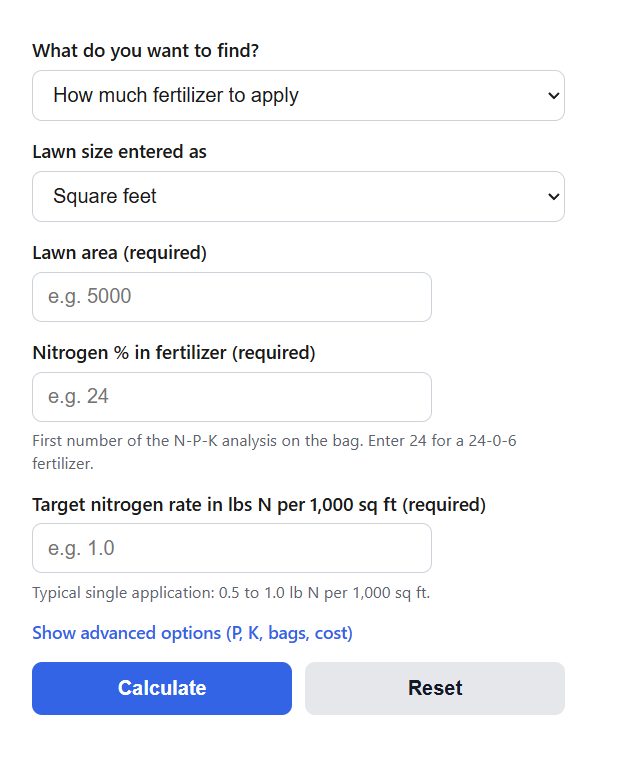
Calculate lawn fertilizer rates from your lawn size, target nitrogen rate, and bag N-P-K analysis, including pounds of product, bags needed, and coverage per bag.
Lawn Fertilizer Rate Formula
F = R / (N/100) * A / 1000
- F is the total fertilizer product to apply (lbs)
- R is the target nitrogen rate (lbs N per 1,000 sq ft)
- N is the nitrogen percentage on the bag, the first number of the N-P-K analysis
- A is the lawn area (sq ft)
The default mode of the calculator uses this formula. You enter your lawn area, the nitrogen rate you want to deliver, and the nitrogen percentage from the bag, and it returns the total pounds of product to spread plus the product rate per 1,000 sq ft. The advanced options apply the same math to the phosphate and potash percentages to show pounds of P2O5 and K2O delivered, and divide the total by the bag weight to count bags and estimate cost.
R = W * (N/100) / A * 1000
- W is the pounds of fertilizer already applied or planned
The nitrogen rate mode rearranges the formula to check a rate. If you know how much product went down on a known area, it tells you the nitrogen rate you actually delivered per 1,000 sq ft and flags whether that rate is light, standard, or heavy enough to risk fertilizer burn.
C = B * (N/100) / R * 1000
- C is the area one bag covers (sq ft)
- B is the bag weight (lbs)
The coverage mode computes how many square feet one bag treats at your target nitrogen rate, which you can compare against the coverage claim printed on the bag.
Product Rates by Fertilizer Analysis and Annual Nitrogen Needs
The first table shows how many pounds of product per 1,000 sq ft deliver three common nitrogen rates for popular fertilizer analyses. Higher nitrogen percentages mean less product for the same feeding.
| Fertilizer analysis (N-P-K) | 0.5 lb N rate | 0.75 lb N rate | 1.0 lb N rate |
|---|---|---|---|
| 6-4-0 (organic type) | 8.3 lbs | 12.5 lbs | 16.7 lbs |
| 10-10-10 | 5.0 lbs | 7.5 lbs | 10.0 lbs |
| 16-4-8 | 3.1 lbs | 4.7 lbs | 6.3 lbs |
| 24-0-6 | 2.1 lbs | 3.1 lbs | 4.2 lbs |
| 28-0-4 | 1.8 lbs | 2.7 lbs | 3.6 lbs |
| 32-0-10 | 1.6 lbs | 2.3 lbs | 3.1 lbs |
The second table gives typical annual nitrogen budgets by grass type. Divide the annual total by the number of applications to set the per-application rate you enter in the calculator. Spread cool-season feedings across spring and fall, and warm-season feedings across late spring and summer.
| Grass type | lbs N per 1,000 sq ft per year | Typical applications per year |
|---|---|---|
| Kentucky bluegrass | 2 to 4 | 3 to 4 |
| Tall fescue | 2 to 3 | 2 to 3 |
| Perennial ryegrass | 2 to 4 | 3 to 4 |
| Fine fescue | 1 to 2 | 1 to 2 |
| Bermudagrass | 3 to 5 | 4 to 5 |
| Zoysiagrass | 1.5 to 3 | 2 to 3 |
| St. Augustinegrass | 2 to 4 | 3 to 4 |
| Centipedegrass | 0.5 to 1.5 | 1 to 2 |
Example Problems
Example 1: You want to apply 0.75 lb of nitrogen per 1,000 sq ft to a 6,000 sq ft lawn using a 24-0-6 fertilizer sold in 15 lb bags. The product rate is 0.75 / (24/100) = 3.13 lbs per 1,000 sq ft. The total is 3.13 * 6,000 / 1,000 = 18.75 lbs of product. That is 18.75 / 15 = 1.25 bags, so you buy 2 bags and store the remainder.
Example 2: You spread 40 lbs of 10-10-10 over an 8,000 sq ft lawn and want to know the rate you delivered. The nitrogen rate is 40 * (10/100) / 8,000 * 1,000 = 0.5 lb N per 1,000 sq ft, a light standard feeding. Because the analysis is 10-10-10, the phosphate and potash rates are also 0.5 lb per 1,000 sq ft each.
Frequently Asked Questions
Why are fertilizer rates based on nitrogen instead of total product?
Nitrogen drives turf growth and is the nutrient most likely to burn grass or run off when overapplied, so university guidelines set rates in pounds of actual nitrogen per 1,000 sq ft. Two bags with different analyses deliver very different nitrogen amounts per pound of product, which is why the same 1 lb N target requires 16.7 lbs of a 6% product but only 3.1 lbs of a 32% product.
Can I use this calculator for phosphorus and potassium?
Yes. The advanced options accept the second and third numbers of the analysis and report pounds of P2O5 and K2O delivered along with the nitrogen results. Keep in mind that several states restrict phosphorus applications on established lawns unless a soil test shows a deficiency, so check your soil test before targeting a phosphate rate.
How much nitrogen is too much in one application?
Stay at or below 1 lb of actual nitrogen per 1,000 sq ft per application with fast-release fertilizers. Rates up to about 1.5 lbs are workable only when most of the nitrogen is slow-release. Above that, the risk of fertilizer burn and nutrient runoff rises sharply, and research suggests healthy turf cannot use much more than about 0.9 lb per application anyway. If you need more nitrogen over the season, add applications instead of raising the rate.