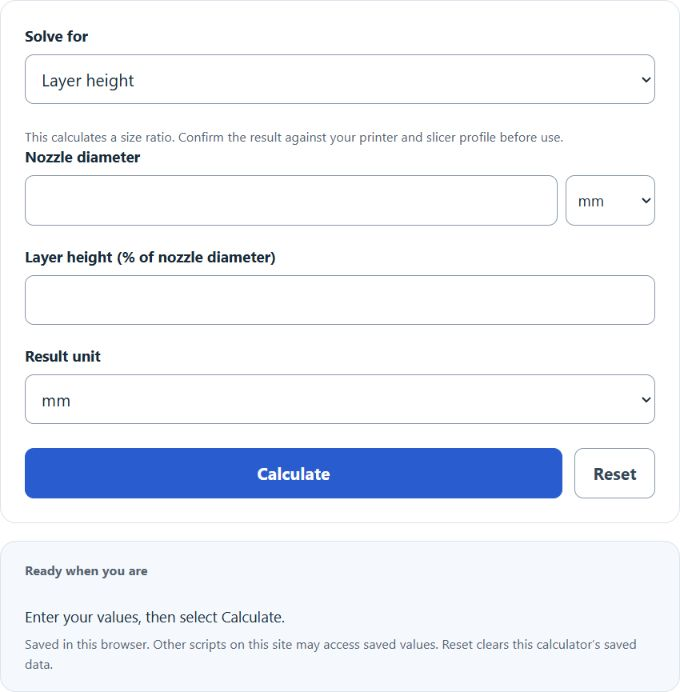
Calculate layer height, nozzle diameter, or layer height percentage for 3D printing from any two values with mm, cm, in, or ft units.
Layer Height Formula
The layer height calculator converts a chosen percentage of your nozzle diameter into an actual 3D printing layer height. This is useful because layer height is usually selected relative to nozzle size rather than as an isolated number. A proportional setting helps balance print quality, visible layer lines, and total print time.
- LH = layer height
- ND = nozzle diameter
- LHP = layer height percentage
If you already know the layer height you want and need to find the equivalent percentage of your nozzle diameter, use the inverse form:
For best results, keep units consistent. In most slicers and printer profiles, both nozzle diameter and layer height are entered in millimeters.
What Layer Height Means in 3D Printing
Layer height is the thickness of each printed layer along the Z-axis. Smaller layer heights produce more layers for the same model, which usually improves surface smoothness and vertical detail. Larger layer heights create fewer layers, which speeds up the print but makes layer lines more visible.
Layer height affects:
- Surface finish — lower settings usually look smoother
- Print time — lower settings usually take longer
- Z-axis detail — smaller steps capture curves and text more cleanly
- Practical part use — rough prototypes often do not need fine layers
It does not work alone. Final print quality also depends on nozzle size, line width, print temperature, cooling, speed, material, and model orientation.
How to Use the Calculator
- Enter your nozzle diameter.
- Select a layer height percentage based on the type of print you want.
- Calculate the resulting layer height.
- Confirm the value against your equipment and slicer profile before using it as the normal layer height.
A good rule of thumb is to start in a moderate range, then adjust based on whether you want more detail or faster output.
Common Starting Ranges by Nozzle Size
| Nozzle Diameter | Common Layer Height Range | Typical Use |
|---|---|---|
| 0.25 mm | 0.08 mm to 0.16 mm | Fine detail, miniatures, small text |
| 0.40 mm | 0.12 mm to 0.28 mm | General-purpose printing, balanced quality and speed |
| 0.60 mm | 0.18 mm to 0.36 mm | Larger functional parts, faster production |
| 0.80 mm | 0.24 mm to 0.48 mm | Large prototypes, coarse draft parts |
50% of nozzle diameter is an illustrative starting assumption, not a universal default. Lower percentages favor finish and detail; higher percentages favor speed and throughput.
Examples
Example 1: 0.4 mm nozzle at 50%
This gives a 0.20 mm layer height, which is a common all-purpose setting.
Example 2: 0.4 mm nozzle at 30%
This is better suited for smoother surfaces and finer visual detail, but print time increases.
Example 3: 0.6 mm nozzle at 60%
This is useful for faster printing of larger functional parts where fine cosmetic detail is less important.
How Layer Height Changes Print Time
As layer height decreases, the printer must create more layers to reach the same model height. A simple approximation is:
- N = number of printed layers
- H = model height
- LH = layer height
If you cut layer height in half, the model will require about twice as many layers. That does not mean print time doubles exactly, but it usually rises significantly.
How to Choose the Right Layer Height
- Use lower values for decorative models, curved surfaces, embossed text, and small details.
- Use mid-range values for everyday prints that need a balance of speed and appearance.
- Use higher values for prototypes, fixtures, jigs, brackets, and large parts where speed matters most.
- Match the setting to the nozzle instead of copying raw numbers between different nozzle sizes.
- Keep the first layer separate if needed; many profiles use a first layer that is thicker than the regular layer height.
- Remember that strength is multi-variable; wall count, material, temperature, orientation, and cooling often matter as much as or more than layer height.
Common Mistakes
- Choosing an extremely small layer height that greatly increases print time without a noticeable visual gain.
- Using a high layer height with a small nozzle and expecting sharp detail on curved surfaces or fine lettering.
- Changing layer height without rechecking speed, temperature, and cooling settings.
- Assuming one profile works equally well for cosmetic prints, functional parts, and large draft models.
Frequently Asked Questions
Is a smaller layer height always better?
Not always. It usually improves surface finish, but it also increases print time and does not automatically fix poor calibration or weak part orientation.
What is a good default for a 0.4 mm nozzle?
0.20 mm is a common starting point because it offers a strong balance of quality, consistency, and speed.
Can layer height be the same as nozzle diameter?
Prusa guidance recommends layer heights below about 80% of nozzle diameter. Confirm the limits for your own printer and profile; a mathematically valid ratio does not establish a workable print setting.
Should every print use the same layer height?
No. The best setting depends on whether your goal is appearance, speed, dimensional detail, or fast production of functional parts.