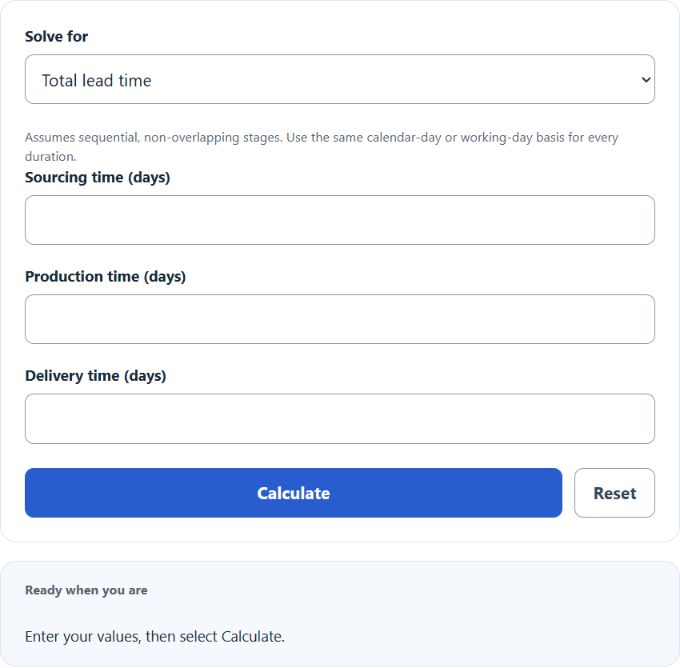
Calculate sourcing, production, delivery, or total lead time in days when you enter any three values and solve the missing value easily.
Related Calculators
- Procurement Date Calculator
- Manufacturing Days Calculator
- Ordering Cost Calculator
- Service Level Calculator
- All Business Calculators
Lead Time Formula
Lead time is the total elapsed time from the start of sourcing to final delivery. In a simple sequential supply chain model with non-overlapping stages, total lead time equals sourcing time plus production time plus delivery time.
- LT = total lead time
- ST = sourcing time
- PT = production time
- DT = delivery time
Use the same unit for every input. If sourcing time is entered in days, production time and delivery time should also be entered in days.
Rearranged Formula Versions
If you know any three values, the missing one can be found by rearranging the equation:
What Lead Time Means
Lead time measures how long it takes for a process to move from request to completion. In purchasing, manufacturing, inventory planning, and operations, it is one of the most important timing metrics because it affects stock availability, customer delivery promises, scheduling, and cash flow.
| Component | What it Includes | Typical Delays |
|---|---|---|
| Sourcing Time | Supplier response, purchasing, material preparation, approvals, internal handoff | Stockouts, vendor delays, slow approvals, long procurement cycles |
| Production Time | Setup, machining, assembly, testing, packaging, queue time on the floor | Capacity constraints, rework, changeovers, labor shortages |
| Delivery Time | Picking, shipping, transit, customs, local distribution, final handoff | Carrier delays, weather, routing errors, receiving bottlenecks |
How to Calculate Lead Time
- Determine the time required to obtain materials or inputs.
- Determine the time required to produce or prepare the item.
- Determine the time required to ship or deliver the item.
- Add all three durations together.
If some time segments are measured in hours and others in days, convert them before calculating.
Example
Suppose a product needs 5 days for sourcing, 10 days for production, and 3 days for delivery.
The total lead time is 18 days.
Finding a Missing Time Component
This calculator is also useful when a target lead time is known and you need to solve for one missing stage.
If the total lead time must be 20 days, sourcing takes 6 days, and delivery takes 4 days, then production time is:
That means production must be completed in 10 days to meet the overall target.
Why Lead Time Matters
- Inventory planning: Longer lead times usually require earlier reordering.
- Customer service: Delivery promises depend on realistic lead times.
- Production scheduling: Accurate timing reduces idle time and missed deadlines.
- Cash management: Long lead times tie up working capital for longer periods.
- Risk control: Understanding each component helps identify where delays occur.
Common Uses for a Lead Time Calculator
- Estimating supplier-to-customer fulfillment time
- Setting reorder points and safety stock assumptions
- Comparing suppliers with different procurement speeds
- Evaluating whether a production schedule can meet a promised ship date
- Breaking total delay into sourcing, manufacturing, and logistics causes
Common Mistakes
- Mixing business days and calendar days in the same calculation
- Leaving out queue, inspection, approval, or packaging time
- Using best-case times instead of normal operating averages
- Ignoring customs, receiving, or final-mile delivery delays
- Assuming supplier lead time is constant during peak demand periods
Tips to Reduce Lead Time
- Use more reliable suppliers or prequalified backups.
- Keep critical materials in stock when shortages are common.
- Reduce setup and changeover time in production.
- Eliminate approval bottlenecks and unnecessary handoffs.
- Use faster shipping methods only where the cost is justified.
- Track each time segment separately so the true bottleneck is visible.
Lead Time vs. Cycle Time
Lead time is the full start-to-finish elapsed time seen by the customer or planner. Cycle time usually refers to the time required to complete the actual work portion of a process. Lead time often includes waiting, queue, transport, and administrative delay, while cycle time may not.
Frequently Asked Questions
Should weekends be included?
Include weekends only if your process actually runs through weekends or if your quoted timing is based on calendar days. The key is to apply the same rule to every input.
Can lead time be calculated in hours instead of days?
Yes. The formula is the same as long as all values use the same unit.
What if there are additional stages?
If your process has inspection, customs, approval, staging, or installation time, those may need to be added as separate components in a more detailed model.
Is shorter lead time always better?
Usually yes, but only if quality, cost, and reliability remain acceptable. A faster process that creates more defects or missed deliveries may not improve overall performance.