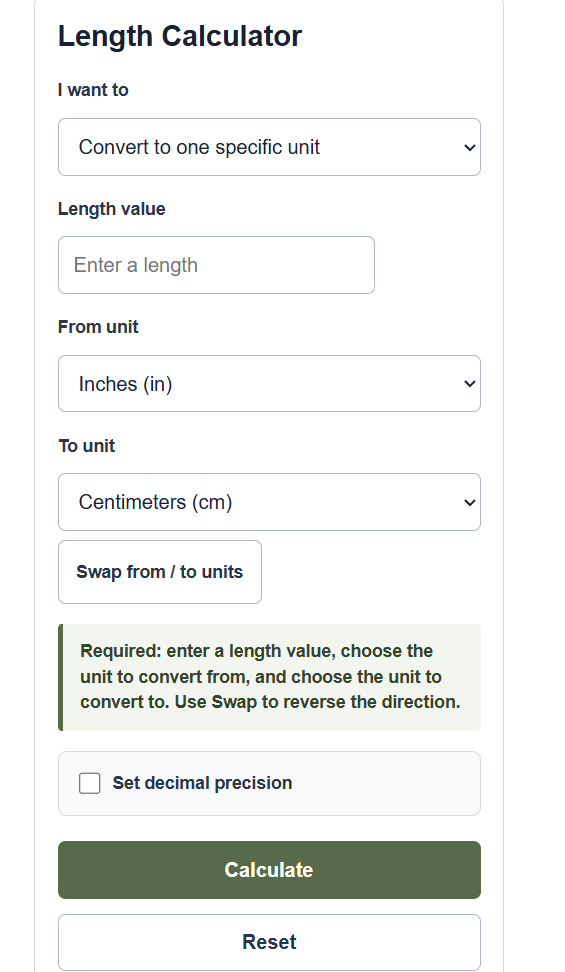
Calculate and convert any length between nanometers, meters, miles, and 8 more units, in one unit or all units at once.
Length Formula
A length conversion works by routing every unit through meters. The calculator first multiplies your value by the number of meters in the unit you are converting from, which gives the length in meters. It then divides that result by the number of meters in the unit you are converting to. Combined into one step, the formula is below.
Result = Value * (Factor_from / Factor_to)
Where Factor_from and Factor_to are each the number of meters in one unit of that type:
- Value = the length you enter
- Factor_from = meters per one unit of the “from” unit (for example, 0.3048 for feet)
- Factor_to = meters per one unit of the “to” unit (for example, 0.0254 for inches)
- Result = the same physical length expressed in the “to” unit
The “Convert to one specific unit” mode returns a single conversion from the chosen “from” unit to the chosen “to” unit, and the Swap button reverses the two so you can flip the direction without retyping. The “Convert to all units at once” mode applies the same formula across every supported unit, so one entry lists the length in nanometers through nautical miles. The decimal precision option only changes how many digits are shown; it does not change the underlying value.
Meters Per Unit and Common Conversions
The first table is the conversion factor each unit uses, that is, how many meters fit in one unit of that type. The calculator reads these values to build every result.
| Unit | Symbol | Meters per unit |
|---|---|---|
| Nanometer | nm | 0.000000001 |
| Micrometer | µm | 0.000001 |
| Millimeter | mm | 0.001 |
| Centimeter | cm | 0.01 |
| Meter | m | 1 |
| Kilometer | km | 1000 |
| Inch | in | 0.0254 |
| Foot | ft | 0.3048 |
| Yard | yd | 0.9144 |
| Mile | mi | 1609.344 |
| Nautical mile | nmi | 1852 |
The next table lists conversions people look up most often, with the value rounded for quick reference.
| From | To | Equals |
|---|---|---|
| 1 inch | Centimeters | 2.54 cm |
| 1 foot | Centimeters | 30.48 cm |
| 1 foot | Meters | 0.3048 m |
| 1 yard | Meters | 0.9144 m |
| 1 meter | Feet | 3.2808 ft |
| 1 mile | Kilometers | 1.6093 km |
| 1 kilometer | Miles | 0.6214 mi |
| 1 nautical mile | Miles | 1.1508 mi |
Example Problems
Example 1. You enter 5 feet and convert to inches. Factor_from for feet is 0.3048 and Factor_to for inches is 0.0254. Result = 5 * (0.3048 / 0.0254) = 5 * 12 = 60 inches.
Example 2. You enter 10 kilometers and convert to miles. Factor_from for kilometers is 1000 and Factor_to for miles is 1609.344. Result = 10 * (1000 / 1609.344) = 10 * 0.62137 = 6.2137 miles.
Frequently Asked Questions
Why does every conversion go through meters?
Meters act as a common reference. If each unit knows how many meters it contains, any unit can convert to any other in one step: scale up to meters, then scale down to the target unit. This is why the calculator only needs one factor per unit instead of a separate factor for every possible pair.
What is the difference between a mile and a nautical mile?
A statute mile is 1609.344 meters and is the mile used for road distance in the United States. A nautical mile is 1852 meters and is used in air and sea navigation because it matches one minute of latitude. A nautical mile is about 1.15 statute miles, so they are not interchangeable.
How many decimal places should I use?
Leave the precision on Auto for everyday conversions, since it shows a sensible number of digits for the size of the result. Set a fixed number of decimal places when you need every answer formatted the same way, such as in a table, or when a small unit like nanometers would otherwise round to zero.