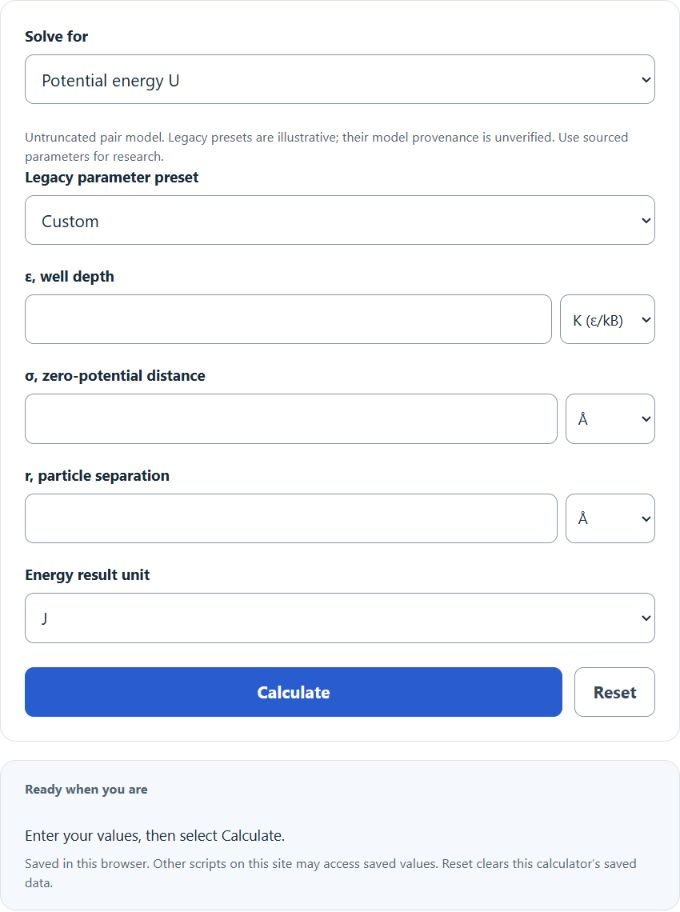
Calculate Lennard-Jones potential energy, radial force, and Lorentz-Berthelot mixing rules from ε, σ, and particle separation for two species.
- All Chemistry Calculators
- Scherrer Formula Calculator
- Molecular Speed Calculator
- Root Mean Square Velocity Calculator
- Average Atomic Mass Calculator
- Mass of Atoms Calculator
- Cell Potential Calculator
Lennard-Jones Potential Formula
The following formula is used to calculate the Lennard-Jones Potential.
Variables:
- U(r) is the Lennard-Jones Potential (Joules)
- ε (epsilon) is the depth of the potential well, representing the strength of the attraction between two particles (Joules)
- σ (sigma) is the finite distance at which the inter-particle potential equals zero, effectively the particle diameter (meters)
- r is the distance between the centers of the two particles (meters)
The (σ/r)^12 term models short-range Pauli repulsion caused by overlapping electron orbitals. The (σ/r)^6 term models the long-range van der Waals attraction, which arises from induced dipole-dipole interactions (London dispersion forces). The exponent of 12 for the repulsive term was chosen largely for computational convenience, as it is simply the square of the attractive term's exponent of 6, making early computer calculations faster. The attractive r^-6 dependence, however, has a firm theoretical basis in quantum mechanical perturbation theory for dispersion interactions.
What is the Lennard-Jones Potential?
The Lennard-Jones (LJ) potential, also called the 12-6 potential, is a mathematical model first proposed by Sir John Edward Lennard-Jones in 1924. It describes the potential energy between a pair of neutral, non-bonded atoms or molecules as a function of the distance between their centers. The model captures two competing physical effects: a steep repulsion at very short distances (when electron clouds overlap) and a weaker attraction at intermediate distances (from London dispersion forces).
The LJ potential is the most extensively studied intermolecular pair potential in computational chemistry and physics. It serves as the foundation for van der Waals interactions in every major biomolecular force field, including OPLS-AA, AMBER, CHARMM, and GROMOS. These force fields use LJ parameters to simulate protein folding, drug binding, membrane dynamics, and material properties at atomic resolution.
Key Relationships and Derived Quantities
The equilibrium distance r_m (where the potential reaches its minimum value of -ε) is related to σ by the expression r_m = 2^(1/6) * σ, which is approximately 1.122σ. This means the particles settle at a distance about 12.2% larger than σ when at their lowest energy configuration. At r = σ, potential energy crosses zero while radial force remains repulsive. Force changes from repulsive to attractive at r_m.
The interparticle force is obtained by taking the negative derivative of the potential with respect to distance: F(r) = -dU/dr = (24ε/r)[2(σ/r)^12 - (σ/r)^6]. This force equals zero at r = r_m (the equilibrium separation), is repulsive (positive) for r < r_m, and attractive (negative) for r > r_m. The radial-force mode computes this quantity directly; positive means outward repulsion.
LJ Parameters for Common Substances
The following table preserves the legacy illustrative parameter presets. Their common model/source provenance has not been established; they are not universal measured constants. Use parameters from a documented force field or fit for research. The values of ε are given as ε/k_B (in Kelvin), where k_B is the Boltzmann constant (1.380649 x 10^-23 J/K). To convert to Joules, multiply ε/k_B by k_B. LJ parameters in general may be fitted to viscosity or second-virial data, but that provenance has not been verified for this legacy set.
| Substance | ε/k_B (K) | σ (Å) | r_m (Å) | ε (x10^-21 J) |
|---|---|---|---|---|
| Neon (Ne) | 35.6 | 2.789 | 3.131 | 0.492 |
| Argon (Ar) | 119.8 | 3.405 | 3.822 | 1.654 |
| Krypton (Kr) | 171.0 | 3.624 | 4.068 | 2.361 |
| Xenon (Xe) | 226.0 | 4.100 | 4.602 | 3.120 |
| Nitrogen (N₂) | 71.4 | 3.310 | 3.715 | 0.986 |
| Oxygen (O₂) | 106.7 | 3.467 | 3.892 | 1.473 |
| Methane (CH₄) | 148.6 | 3.730 | 4.187 | 2.052 |
Notable trends: ε increases with atomic mass and polarizability across the noble gas series. Xenon's well depth is roughly 6.5 times deeper than neon's, reflecting xenon's much larger, more polarizable electron cloud. The σ values also increase with atomic size, ranging from 2.789 Å for neon to 4.100 Å for xenon. These legacy presets are available as explicitly selected illustrative values; inputs start blank.
Lorentz-Berthelot Mixing Rules
When modeling interactions between two different species (e.g., argon interacting with krypton), the LJ parameters for the unlike pair must be estimated. The Lorentz-Berthelot combining rules are the most widely used approach. The mixed size parameter is the arithmetic mean: σ_ij = (σ_i + σ_j) / 2. The mixed energy parameter is the geometric mean: ε_ij = √(ε_i * ε_j). The mixing mode implements these rules and optionally computes cross-interaction potential and force at a specified separation.
Mixing rules depend on the chosen force field and package settings. OPLS uses geometric means for both σ and ε, whereas Lorentz–Berthelot uses arithmetic σ and geometric ε. Alternative rules, such as the Waldman-Hagler and Kong rules, can give better accuracy for highly dissimilar pairs (for example, a small atom like helium interacting with a large molecule), but the Lorentz-Berthelot rules remain the standard starting point for most practical work.
Reduced Units and the LJ Fluid
In molecular simulations, quantities are often expressed in "reduced" (dimensionless) LJ units to keep results general across substances. The reduced temperature is T* = k_B T / ε, the reduced density is ρ* = ρσ^3, and the reduced pressure is p* = pσ^3 / ε. Any result obtained in reduced units can be mapped onto a specific substance by plugging in its ε and σ values.
The LJ fluid has well-characterized thermodynamic properties. Its critical point, determined by extensive simulation studies, occurs at a reduced temperature T*_c ≈ 1.312, a reduced density ρ*_c ≈ 0.316, and a reduced pressure p*_c ≈ 0.128. For argon, this maps to a predicted critical temperature of about 157 K (the experimental value is 150.7 K), illustrating both the utility and the approximate nature of the 12-6 model. The LJ fluid also exhibits a triple point near T* ≈ 0.694.
Connection to Thermodynamic Properties
The second virial coefficient B(T), which describes deviations from ideal gas behavior at low densities, can be computed directly from the LJ potential through a classical statistical mechanical integral. While the integral has no closed-form solution for the 12-6 potential, it can be expressed as a series involving gamma functions or evaluated numerically with high precision. Fitting experimental B(T) data across a range of temperatures is one of the primary methods for extracting ε and σ for a given substance.
The LJ potential also connects to transport properties. The Chapman-Enskog theory uses the LJ potential to compute collision integrals, which in turn predict viscosity, thermal conductivity, and diffusion coefficients of dilute gases. The so-called Ω-integrals tabulated by Hirschfelder, Curtiss, and Bird (1954) remain a standard reference for these transport property calculations.
Limitations and Alternative Potentials
The LJ 12-6 potential has known limitations. It is a pair potential and cannot capture many-body effects such as the Axilrod-Teller three-body dispersion interaction, which becomes significant in condensed phases. The r^-12 repulsive wall is steeper than what quantum mechanical calculations suggest; the true short-range repulsion decays exponentially. Additionally, the model has only two adjustable parameters, which limits its ability to simultaneously fit multiple thermodynamic properties with high accuracy.
The Mie potential generalizes the LJ form by allowing the repulsive and attractive exponents to vary: U(r) = C * ε[(σ/r)^n - (σ/r)^m], where n and m replace the fixed 12 and 6. The SAFT-VR Mie equation of state and force fields like MiPPE use this flexibility to achieve significantly better agreement with experimental vapor-liquid equilibria. The Buckingham (exp-6) potential replaces the r^-12 term with an exponential: U(r) = A*exp(-Br) - C/r^6, which more accurately represents the true physics of electron cloud overlap but introduces the risk of an unphysical attraction at very small r. For metallic systems, the embedded atom method (EAM) and similar many-body potentials are preferred over any pair potential form.
Applications in Modern Simulation
Despite its simplicity, the LJ potential remains central to molecular dynamics (MD) and Monte Carlo (MC) simulation. In biomolecular force fields, every non-bonded atom pair has assigned ε and σ values, and the LJ interaction is evaluated millions of times per timestep. Modern MD engines like GROMACS, LAMMPS, NAMD, and OpenMM use optimized algorithms (neighbor lists, cutoff schemes, and particle mesh methods) to handle these calculations efficiently for systems containing millions of atoms over microsecond timescales.
In practice, the LJ potential is typically truncated at a cutoff distance r_c (commonly 2.5σ or 10 to 12 Å) and energy-shifted to remove an energy discontinuity or smoothly switched to reduce force discontinuities. An energy-only shift does not change force. At r = 2.5σ, the potential has decayed to roughly 1/60th of the well depth, so the truncation error is small but not always negligible for properties like the surface tension or the equation of state. Long-range corrections are applied analytically to account for the neglected tail.
Beyond atomistic simulation, the LJ potential serves as the canonical test system for developing and benchmarking new simulation algorithms, statistical mechanical theories, and machine learning potentials. Its phase diagram, transport properties, and thermodynamic surface are known to extraordinary precision, making it the standard reference against which new computational methods are validated.