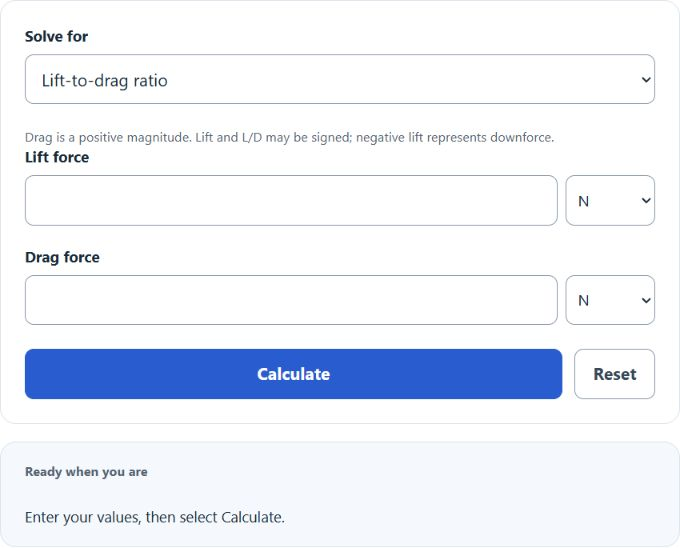
Choose lift force, drag force, or lift-to-drag ratio to solve, then enter the two known values for the same flight condition. Force units are N, kN, or lbf; drag must be positive, while signed lift and L/D can represent downforce.
- All Physics Calculators
- All Ratio Calculators
- Lift Force Calculator
- Drag Equation Calculator (Drag Force Calculator)
- Glide Ratio Calculator
Lift-to-Drag Ratio Formula
The lift-to-drag ratio compares the total lift force to the total drag force. It is a unitless value because both forces are measured in the same type of unit before the ratio is calculated.
- LDR = lift-to-drag ratio, unitless
- L = total lift force
- D = total drag force
If you need to solve for lift force instead, rearrange the formula:
If you need to solve for drag force, rearrange the formula:
- Calculate lift-to-drag ratio: enter lift force and drag force. The calculator divides lift by drag.
- Calculate lift force: enter drag force and lift-to-drag ratio. The calculator multiplies drag by the ratio.
- Calculate drag force: enter lift force and lift-to-drag ratio. The calculator divides lift by the ratio.
- Unit handling: force values are converted to newtons internally, then converted back to the selected result unit.
Force Unit Conversions and Typical L/D Values
Use these tables to check units and interpret the size of a lift-to-drag ratio. Aircraft ranges are broad illustrative context, not validated limits for a specific aircraft or flight condition; use its approved performance data.
| Force unit | Equivalent in Newtons | Equivalent from 1 N |
|---|---|---|
| 1 N | 1 N | 1 N |
| 1 kN | 1000 N | 0.001 kN |
| 1 lbf | 4.4482216152605 N | approximately 0.224809 lbf |
| Object or aircraft type | Typical lift-to-drag ratio range | Interpretation |
|---|---|---|
| Blunt body | Less than 1 to 3 | High drag compared with lift |
| Small general aviation aircraft | 7 to 12 | Moderate aerodynamic efficiency |
| Commercial jet aircraft | 15 to 20 | Efficient cruise performance |
| Sailplane or glider | 30 to 60+ | Very high aerodynamic efficiency |
Examples
Example 1: Calculate lift-to-drag ratio
You have a lift force of 12,000 N and a drag force of 800 N.
The lift-to-drag ratio is 15.
Example 2: Calculate drag force
You have a lift force of 50 kN and a lift-to-drag ratio of 10.
The drag force is 5 kN.
FAQ
What does a higher lift-to-drag ratio mean?
A higher lift-to-drag ratio means the object produces more lift for each unit of drag. In aircraft, a higher value usually means better aerodynamic efficiency, longer glide distance, or lower thrust required for steady flight.
Does the lift-to-drag ratio have units?
No. The ratio is unitless because it divides one force by another force. You can use newtons, kilonewtons, or pounds-force, but lift and drag must represent the same kind of force measurement.
Can drag force be zero?
No, not for this calculation. Drag force is in the denominator of the lift-to-drag ratio formula, so a drag value of zero would require division by zero. The calculator will not compute the ratio if drag force is zero.