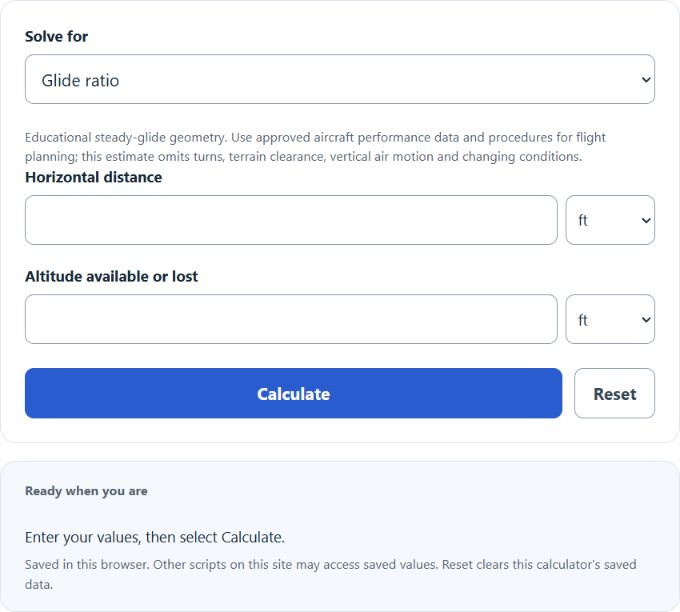
Calculate glide ratio, still-air distance or altitude loss, with glide angle, descent gradient, altitude per nautical mile and an optional constant-condition wind estimate. This educational tool does not replace approved flight-performance data or procedures.
- All Physics Calculators
- Stall Speed Calculator
- Drag Coefficient Calculator
- Wing Area Calculator
- VDP Calculator
- Rate of Climb Calculator
- Fuel Uplift Calculator
- Glide Distance Calculator
Glide Ratio Formula
The glide ratio formula is the following:
- Where GLR is the glide ratio
- D is the horizontal distance traveled by the glider
- A is the positive altitude loss, expressed in the same length unit as D
To calculate a glide ratio, divide the horizontal distance traveled by the change in altitude.
Glide Ratio Definition
A glide ratio is a measure of the horizontal distance traveled over the change in altitude of a gliding object. These gliding objects are called gliders.
How to calculate glide ratio?
For a steady glide, divide horizontal distance by positive altitude loss in matching units. Gravity, lift and drag act on an unpowered glider; see NASA’s glide geometry. Distance mode can add an along-track wind estimate using true airspeed projected horizontally, unchanged sink rate and constant ratio. It excludes crosswind, vertical air motion and turns, and does not choose an optimum speed.
What is a good glide ratio?
Glide ratio depends on the aircraft, configuration and flight condition. Use the aircraft’s approved performance data; a ratio entered here is an assumption, not a measured capability. Forty-to-one is not a general wingsuit performance assumption.
Does glide ratio change with weight?
At the appropriate best L/D speed in still air, a weight change can leave the maximum glide ratio approximately unchanged while changing the corresponding speed and sink rate. This does not imply equal ground range in wind or at an unchanged airspeed; consult the aircraft’s performance guidance.
How to increase glide ratio?
For steady still-air gliding, glide ratio equals lift divided by drag (L/D). The ratio depends on the combined lift and drag at the flight condition; increasing lift alone does not necessarily improve it.
What is the glide ratio of planes?
There is no universal airliner glide ratio. Use model- and configuration-specific approved data rather than treating an illustrative ratio as an operational guarantee.
How to find a glider glide ratio?
Use GLR = D/A with matching length units. In a steady still-air glide it also equals L/D or Cl/Cd when the aerodynamic coefficients use the same reference area. Wind changes the achieved ground-distance ratio.
A glider is a plane-like object that is designed to travel as far horizontally as possible when dropped from a certain elevation.