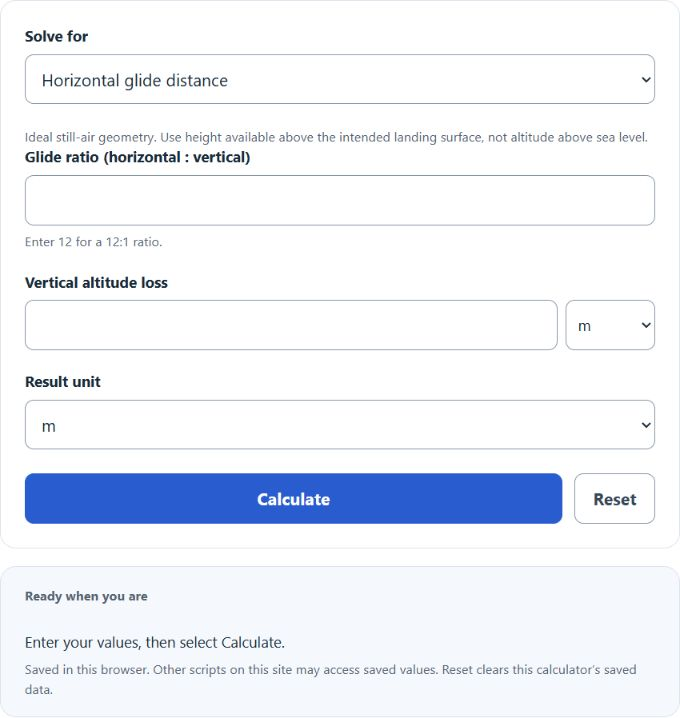
Choose glide ratio, vertical altitude loss, or horizontal glide distance to calculate, then enter the two required values in meters, feet, statute miles, or kilometers.
- All Physics Calculators
- All Distance Calculators
- Glide Ratio Calculator
- Vertical Distance Calculator
Glide Distance Formula
Glide distance is the horizontal distance traveled while descending a known vertical distance at a given glide ratio. This calculator is useful for estimating range in aviation, paragliding, model flight, and any motion where forward distance is tied to altitude loss.
In this equation:
| Variable | Meaning | Notes |
|---|---|---|
| GD | Glide distance | The horizontal distance covered during the glide |
| GR | Glide ratio | A dimensionless ratio such as 10, 12, or 15; a ratio written as 12:1 means GR = 12 |
| VD | Vertical distance | The altitude lost during the glide |
Both distances are converted to matching units before calculating a ratio. For a distance result, choose the output unit independently. Use height available above the intended landing surface, not altitude above sea level.
How to Interpret Glide Ratio
A glide ratio of 10:1 means the object can ideally travel 10 units forward for every 1 unit of altitude lost. Higher glide ratios indicate more efficient gliding and a flatter descent path.
- 8:1 = 8 units forward per 1 unit down
- 12:1 = 12 units forward per 1 unit down
- 20:1 = 20 units forward per 1 unit down
How to Calculate Glide Distance
- Identify the glide ratio.
- Measure or estimate the vertical distance available.
- Multiply the glide ratio by the vertical distance.
- Express the result in the desired horizontal distance unit.
If you already know two of the three values, the relationship can be rearranged to solve for the missing variable.
Example Calculation
If the glide ratio is 12 and the vertical distance is 800 ft, then:
That means the ideal horizontal glide distance is 9,600 ft.
Glide Distance and Descent Angle
Glide ratio is closely related to descent angle. A larger glide ratio produces a smaller descent angle and a longer range for the same altitude loss.
Where θ is the glide or descent angle measured from the horizontal.
Practical Notes
- Still-air estimate: The calculator gives an idealized distance based on glide ratio and altitude loss alone.
- Wind matters: Tailwinds increase ground distance, while headwinds reduce it.
- Configuration matters: Drag, flap settings and trim affect glide performance. Weight also changes the best-glide speed; use the aircraft performance guidance for its actual loading.
- Turning reduces range: Banking and maneuvering typically increase sink and shorten the achievable distance.
- Best-glide performance: Real-world maximum range depends on maintaining the appropriate glide speed and stable flight condition.
Common Input Mistakes
- Entering a ratio like 12:1 as 12/1 instead of simply 12.
- Confusing vertical distance with total path length traveled.
- Mixing units without converting them properly.
- Assuming the ideal glide distance always equals actual ground distance in wind or turbulence.
When This Calculator Is Most Useful
- Estimating the horizontal range available from a known altitude
- Comparing different glide ratios
- Exploring ideal geometry; this tool cannot establish whether a landing area is safely reachable
- Understanding how altitude loss translates into forward travel