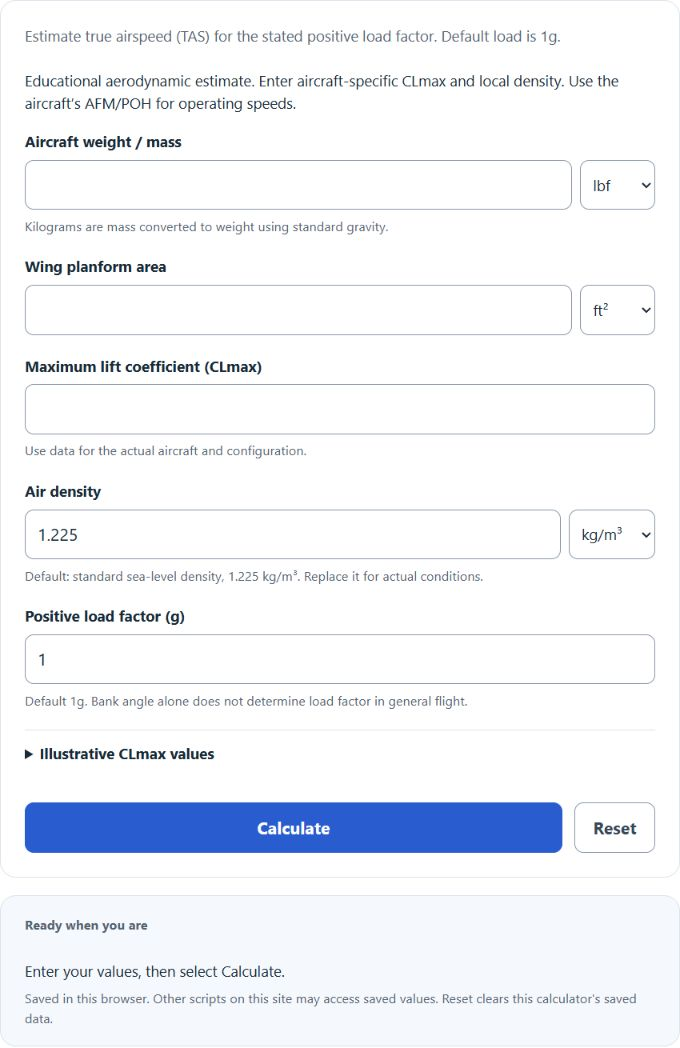
Estimate aircraft stall true airspeed (TAS) from weight, wing area, aircraft-specific CLmax, air density and a positive load factor. The calculator also shows equivalent airspeed (EAS); it does not calculate an atmosphere from altitude or torque-converter RPM.
- All Physics Calculators
- Air Density Calculator
- Pressure Altitude Calculator
- ISA Temperature Calculator
- Wing Area Calculator
- Maneuvering Speed Calculator
- Lift-to-Drag Ratio Calculator
Stall Speed Formula
For the specified configuration and positive load factor, this model estimates the true airspeed at which the required lift reaches the maximum lift associated with CLmax. The stall itself is caused by angle of attack, not by a single fixed speed, which is why stall speed changes with weight, flap setting, bank angle, icing, and air density.
In steady 1g level flight, required lift is usually equal to aircraft weight, so the same relationship is often written as:
| Variable | Meaning | Typical Notes |
|---|---|---|
| Vs | Stall speed | This density-based equation gives TAS; EAS is also shown. IAS needs aircraft-specific corrections. |
| L | Required lift force | In straight-and-level 1g flight, this is typically equal to weight |
| W | Aircraft weight | Use force units such as N or lbf |
| CL,max | Maximum lift coefficient | Use the value for the actual configuration at stall |
| ρ | Air density | Changes with altitude, temperature, and pressure |
| S | Wing planform area | Use the lifting surface area assumed by the aircraft data |
Rearranging the Equation
The widget solves for TAS from the entered conditions. The following algebraic rearrangements explain the underlying lift relationship; inverse solving is not a widget mode. With load factor n, required lift is L = nW:
How to Use the Stall Speed Calculator
- Enter aircraft weight or mass. Select N or lbf for force, or kg for mass converted using standard gravity. Required lift is n × weight; the default positive load factor is 1g.
- Enter the maximum lift coefficient. Use CL,max for the exact configuration being analyzed, such as clean, takeoff flap, or landing flap.
- Enter air density. Density falls as altitude increases and also changes with temperature and pressure.
- Enter wing area. Use wing planform area, keeping units consistent with the rest of the calculation.
- Set the positive load factor and select Calculate. The result is an ideal TAS estimate for the entered conditions. Example CLmax choices are illustrative only; use aircraft-specific configuration data. Consult the AFM/POH for operating speeds.
Unit tip: Keep the entire equation in one unit system. For hand calculations, use N, kg/m3 and m2, or lbf, slugs/ft3 and ft2. The widget converts each selected input unit internally. The lbf option is pounds-force; the kg option is mass multiplied by standard gravity, 9.80665 m/s². Changing an input unit converts an entered quantity.
What Changes Stall Speed?
| Change | Effect on Stall Speed | Why It Happens |
|---|---|---|
| Higher weight | Increases | More lift is required, so the wing must operate at a higher dynamic pressure before reaching CL,max. |
| Higher CL,max | Decreases | A wing that can make more lift before stalling can fly slower before reaching the critical angle of attack. |
| Lower air density | Raises stall TAS | Thin air requires more true speed to create the same lift. |
| Larger wing area | Decreases | More lifting surface reduces the speed needed to support the aircraft. |
| Higher load factor | Increases | Turning or pulling G increases required lift above simple 1g weight support. |
| Ice, contamination, or damage | Usually increases | These conditions often reduce attainable CL,max and disturb airflow over the wing. |
Useful Stall Speed Relationships
Two of the most important real-world changes are weight and load factor.
This means stall speed changes with the square root of weight. A 21% increase in weight produces about a 10% increase in stall speed.
For a positive load factor, the ideal stall speed scales with √n; n above 1 raises it above the 1g value. Only in a coordinated, constant-altitude turn does bank angle determine load factor through:
At a 60° bank, the load factor is 2, so stall speed becomes about 1.414 times the 1g stall speed.
Altitude, IAS, and TAS
For the same aircraft weight, configuration and load factor, stall equivalent airspeed is constant in this fixed-CLmax model. EAS = TAS × √(ρ / 1.225), with density in kg/m³. At low speed, IAS may approximate EAS when instrument, position and compressibility effects are negligible. Density alone does not determine an aircraft-specific IAS reading. True airspeed at the stall increases as density decreases.
That is why an aircraft may stall at roughly the same indicated airspeed at sea level and at altitude, while the actual speed through the air is higher at altitude.
Example Calculation
If the required lift is 9,800 N, the maximum lift coefficient is 1.5, the air density is 1.225 kg/m3, and the wing area is 16.2 m2, then:
This corresponds to a stall speed of about 49.9 knots.
Practical Notes
- Use CL,max for the exact aircraft configuration. Flaps, slats, and other high-lift devices can change stall speed significantly.
- The equation is most useful as a clean aerodynamic estimate. Published aircraft handbook values should always take priority for actual operation.
- Wing contamination, turbulence, and maneuvering can make the effective margin above stall smaller than the simple 1g calculation suggests.
- A stall can occur at any airspeed if the wing exceeds its critical angle of attack.
FAQ
Does higher weight increase stall speed?
Yes. Heavier aircraft need more lift, so the wing must fly at a higher airspeed before reaching the maximum usable lift coefficient.
Do flaps reduce stall speed?
Usually yes. Flaps generally increase CL,max, which lets the wing support the aircraft at a lower airspeed before stalling.
Does stall speed increase with altitude?
It increases in true airspeed, but for the same weight and configuration it remains nearly the same in indicated airspeed.
Can an airplane stall above the published stall speed?
Yes. Published stall speeds are typically based on specific configurations and load factors. Banking, pulling G, or abrupt control inputs can cause a stall at a much higher airspeed.
Correct stall-speed relationship: Vs,TAS = √[2L / (ρ × S × CL,max)] = √[2nW / (ρ × S × CL,max)]. Here L is required lift, W is aircraft weight, n is positive load factor, ρ is air density and S is wing planform area. Use consistent force, density and area units.