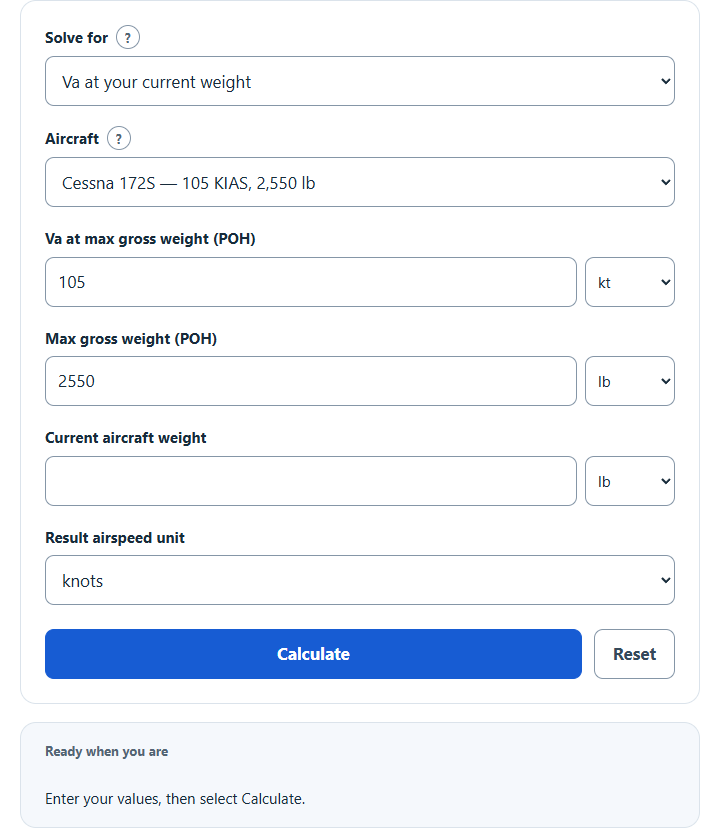
Calculate maneuvering speed (Va) at your current weight from POH values or common aircraft presets, or estimate Va from stall speed and load factor.
- All Physics Calculators
- Stall Speed Calculator
- Aircraft Turn Radius Calculator
- Angle of Climb Calculator
- Pressure Altitude Calculator
- Takeoff Velocity Calculator
- Rate of Climb Calculator
Calculator Functions
| Function | What it does | What it requires |
|---|---|---|
| Va at your current weight | Estimates maneuvering speed at a weight below maximum gross weight | Requires the POH Va at maximum gross weight, the maximum gross weight and the current aircraft weight |
| Weight for a given Va | Finds the aircraft weight that matches a given maneuvering speed | Requires the POH Va at maximum gross weight, the maximum gross weight and the Va at the current weight |
| Va from stall speed and load factor | Estimates the speed at which a stall and the limit load factor coincide | Requires the 1-g stall speed and the positive limit load factor |
An aircraft list fills in the published Va and maximum gross weight for the Cessna 152, 172N, 172S and 182T, the Piper Warrior III and Archer III and the Cirrus SR22, and any other aircraft can be entered by hand. The filled-in numbers should be checked against the POH for the aircraft being flown. Speeds can be entered in knots, mph or km/h and weights in pounds or kilograms.
Maneuvering Speed Formulas
| Va₂ | Maneuvering speed at the current weight |
| Va₁ | Published maneuvering speed at maximum gross weight |
| W₂ | Current aircraft weight |
| W₁ | Maximum gross weight |
| Vs | 1-g stall speed at the same weight and configuration |
| n | Positive limit load factor (g) |
Design maneuvering speed is the speed below which a single flight control can be moved once to full deflection, about one axis, in smooth air without risk of damage to the airplane [1]. At or below it the wing stalls before the load on the structure passes its limit [1]. A lighter airplane stalls at a lower speed, so it reaches the same load factor at a lower speed, and Va falls with the square root of weight.
Va at your current weight
The main formula applies directly. A Cessna 172S with a published Va of 105 KIAS at 2,550 lb, flown at 2,000 lb, gives 105 × √(2,000 ÷ 2,550) = 93.0 knots. The current weight cannot be more than the maximum gross weight.
Weight for a given Va
With the same 172S figures, a Va of 93 knots corresponds to 2,550 × (93 ÷ 105)² = 2,000 lb.
Va from stall speed and load factor
The load factor at the stall rises with the square of airspeed, so an airplane stalled at 1.7 times its normal stall speed is under 1.7 × 1.7 = 2.89 g [1]. Turned around, the speed that reaches a load factor n at the stall is Vs × √n. Limit load factors are 3.8 for the normal category, 4.4 for utility and 6.0 for acrobatic [1]. A 60-knot stall speed with a 3.8 g limit gives 60 × √3.8 = 117.0 knots. This is an aerodynamic cross-check, not the approved Va, and the load factor has to be greater than 1.
Limits of This Estimate
- The approved maneuvering speed is the one in the Airplane Flight Manual or POH for the aircraft and its loading [1]. A calculated value does not replace it.
- Flying at or below maneuvering speed does not protect the structure against repeated full control inputs in one axis, or full inputs in more than one axis at once [1].
- The weight scaling assumes the same configuration and the same kind of airspeed for both values, and it does not cover gust loads. Some manuals publish Va at several weights, and those figures take priority.
- The square-root weight relation is an aerodynamic approximation based on how stall speed changes with weight, not a certified figure. These estimates are based on the best available data and estimations.
Sources
- Federal Aviation Administration, Pilot's Handbook of Aeronautical Knowledge, Chapter 5, Aerodynamics of Flight: definition of design maneuvering speed, load factor and stall speed, limit load factors by category and the limits of flying below Va