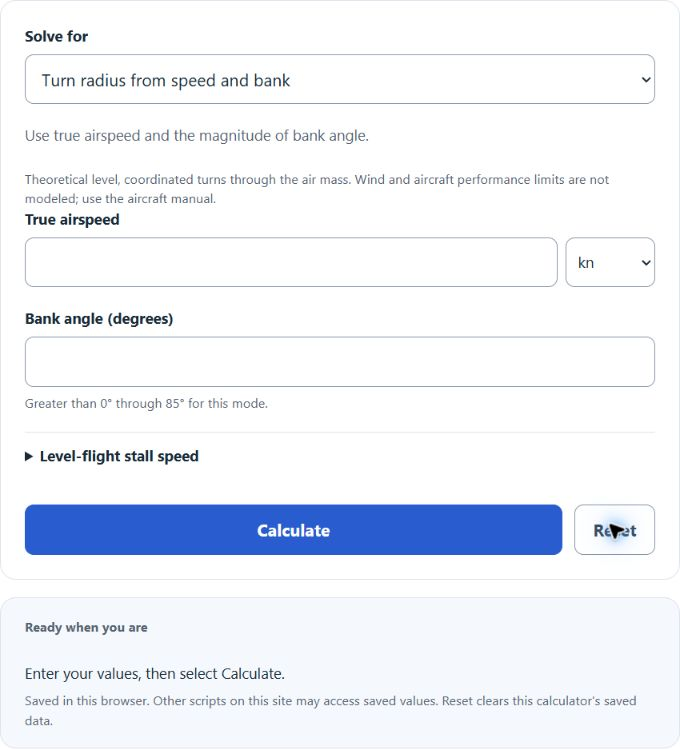
Calculate aircraft turn radius, bank angle, turn rate, and 360° turn time from speed plus bank angle, turn rate, or desired radius.
- All Physics Calculators
- Gust Factor Calculator
- Turning Radius Calculator
- Stall Speed Calculator
- Maneuvering Speed Calculator
- Angle of Climb Calculator
- Glide Ratio Calculator
Aircraft Turn Radius Formula
The calculator uses the level, coordinated turn equations. Pick the formula that matches the inputs you have.
- r = turn radius
- V = true airspeed through the air mass
- phi = bank angle
- omega = turn rate (radians per second; multiply by 180/pi for degrees per second)
- g = 9.80665 m/s²
- n = load factor in G
The formulas assume a level, coordinated turn with no wind effects on the air-mass radius. Do not substitute ground speed to account for wind; wind generally distorts the ground track rather than preserving a circle. Speeds are converted to m/s internally before calculation.
Reference Values
Common bank angles, the resulting load factor, and the radius they produce at typical airspeeds.
| Bank | Load factor | Radius at 100 kn | Radius at 250 kn | Radius at 450 kn |
|---|---|---|---|---|
| 15° | 1.04 G | 3,304 ft | 20,652 ft | 66,914 ft |
| 25° | 1.10 G | 1,899 ft | 11,867 ft | 38,450 ft |
| 30° | 1.15 G | 1,534 ft | 9,585 ft | 31,055 ft |
| 45° | 1.41 G | 885 ft | 5,534 ft | 17,929 ft |
| 60° | 2.00 G | 511 ft | 3,195 ft | 10,352 ft |
Standard rate turn references used in instrument flight. Bank formulas below use V in m/s and return the inverse tangent in degrees.
| Term | Turn rate | 360° time | Bank formula |
|---|---|---|---|
| Standard rate | 3°/s | 2 min | atan(V × (π/60) / 9.80665) |
| Half standard | 1.5°/s | 4 min | atan(V × (π/120) / 9.80665) |
Worked Example
An aircraft at 140 knots true airspeed in a 30° bank.
- Convert speed: 140 kn = 72.02 m/s
- tan(30°) = 0.5774
- r = 72.02² / (9.80665 × 0.5774) = 916 m, or about 3,006 ft
- Turn rate = 72.02 / 916 = 0.0786 rad/s = 4.5°/s
- Time for 360°: 80 seconds
- Load factor: 1 / cos(30°) = 1.15 G
FAQ
Does this account for wind? No. The formula gives the radius through the air mass. In wind, the ground track becomes a distorted curve even at constant bank.
True airspeed or indicated? Use true airspeed for the air-mass radius. Indicated airspeed under-reports at altitude and will give a smaller radius than the aircraft actually flies.
Why does the result change with altitude? It changes only because TAS rises with altitude for the same indicated airspeed. The geometry itself depends only on V, g, and bank angle.
What bank is too steep? Above 60° the load factor exceeds 2 G and stall speed rises by more than 40%. Verify the maneuver is within aircraft limits and pilot training.