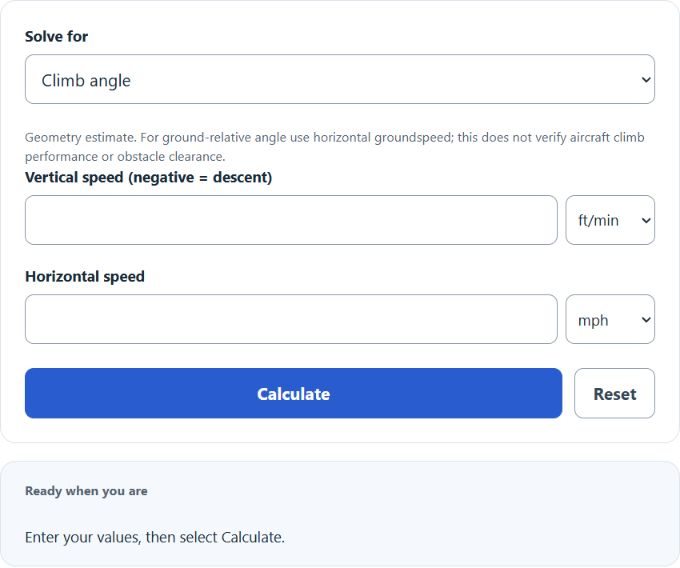
Calculate aircraft angle of climb, vertical speed, or ground speed from any two inputs in knots, mph, km/h, ft/min, or degrees/radians.
Related Calculators
- Magnetic Variation Calculator
- Upward Force Calculator
- Work Done By Friction Calculator
- Stream Velocity Calculator
- All Physics Calculators
Angle of Climb Formula
The angle of climb is found from the relationship between vertical speed and horizontal speed. The calculator converts speeds to common units, then uses the tangent relationship. Select the value to solve: angle, vertical speed, or horizontal speed.
- θ = angle of climb in degrees
- Vv = vertical speed, or rate of climb, in ft/min
- Vh = horizontal speed in ft/min
- π = pi, approximately 3.14159
The climb gradient is the same relationship expressed as a percentage.
- Climb Gradient = climb rate as a percent of horizontal travel
- Vv = vertical speed in ft/min
- Vh = horizontal speed in ft/min
The rise-to-run ratio compares one unit of vertical rise to the required horizontal run.
- Run Ratio = horizontal distance per 1 unit of vertical rise
- Vh = horizontal speed in ft/min
- Vv = vertical speed in ft/min
The calculator supports different input units for rate of climb and horizontal speed. The implementation uses m/s internally and also reports ft/min; the angle and gradient are unchanged by the common unit choice. Horizontal speed must be greater than zero because it is used as the denominator.
Speed Unit Conversion Factors
These are the conversion factors used to put both speed inputs into ft/min before calculation.
| Input unit | Multiply by | Result |
|---|---|---|
| ft/min | 1 | ft/min |
| m/s | 196.850394 | ft/min |
| mph | 88 | ft/min |
| km/h | 54.6806649 | ft/min |
| knots | 101.268591 | ft/min |
Climb Angle and Gradient Reference
| Climb angle | Approximate gradient | Approximate rise-to-run ratio |
|---|---|---|
| 1° | 1.75% | 1 : 57.29 |
| 3° | 5.24% | 1 : 19.08 |
| 5° | 8.75% | 1 : 11.43 |
| 10° | 17.63% | 1 : 5.67 |
| 15° | 26.79% | 1 : 3.73 |
Example Problems
Example 1: Rate of climb in ft/min and speed in mph
You have a rate of climb of 800 ft/min and a horizontal speed of 100 mph.
Convert horizontal speed:
Find the angle:
The climb gradient is 9.09%, and the rise-to-run ratio is about 1 : 11.00.
Example 2: Rate of climb in m/s and speed in knots
You have a vertical speed of 5 m/s and a horizontal speed of 90 knots.
Convert both speeds:
Find the angle:
The climb gradient is 10.80%, and the rise-to-run ratio is about 1 : 9.26.
FAQ
What is the difference between angle of climb and climb gradient?
Angle of climb is measured in degrees. It tells you the steepness of the climb as an angle above the horizontal. Climb gradient expresses the same steepness as a percentage. For example, a 10% climb gradient means the aircraft or object gains 10 units of height for every 100 units of horizontal travel.
Why does horizontal speed need to be greater than zero?
The formula divides vertical speed by horizontal speed. If horizontal speed is zero, the division is undefined. A zero horizontal speed would also not describe a normal climb angle based on forward movement.
Does airspeed equal horizontal speed?
Not always. The calculator uses horizontal speed, which is the speed across the ground or along the horizontal path. In aircraft calculations, indicated airspeed, true airspeed, and groundspeed can differ because of wind, altitude, and instrument effects. For a climb angle relative to the ground, use horizontal groundspeed when available.