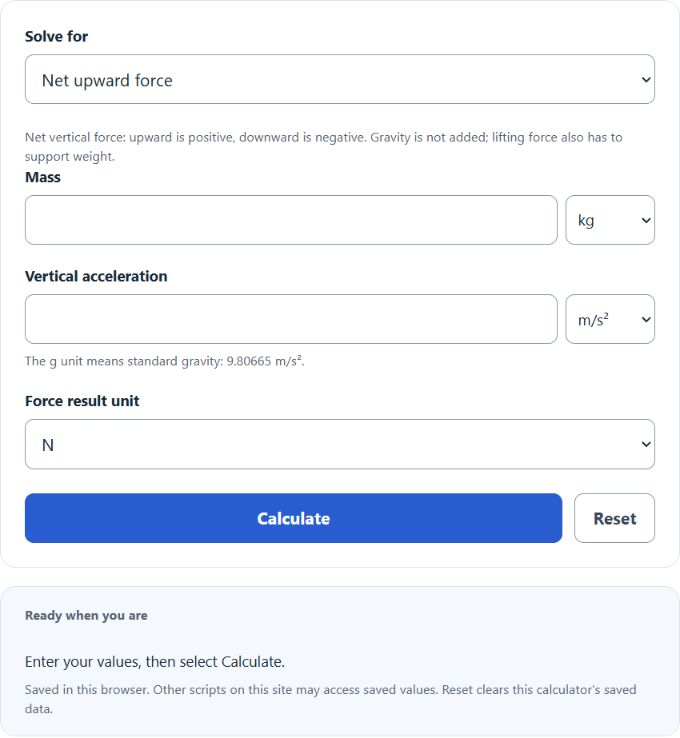
Calculate upward force, mass, or acceleration from F = m·a with kg, g, lb, oz, m/s², ft/s², N, lbf, and dyn as needed for all units.
- All Physics Calculators
- Downward Force Calculator
- Horizontal Vertical Force Calculator
- Uphill Force Calculator
- Net Force Calculator
- Gravitational Force Calculator
- Resultant Force Calculator
Upward Force Formula
The upward force calculator determines the net force acting upward from an object's mass and upward acceleration. In physics terms, this is the resultant vertical force, not always the same as the total lifting force provided by a cable, motor, jack, or person.
- UFnet = net upward force
- m = mass of the object
- au = upward acceleration
This comes directly from Newton’s second law applied in the vertical direction. If the object accelerates upward, the net force must also be upward.
Net Upward Force vs. Applied Upward Force
A common point of confusion is the difference between net upward force and applied upward force.
The calculator on this page uses mass and acceleration to return the net upward force. If gravity is also acting downward, the actual lifting force must be larger than the net force.
Use the first equation when you want the resultant force. Use the second when you want the total upward force required to lift an object against gravity near Earth.
How to Use the Upward Force Calculator
- Enter the object’s mass.
- Enter the upward acceleration.
- Select the appropriate units for each input.
- Click calculate to obtain the net upward force.
If your goal is to find the force needed to actually raise the object, remember to account for weight as well. The calculator result alone is the net force, not necessarily the full lifting force.
Variable and Unit Reference
| Quantity | Meaning | Common Units |
|---|---|---|
| Mass | Amount of matter in the object | kg, g, lb, oz |
| Upward Acceleration | Rate of change of upward velocity | m/s², ft/s², g |
| Upward Force | Net force in the upward direction | N, lb-force, dyn |
When acceleration is entered in g, it represents a multiple of standard gravity. This is useful for high-acceleration motion, launch systems, and impact or test scenarios.
Example
If an object has a mass of 17 kg and accelerates upward at 4 m/s², the net upward force is:
The net upward force is 68 N.
If you instead need the applied lifting force required to create that motion while gravity acts downward, then:
So the actual upward force required would be about 235 N.
What the Result Means
- Positive upward force: the net force is upward, so the object accelerates upward.
- Zero upward force: vertical forces are balanced, so there is no vertical acceleration.
- Negative upward force: the net force is downward, even if an upward force is present.
Common Applications
- Elevators starting upward
- Cranes and hoists lifting loads
- Rockets during ascent
- Hydraulic lifts and jacks
- Winches and pulley systems
- Mechanical design involving vertical motion
In each of these cases, the key question is whether you need the net upward force or the total applied force. That distinction determines which equation should be used.
Common Mistakes
- Confusing mass and weight: mass is the input for this calculator; weight is a force caused by gravity.
- Ignoring gravity: the calculator gives net force from acceleration, not the full force needed to overcome weight.
- Mixing unit systems: keep units consistent or rely on the calculator’s conversion options.
- Using the wrong sign convention: upward is treated as positive, so downward acceleration reduces the upward net force.
Practical Interpretation
If an object is moving upward at a constant speed, its acceleration is zero, so the net upward force is zero even though an upward support force may still exist. That happens because the upward support force and downward weight balance each other.
If the object speeds up while moving upward, the upward support force must exceed the downward forces. If it slows down while moving upward, the net force is downward even though the object may still be traveling upward for a time.