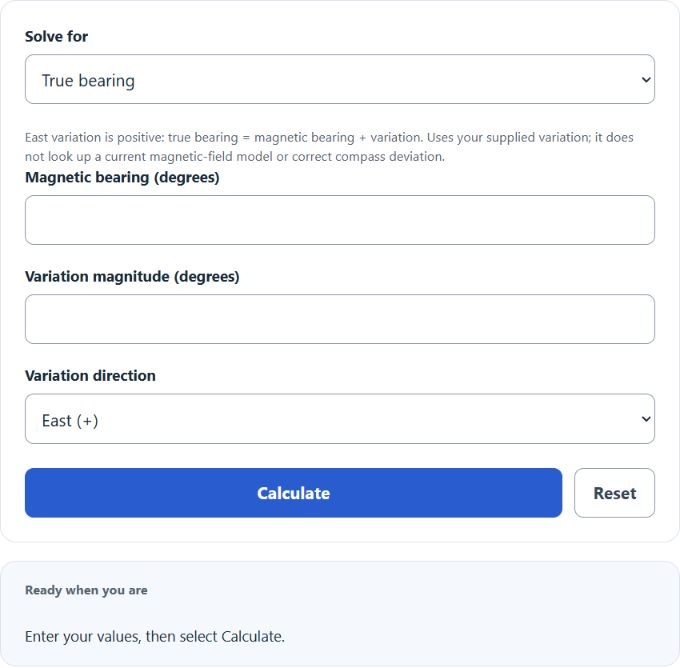
Calculate magnetic or true bearing from local variation, or project charted variation forward by annual change and elapsed years using east or west inputs.
Related Calculators
- Glide Ratio Calculator
- Magnetic Azimuth to Grid Azimuth Calculator
- Bearings to Azimuths Calculator
- Angle Between Bearings Calculator
- Reverse Bearing Calculator
- 1 in 60 Rule Calculator
- All Physics Calculators
Magnetic Variation Formula
Select Update charted variation to apply this linear chart-update formula. Use east-positive and west-negative signed variation and annual change; this is an approximation, not a current magnetic-field model.
Formula source: Canadian Cadet Publications – Annex L: Calculating Magnetic Declination (2016)
Variables:
- MV is the projected magnetic variation (degrees; east positive, west negative)
- D is the declination at the start of the year (degrees)
- M is the signed annual change in declination (degrees per year; divide arcminutes per year by60)
- Y is elapsed years since the chart reference epoch
To calculate the magnetic variation, multiply the annual change in declination by the number of years since the start of the year. Add this result to the declination at the start of the year. The result is the magnetic variation.
What is a Magnetic Variation?
Magnetic variation, also known as magnetic declination, is the angle between magnetic north and true north at a particular location. It is the result of the Earth's complex and ever-changing magnetic field. This variation is important to consider in navigation and compass-based activities, as it can cause a significant difference between the compass bearing and the actual geographic direction. The value of magnetic variation changes depending on where you are on the Earth and also changes slowly over time.
How to Calculate Magnetic Variation?
Select Update charted variation, then follow these steps. Bearing-conversion modes instead use true = magnetic + signed variation.
- First, determine the declination at the start of the year (D) in degrees.
- Next, determine the annual change in declination (M) in degrees per year.
- Next, determine the number of years since the start of the year (Y).
- Next, gather the formula from above = MV = D + (M * Y).
- Finally, calculate the Magnetic Variation (MV).
- After inserting the variables and calculating the result, check your answer with the calculator above.
Example Problem :
Use the following variables as an example problem to test your knowledge.
declination at the start of the year (D) = 10 degrees
annual change in declination (M) = 2 degrees per year
number of years since the start of the year (Y) = 5 years. With east-positive signs, the projected variation is10 +2 ×5 =20° east