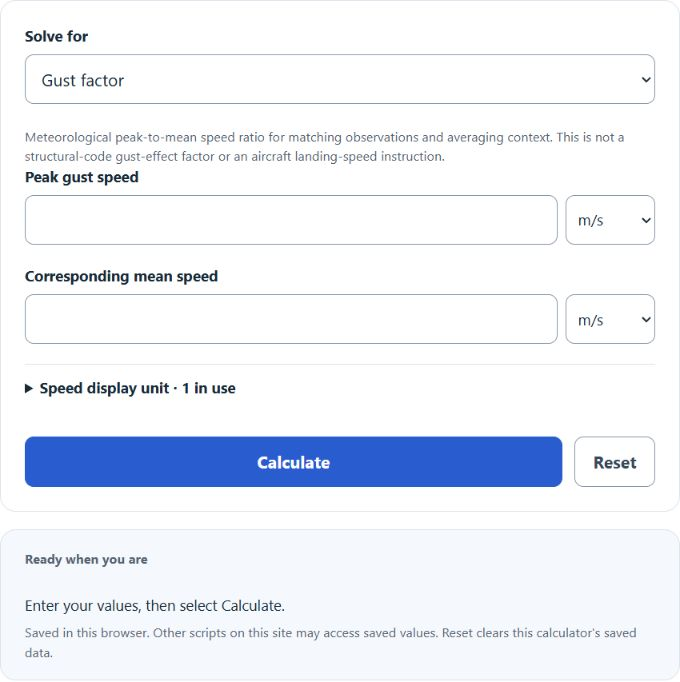
Gust Factor Calculator solves peak gust, mean wind, or gust ratio across mph, knots, km/h, and m/s, with gust increment and velocity-pressure impact.
- All Construction Calculators
- Wind Pressure & Force Calculator
- Ground Speed Calculator
- Glide Ratio Calculator
- Aircraft Turn Radius Calculator
- Blowing Force Calculator
Gust Factor Formula
The following equation is used to calculate the Gust Factor.
- Where GF is the dimensionless peak-to-mean gust factor
- GWS is the gust wind speed (knots)
- SWS is the sustained wind speeds (knots)
To calculate this meteorological gust factor, divide peak gust speed by the corresponding positive mean or sustained wind speed, using matching units and observation context.
What is a Gust Factor?
Definition:
The meteorological gust factor is the ratio of peak gust speed to the corresponding mean wind speed. The gust increment is their difference and has speed units.
This ratio is not an aircraft landing-speed adjustment or a structural-code gust-effect factor. Those applications require their own approved methods and matching wind definitions.
How to Calculate a Gust Factor?
Example Problem:
The following example outlines the steps and information needed to calculate the Gust Factor.
First, determine the gusting wind speed. In this example, the winds are gusting to 40 knots.
Next, determine the sustained wind speed. In this case, the sustained wind speeds are 25 knots.
Finally, calculate the gust factor using the formula above:
GF = GWS / SWS
GF = 40 / 25
GF = 1.6 (dimensionless); the separate gust increment is 40 − 25 = 15 knots.