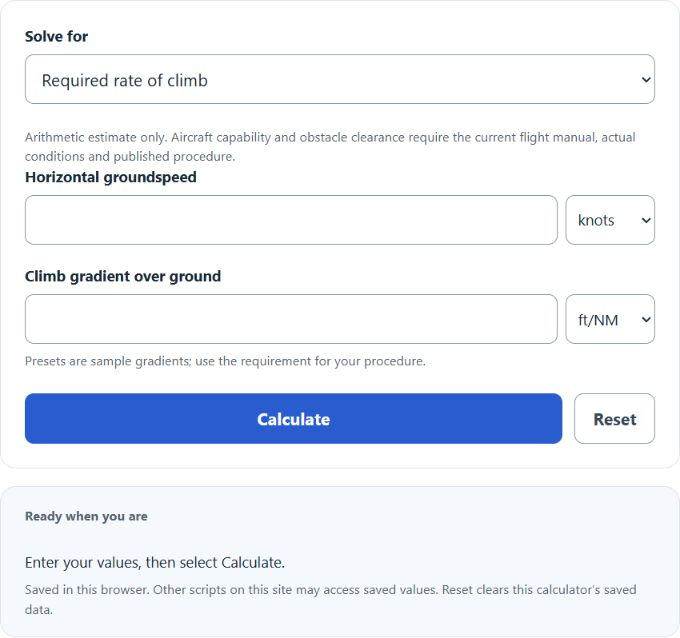
Enter horizontal groundspeed and the required climb gradient to calculate vertical rate, or enter altitude gain and a constant climb rate to estimate elapsed time. These calculations do not establish aircraft performance or obstacle clearance.
- All Physics Calculators
- Propeller Thrust Calculator
- Ground Speed Calculator
- Stall Speed Calculator
- Glide Ratio Calculator
- Lift Force Calculator
- Wing Volume Calculator
- Fuel Uplift Calculator
Rate of Climb Formula
The following formula is used to calculate the rate of climb.
- Where ROC is the rate of climb of the aircraft
- Vg is horizontal groundspeed; convert its units to the desired vertical-rate units
- fa is the climb angle over ground, from 0 to below 90 degrees
For horizontal groundspeed, multiply by tan(climb angle). Equivalently, ROC (ft/min) = groundspeed (knots) × gradient (ft/NM) / 60. Using sin(angle) requires the total path-speed magnitude instead of horizontal groundspeed.
The tangent is dimensionless, so the vertical rate has the same length/time units as the converted horizontal speed.
What is a rate of climb?
Definition:
A rate of climb is a measure of the total distance per unit time of the vertical component of an aircraft’s movement. In other words, how quickly the aircraft is rising off the ground.
How to calculate rate of climb?
Example Problem:
The following example problem outlines how to calculate a rate of climb.
First, determine horizontal groundspeed. This illustrative geometric example uses 300 m/s; it is not an aircraft performance recommendation.
Next, determine the flight angle. This plane in particular has a flight angle of 15 degrees.
Finally, calculate the rate of climb using the formula above:
ROC = Vg * tan(fa)
ROC = 300 * tan(15deg)
ROC ≈ 80.384758 m/s