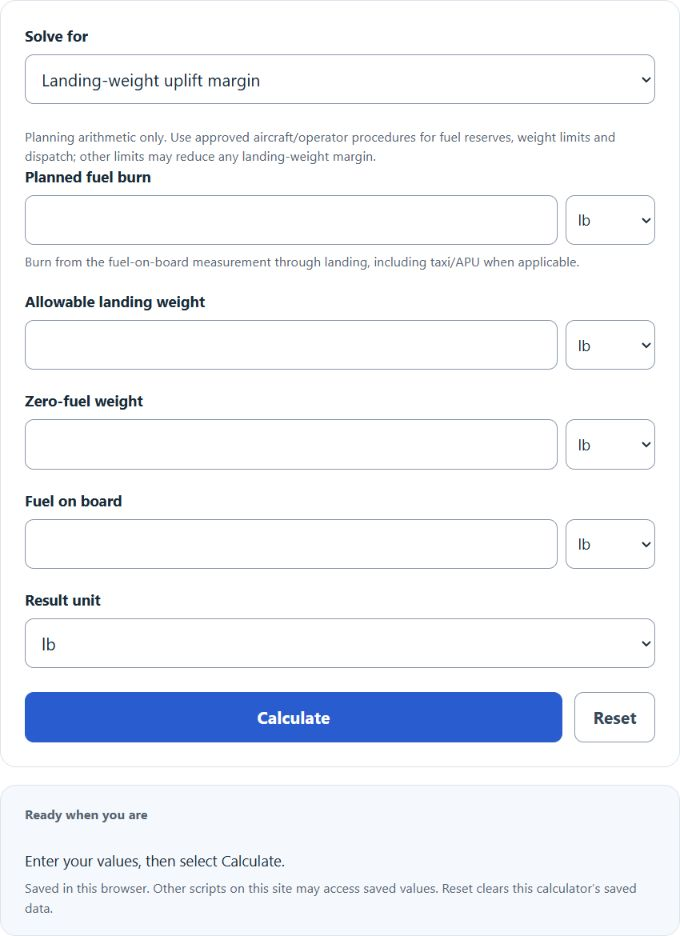
Calculate fuel uplift, block fuel, and mass-volume conversions from planned fuel burn, landing weight, fuel on board, and fuel density.
- All Unit Converters
- Zero Fuel Weight Calculator
- Aviation Fuel Weight Calculator
- Fuel Time Calculator
- Rate of Climb Calculator
- Angle of Climb Calculator
- Pressure Altitude Calculator
Fuel Uplift Formula
The following equation is used to calculate the maximum fuel uplift limited by the maximum allowable landing weight (MLW). Other limits (e.g., maximum takeoff weight, maximum ramp weight, tank capacity, and structural limits) may further restrict the actual uplift.
- Where MFUL is the maximum fuel uplift (weight: kg or lb)
- FPFB is the flight planned fuel burn (weight: kg or lb)
- MALW is the maximum allowable landing weight (weight: kg or lb)
- ZFW is the zero fuel weight (weight: kg or lb)
- FAOB is the fuel weight already on board (weight: kg or lb)
To calculate the fuel uplift, add together the flight planned fuel burn and maximum allowable landing weight, then subtract the zero fuel weight and the fuel weight already on board. Use consistent units throughout (all kg or all lb).
What is a Fuel Uplift?
Definition:
A fuel uplift is the amount of fuel added to an aircraft during refueling (often recorded as a weight and/or volume). In this calculator, “maximum fuel uplift” means the maximum additional fuel you can load without exceeding the maximum allowable landing weight after the planned fuel burn, assuming other limits are not restrictive.
How to Calculate Fuel Uplift?
Example Problem:
The following example outlines the steps and information needed to calculate Fuel Uplift.
First, determine the flight planned fuel burn. In this case, the planned burn is 110,000 lbs.
Next, determine the maximum allowable landing weight. This is determined to be 310,000 lbs.
Next, determine the zero fuel weight. This is found to be 240,000 lbs.
Next, determine the fuel already on board. In this example, there is only 25,000 lbs on board.
Finally, calculate the maximum fuel uplift.
MFUL = (FPFB+MALW) - ZFW - FAOB
MFUL = (110000+310000) - 240000 - 25000
MFUL = 155,000 lbs
FAQ
What factors can affect the maximum fuel uplift calculation for an aircraft?
Several factors can influence the maximum fuel uplift calculation, including aircraft weight limits, fuel density variations due to temperature, the anticipated weight of cargo and passengers, and regulatory requirements for reserve fuel.
How does the zero fuel weight (ZFW) impact an aircraft's performance?
The zero fuel weight (ZFW) is an important planning weight because it is the aircraft’s weight without usable fuel. Together with the planned fuel load, it helps determine takeoff and landing weights, which in turn affect takeoff/landing distances, climb performance, and fuel efficiency.
Why is it important to accurately calculate the flight planned fuel burn (FPFB)?
Accurately calculating the flight planned fuel burn is essential for ensuring flight safety, optimizing fuel consumption, and minimizing operational costs. Planned burn represents expected consumption from the fuel-on-board reference instant through landing. Required reserves are planned separately and are not part of expected burn.