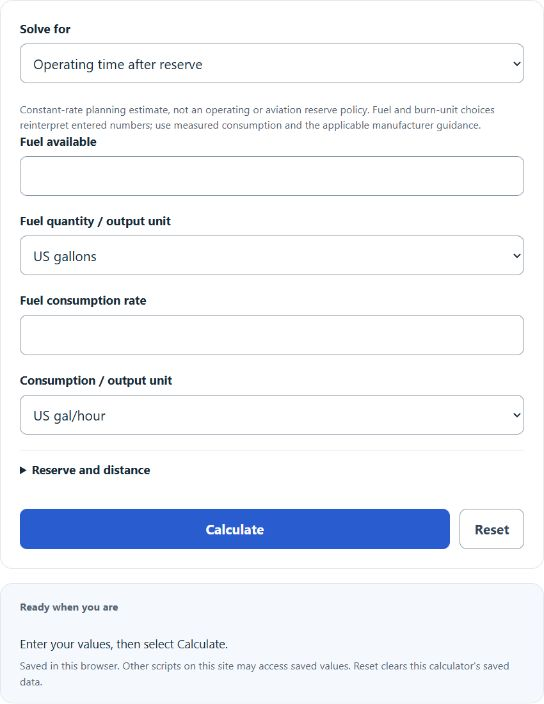
Estimate fuel endurance after a supplied reserve, fuel needed for a planned time, or an average burn rate consistent with supplied fuel and time. Optional speed gives a distance estimate, and details show consumption sensitivity. This constant-burn model does not certify a safe operating limit or an aviation reserve policy.
Fuel Time Formula
Variables:
- FT is total modeled endurance before subtracting reserve time (hours)
- FL is the available fuel quantity, normalized to a volume or mass basis consistent with FR
- FR is the positive fuel consumption or burn rate on the same normalized basis per hour
FT = FL / FR estimates time to consume the entered fuel at a constant burn rate; it is not a tank-refilling time. Convert reserve minutes to hours R, then modeled after-reserve time is FT - R. An entered reserve greater than total endurance is rejected; equality gives zero operating time. Sensitivity rows explicitly flag a reserve shortfall instead of hiding it behind zero. The reverse modes use fuel = burn * (planned time + R) and burn = fuel / (planned time + R), using the same average burn assumption for planned and reserve time. Normalize both volume inputs to liters or mass inputs to kilograms. When one input is volume and the other mass, supply positive fuel density in kg/L so mass = volume * density; there is no invented density value. Matching mass or volume bases do not need density.
How to Calculate Fuel Time?
Use the following steps for the selected solve mode. Required fuel, burn rate and planned operating time must be positive whenever that mode uses them; reserve and speed are separate optional assumptions.
- Choose endurance, required fuel or average burn rate. Enter the available fuel quantity when solving endurance or burn rate, or the planned operating time when solving required fuel or burn rate.
- Select US gallons, liters, kilograms or pounds for fuel and the corresponding per-hour units for burn. Enter the required burn rate when solving endurance or fuel. If mass and volume are mixed, enter the actual positive density in the visible kg/L field; matching bases do not require it.
- Optionally enter nonnegative reserve minutes; blank explicitly uses zero reserve. Supply the reserve appropriate to the actual operation rather than assuming a preset policy. Optional average speed has no default, and zero speed is valid.
- Calculate using the formulas above after converting reserve minutes to hours and reconciling fuel and burn units. If you supply speed, distance is modeled time multiplied by the consistently converted speed in knots, km/h or mph. Use average ground speed when estimating distance over ground.
- Review the formula and the 10% lower/higher consumption scenarios in expandable details. These illustrate sensitivity to the entered assumptions, not a guaranteed operating range. For an aircraft, use its AFM/POH performance data, actual conditions and applicable planning requirements; this calculator does not establish a safe fuel reserve.
Example Problem :
For the original endurance example, choose US gallons for fuel and US gal/h for burn, enter 577 and 1234 respectively, and leave reserve blank to use zero. No density is required because both inputs use volume. Speed may remain blank because it is not needed to calculate time.
fuel load (US gallons) = 577
fuel burn rate (US gal/h) = 1234. Total endurance is 577 / 1234 = about 0.467585 hours, or 28.0551 minutes. With the example zero reserve, modeled after-reserve time is the same. This is an arithmetic example, not a recommended operating duration.
Frequently Asked Questions (FAQ)
What factors can affect fuel consumption rates?
Fuel consumption rates can be influenced by several factors including vehicle type, driving behavior, load weight, and environmental conditions such as terrain and weather.
How can I improve fuel efficiency?
Improving fuel efficiency can be achieved through regular vehicle maintenance, optimizing load weight, using cruise control on highways, and adopting fuel-efficient driving habits like gentle acceleration and deceleration.
Are there any tools to help track fuel consumption over time?
Yes, several apps and devices are available that can track fuel consumption, provide insights into driving habits, and offer tips for improving fuel efficiency. Many modern vehicles also come equipped with fuel economy monitoring features.
How does fuel quality affect fuel consumption?
Use fuel meeting the equipment manufacturer's required grade and specification. Higher octane indicates resistance to knock, not a guaranteed reduction in consumption; benefits depend on engine design and operating conditions, as explained by DOE/EPA guidance on octane. This calculator uses the burn rate and density you supply and does not predict fuel-quality or engine-wear effects.