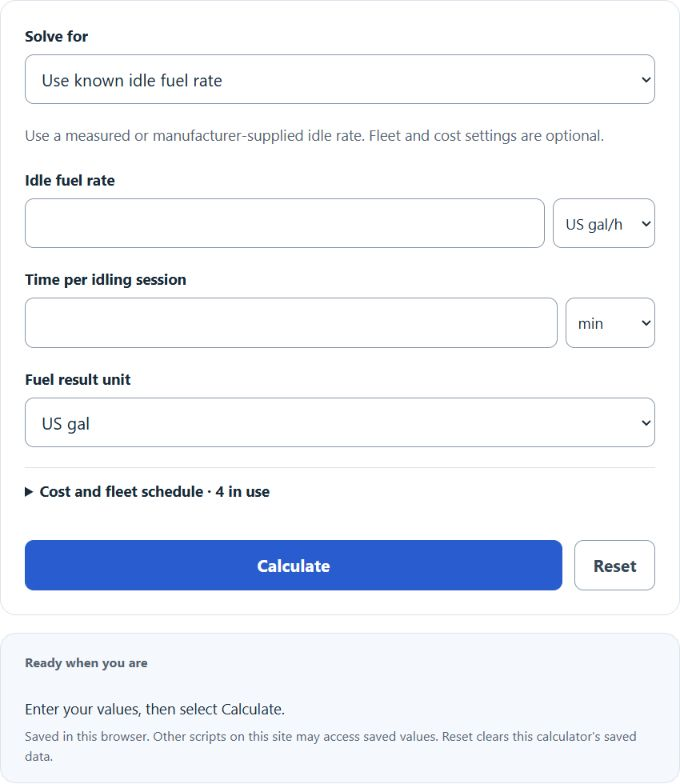
Calculate fuel burned and idling cost from a known idle rate or engine-size estimate, with per-session, hourly, weekly, and yearly results in gallons or liters.
- All Automotive Calculators
- Reefer Unit Fuel Consumption Calculator
- Helicopter Fuel Consumption Calculator
- Boat Fuel Consumption Calculator
- BSFC (Brake Specific Fuel Consumption) Calculator
- Distance to Empty (DTE) Calculator
Idling Fuel Consumption Formula
The calculator estimates idle fuel use in liters per hour, then uses your idle time and fuel price to estimate cost.
By supplied idle rate
By engine size
Fuel cost
- F = fuel burned while idling, in liters per hour
- R = measured or supplied idle fuel rate per vehicle, in liters per hour
- D_L = engine displacement in liters
- k = idle fuel factor, in liters per hour per liter of engine displacement
- P_L = fuel price per liter
- C_hr = cost per hour of idling
- C_session = fleet cost per session
- C_year = cost per year of idling
- H = hours idling per session; N = vehicles, S = sessions per week, W = weeks per year
The known-rate mode uses your supplied rate. Engine-size mode multiplies displacement by your supplied factor; no universal gasoline or diesel factor is assumed. Rates depend on the vehicle and operating conditions. Fuel price is optional; blank omits cost and zero means a zero price. All costs retain your input currency.
Illustrative Idle Fuel Rate Inputs
These inputs demonstrate conversions only; they are not validated rates for vehicle classes. Prefer measured or manufacturer data for your operating conditions. See the U.S. Department of Energy idle-reduction resources.
| Illustrative input case | Assumed idle rate | Approx. US gal/hr |
|---|---|---|
| Case1 (not a vehicle prediction) | 0.4 L/hr | 0.11 gal/hr |
| Case2 (not a vehicle prediction) | 0.6 L/hr | 0.16 gal/hr |
| Case3 (not a vehicle prediction) | 0.9 L/hr | 0.24 gal/hr |
| Case4 (not a vehicle prediction) | 1.5 L/hr | 0.40 gal/hr |
| Case5 (not a vehicle prediction) | 1.9 L/hr | 0.50 gal/hr |
| Case6 (not a vehicle prediction) | 3.0 L/hr | 0.79 gal/hr |
Illustrative Engine Factor Assumptions
| Assumed case | Factor | Meaning |
|---|---|---|
| Illustration A | 0.30 L/hr per engine liter | If k =0.30, a2.0L engine gives0.60L/h. This is an assumption, not a preset. |
| Illustration B | 0.25 L/hr per engine liter | If k =0.25, a6.0L engine gives1.50L/h. This is an assumption, not a preset. |
Example Calculations
Example 1: Supplied rate of0.6L/h for1hour per session
Assume a supplied rate of0.6L/h for one vehicle. If fuel costs $3.50 per gallon, the price per liter is $3.50 ÷ 3.785 = $0.9247/L.
Cost per session =0.6 × (3.50 ÷ 3.785411784) ≈$0.5548. At5sessions per week and52weeks, annual cost is about$144.24, calculated before rounding.
Example 2: Supplied engine factor,2hours per session
Assume a supplied factor k =0.25L/h per engine L for a6.0L engine: rate =6.0 ×0.25 =1.50L/h.
At$1.40/L, hourly cost is$2.10 and session cost is$4.20. For5sessions per week and52weeks, annual fuel is780L and cost is$1,092.
FAQ
How accurate is an idling fuel consumption estimate?
It is an estimate. Real idle fuel use depends on engine size, fuel type, engine temperature, accessories, air conditioning, electrical load, idle speed, and emissions equipment. The result is useful for planning fuel cost, but it may not match a measured fuel-flow reading exactly.
Does using air conditioning increase fuel burned while idling?
Yes. Air conditioning adds load to the engine. That can raise idle fuel consumption, especially in small gasoline vehicles. Heaters, defrosters, lights, PTO equipment, and high electrical loads can also increase idle fuel use.
How do I convert liters per hour to gallons per hour?
Divide liters per hour by 3.785. For example, 1.50 L/hr ÷ 3.785 = 0.40 US gal/hr.