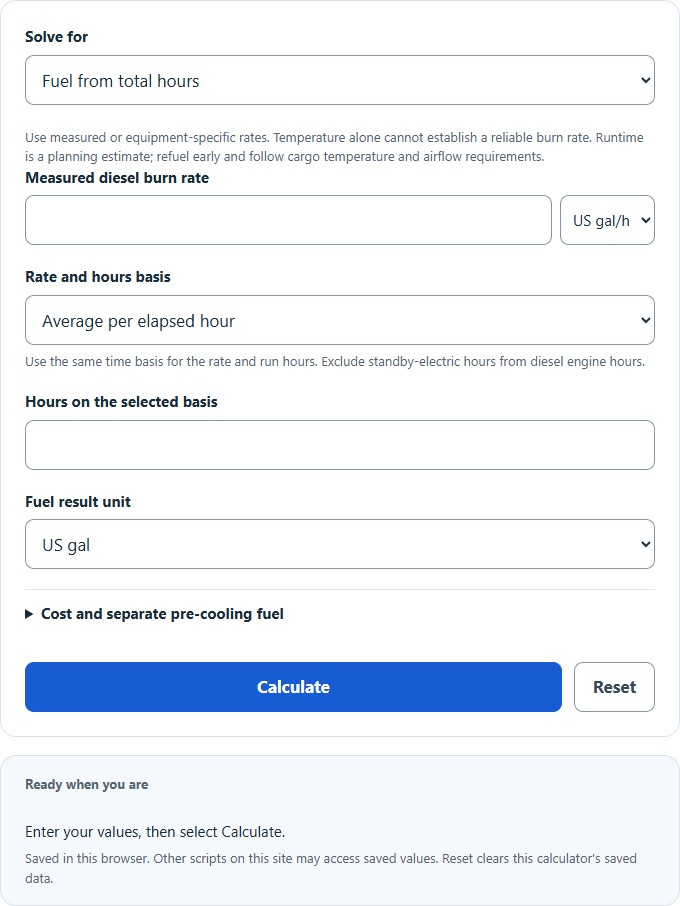
Calculate reefer unit fuel consumption in gallons from burn rate and run hours, estimate diesel cost, and find how long a full tank of fuel will last.
- All Automotive Calculators
- Idling Fuel Consumption Calculator
- Fuel Price Calculator
- Cargo Securement Tie-Down Calculator
Reefer Unit Fuel Consumption Formula
The calculator works in two directions. To find the diesel a reefer unit burns on a trip, it multiplies the burn rate by the number of hours the unit runs:
F = GPH * H
If you add pre-cool fuel or a diesel price, it extends the same result:
Total Fuel = (GPH * H) + Precool
 Cost = Total Fuel * Price
To find how long a tank of fuel will last, it divides the usable fuel by the burn rate:
Runtime = Tank / GPH
Variables:
- F is the diesel the reefer unit consumes, in gallons
- GPH is the measured burn rate in US gallons per elapsed hour or per diesel engine-on hour, as selected
- H is hours on the same basis as the rate; include pre-cooling only when its fuel is not entered separately
- Precool is separately entered diesel not already included in the run-hours estimate; blank means zero
- Tank is the usable fuel in the reefer belly tank, in gallons
- Price is the diesel price per gallon
Enter a measured or equipment-specific diesel burn rate. Use a rate per elapsed hour with elapsed hours, or a rate per diesel engine-on hour with diesel engine hours. These are different denominators: do not count standby-electric hours as diesel engine hours or apply a running-duty factor twice. The calculator does not infer a reliable rate from setpoint, weather or operating mode. Choose total hours, a daily schedule, or runtime from usable fuel.
Illustrative Diesel Burn-Rate Scenarios
The following numbers are illustrative planning assumptions for sensitivity checks, not manufacturer specifications or predictions for a cargo temperature. The calculator requires your own measured or equipment-specific rate. Lower, middle and higher assumptions show why the rate matters; no universal weather, Cycle-Sentry or multi-zone multiplier is applied.
| Planning scenario | Lower rate | Middle rate | Higher rate |
|---|---|---|---|
| Scenario A | 0.55 | 0.65 | 0.88 |
| Scenario B | 0.64 | 0.75 | 1.01 |
| Scenario C | 0.77 | 0.90 | 1.22 |
| Scenario D | 0.85 | 1.00 | 1.35 |
Once you know the burn rate, the next table shows supported hours for different amounts of usable fuel. Hours use the same basis as the entered rate. Diesel engine-on hours do not by themselves establish elapsed cooling time. Values are rounded planning examples, not refueling guarantees.
| Burn rate | 30 gal | 50 gal | 75 gal | 100 gal |
|---|---|---|---|---|
| 0.5 gal/hr | 60 hr | 100 hr | 150 hr | 200 hr |
| 0.7 gal/hr | 43 hr | 71 hr | 107 hr | 143 hr |
| 0.9 gal/hr | 33 hr | 56 hr | 83 hr | 111 hr |
| 1.1 gal/hr | 27 hr | 45 hr | 68 hr | 91 hr |
| 1.3 gal/hr | 23 hr | 38 hr | 58 hr | 77 hr |
Reefer Unit Fuel Consumption Example Problems
Example 1: Fuel used and cost on a frozen load.
Your measured average diesel rate is 0.90 US gal per elapsed hour. The unit is monitored over 18 elapsed hours, including a 2-hour pre-cool period. Select average per elapsed hour and enter 18 hours; leave separate pre-cooling fuel blank to avoid double counting:
F = 0.90 * 18 = 16.2 gallons. At a diesel price of $3.90 per gallon, that is 16.2 * 3.90 = $63.18 in reefer fuel for the trip.
Example 2: How long a tank will last.
You have 50 US gallons of usable fuel after your reserve and a measured rate of 0.8 US gal per diesel engine-on hour. Divide usable fuel by that rate:
Runtime = 50 / 0.8 = 62.5 diesel engine-on hours. At 24 engine-on hours per day, that is about 2.6 scheduled days. A start-stop duty cycle requires a matching measured elapsed-hour rate or an engine-on schedule.
Frequently Asked Questions
How much fuel does a reefer unit use per hour?
There is no single rate established by this tool for every trailer unit or cargo. Use measured diesel consumed divided by hours on a clearly stated basis, or applicable equipment-specific data. Temperature, ambient conditions, insulation, doors and the operating configuration affect demand. A product-specific fuel-saving comparison does not establish a universal Cycle-Sentry percentage.
Does the reefer run off the truck’s fuel tank?
Many diesel-powered trailer units have a separate fuel supply, but configurations vary. Check the actual unit and trailer documentation and usable capacity. Do not assume that the tractor fuel gauge measures reefer fuel. Refuel before the usable fuel is exhausted.
How can you lower reefer fuel consumption?
Follow the cargo’s required temperature and airflow and the equipment’s operating instructions. Use start-stop operation only when approved for that load. Use shore power only on equipment configured for electric standby. Maintain seals, insulation and coils and follow the service schedule; this tool does not assign a universal percentage penalty to leaks or recommend changing a cargo’s operating mode.