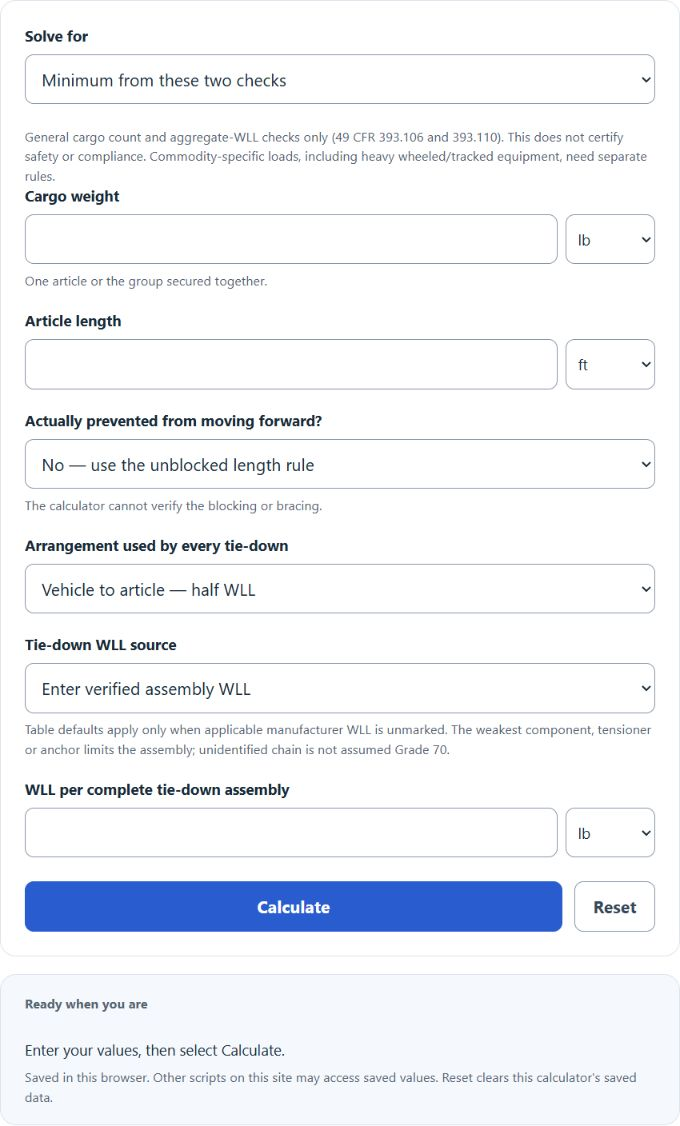
Estimate the general cargo length-rule minimum and aggregate working load limit (WLL) count under 49 CFR 393.106 and 393.110. These two numerical checks do not certify load safety or full compliance; commodity-specific rules, including those for heavy wheeled or tracked equipment, require separate assessment.
Cargo Securement Tie-Down Formula
Two independent rules set how many tie-downs a load needs, and you must satisfy whichever gives the larger number. The first rule is the aggregate working load limit (WLL) rule. The combined WLL of all tie-downs must be at least half the weight of the cargo:
WLL_required = 0.5 * W
Each tie-down only counts for part of its rated WLL, depending on how it is run. A direct tie-down that attaches to the cargo counts half its WLL. A tie-down that runs over the top of the load and anchors to the opposite side counts its full WLL:
WLL_aggregate = sum( f * WLL_i )
The second rule is the length rule, which sets a minimum count regardless of weight. For an article that is not blocked from moving forward:
N_length = 2 + ceil( (L - 10) / 10 ) for L > 10 ft
Variables:
- W is the weight of the article or group of articles secured together
- WLL_required is the minimum aggregate working load limit, at least one half of W
- WLL_i is the working load limit of tie-down i, taken as the lowest rated part of the assembly (webbing or chain, ratchet or binder, and anchor point)
- f is the fraction of each tie-down WLL that counts: 0.5 for a direct tie-down or a strap that returns to the same side, and 1.0 for a tie-down run over the top to the opposite side
- L is the length of the longest article in feet
- N_length is the minimum number of tie-downs from the length rule; ceil means round up to the next whole number
The calculator applies both rules at once. In “Number of tie-downs needed” mode it returns the length-rule minimum, the WLL-rule minimum, and the larger of the two as the minimum from these two checks. In “Check a securement setup” mode it takes the number of tie-downs you plan to use and reports whether these two numerical checks are met, so you can see whether it is the count or the WLL that falls short. The short length rule for a fully blocked article is one tie-down for every 10 feet of length or fraction thereof.
FMCSA Default Working Load Limits
When a tie-down is not marked with a WLL by its manufacturer, these are the default values from 49 CFR 393.108. Use manufacturer-marked WLL when it differs from a table default, and limit the assembly to its weakest component, tensioner or anchor. Chain grade must be identifiable; unidentified chain is treated as Grade 30, not Grade 70.
| Tie-down | Size | WLL (lb) |
|---|---|---|
| Synthetic strap | 2 in | 2,000 |
| Synthetic strap | 3 in | 3,000 |
| Synthetic strap | 4 in | 4,000 |
| Grade 70 chain | 5/16 in | 4,700 |
| Grade 70 chain | 3/8 in | 6,600 |
| Grade 70 chain | 1/2 in | 11,300 |
| Grade 43 chain | 3/8 in | 5,400 |
The next table is the practical shortcut most drivers want: how many tie-downs the WLL rule requires for a given cargo weight. It shows the required aggregate WLL, then the count of 2 inch straps run as direct versus over the top, and the count of 3/8 inch Grade 70 chains run direct. These are WLL-rule minimums only; for an unblocked article longer than 5 feet the general length rule still sets a floor of at least two tie-downs.
| Cargo weight | Required WLL | 2 in straps direct | 2 in straps over top | 3/8 in G70 direct |
|---|---|---|---|---|
| 2,000 lb | 1,000 lb | 1 | 1 | 1 |
| 5,000 lb | 2,500 lb | 3 | 2 | 1 |
| 10,000 lb | 5,000 lb | 5 | 3 | 2 |
| 15,000 lb | 7,500 lb | 8 | 4 | 3 |
| 20,000 lb | 10,000 lb | 10 | 5 | 4 |
| 30,000 lb | 15,000 lb | 15 | 8 | 5 |
| 40,000 lb | 20,000 lb | 20 | 10 | 7 |
Example Problems
Example 1: General-rule count for a crate.
For a general-rule example, you haul a 20,000 lb crate that is 12 feet long, it is not blocked forward, and you secure it with 3/8 inch Grade 70 chains run direct to the crate. The WLL rule needs an aggregate of 0.5 * 20,000 = 10,000 lb. Each direct chain counts half of 6,600, or 3,300 lb, so you need ceil(10,000 / 3,300) = 4 chains. The length rule needs 2 tie-downs for the first 10 feet plus 1 more for the extra 2 feet, or 3. The larger numerical minimum is 4 equivalent chains. This example is not a heavy-equipment securement assessment: wheeled or tracked equipment weighing at least 10,000 lb has separate requirements in 49 CFR 393.130, including at least four tie-downs.
Example 2: Checking a strap setup.
For another general-rule example, you secure a 10,000 lb crate that is 9 feet long with four 2 inch straps run direct. The length rule minimum is 2, so the count passes. The WLL rule needs 5,000 lb, but each direct strap counts only 1,000 lb, so four straps give 4,000 lb and fall short. You need ceil(5,000 / 1,000) = 5 straps, so you add one more even though the number of straps already looked like enough.
Frequently Asked Questions
How many tie-downs does the law actually require?
You have to pass two separate tests and use whichever demands more. The length rule sets a minimum count: one tie-down for a short light article, two for anything over 5 feet up to 10 feet, and one more for each additional 10 feet or part of 10 feet. The working load limit rule is separate: the combined WLL of your tie-downs has to be at least half the cargo weight. A load can meet the count and still fail the WLL test, which is why heavy but short items often need more straps than the length rule alone would suggest.
Why does an over-the-top tie-down count double a direct one?
It is about how many rated ends resist the load. A tie-down that runs over the cargo and anchors to the vehicle on both sides is restrained at each end, so the rules let you count its full WLL. A direct tie-down attaches to the cargo at one end, so only that single leg resists motion and it counts for half its WLL. A strap that goes over the top but returns to an anchor on the same side also counts as half.
Is working load limit the same as breaking strength?
No, and mixing them up is a common way to under-secure a load. Breaking strength is the force at which the component fails in testing. Working load limit is the manufacturer or applicable table rating. Design factors depend on the product; do not infer WLL from a universal breaking-strength ratio. Cargo securement math uses WLL, not breaking strength, and the WLL of the whole assembly is the lowest value among the webbing or chain, the ratchet or binder, and the anchor point it connects to.