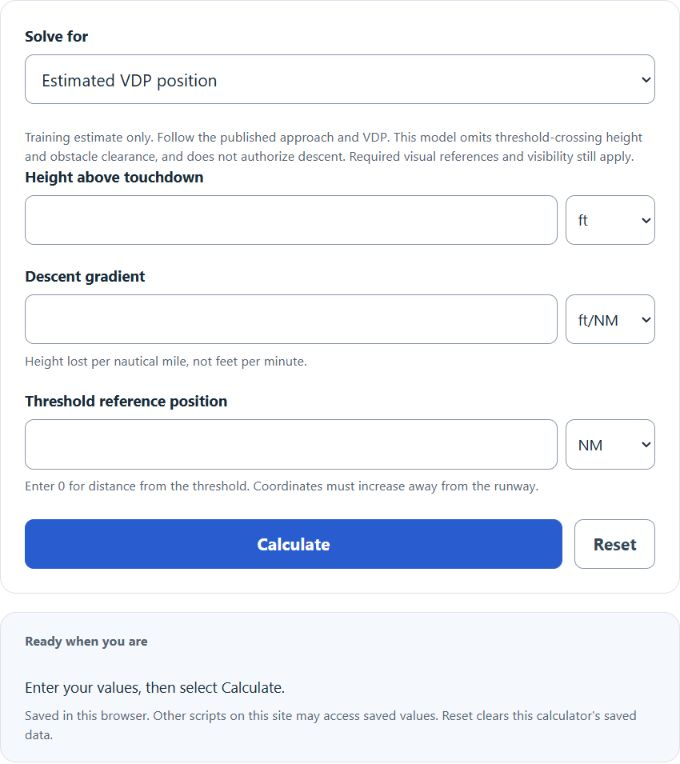
Estimate a visual descent point (VDP) position, height above touchdown, descent gradient, or threshold reference position. Select what to solve for and enter the three known values. This is a training model, not a replacement for a published approach.
- Lift Force Calculator
- Glide Ratio Calculator
- GSD (Ground Sample Distance) Calculator
- Wing Area Calculator
- All Chemistry Calculators
VDP Formula
The visual descent point (VDP) is the point on a nonprecision approach where a normal visual descent to the touchdown zone can begin. This calculator uses height above touchdown, descent gradient, and a threshold reference position for a simplified along-track estimate. It does not calculate a charted VDP, account for threshold-crossing height or obstacles, or convert DME slant range into along-track distance.
- VDP = visual descent point distance
- HAT = height above touchdown
- DR = descent gradient in distance-based units such as ft/NM
- RT = runway threshold distance reference
The calculation first determines how many nautical miles are needed to lose the required altitude at the selected descent gradient, then adds the threshold position on a common along-track scale that increases away from the runway. An arbitrary DME reading cannot be used as an offset without establishing the applicable station geometry. Use the published procedure and required visual references for flight.
Rearranged Forms
If you are solving for a different variable, these equivalent forms are useful:
Input Guide
| Field | Meaning | Common Units | What to Enter |
|---|---|---|---|
| HAT | Height above touchdown zone elevation | ft, m, km | The vertical distance between the aircraft and the touchdown zone reference elevation |
| DR | Descent gradient | ft/NM, m/NM | A distance-based descent rate, not a time-based vertical speed |
| RT | Runway threshold reference | NM, km | The threshold position on the same distance reference used for the approach |
| VDP | Visual descent point | NM, km | An estimated along-track position; not authorization to descend |
How to Use the Calculator
- Enter the height above touchdown, not field elevation and not altitude above mean sea level.
- Enter the descent gradient in feet per nautical mile or meters per nautical mile.
- Enter the runway threshold reference; use 0 when measuring distance from the threshold. All positions must be nonnegative on the same outward-increasing along-track scale.
- Select the quantity to solve for and enter the three displayed known values. Height and descent gradient must be positive, and the VDP position must exceed the threshold position.
- Confirm that all distances use the same reference system before interpreting the result.
Example
If the height above touchdown is 600 ft, the descent gradient is 300 ft/NM, and the runway threshold reference is 0.3 NM, the VDP is:
The model gives an estimated position of 2.3 NM on the defined along-track scale, 2 NM before its threshold position. This arithmetic does not establish a safe or authorized descent point; follow the published approach and required visual references.
What Affects the VDP
- Higher HAT moves the VDP farther from the runway because more altitude must be lost.
- Steeper descent gradients move the VDP closer in because altitude is lost over less distance.
- Larger threshold offsets increase the reported VDP value by the same amount.
- A 3° geometric descent path is about 318.44 ft per nautical mile. The 300 ft/NM planning rule is a rough approximation.
Common Mistakes
- Using altitude MSL instead of height above touchdown.
- Entering feet per minute instead of feet per nautical mile.
- Treating a DME reading as an along-track threshold offset without accounting for station geometry.
- Mixing kilometers and nautical miles without converting.
- Assuming the computed value replaces the published approach procedure or stabilized approach criteria.
Special Case
If the runway threshold is the zero-distance reference, the threshold term drops out and the VDP depends only on height above touchdown and descent gradient:
Use this simplified relationship for training and arithmetic checks. The FAA Aeronautical Information Manual, section 5-4-5 explains the role and limitations of published VDPs. This model does not evaluate obstacle clearance or whether descent below minimum descent altitude is permitted.