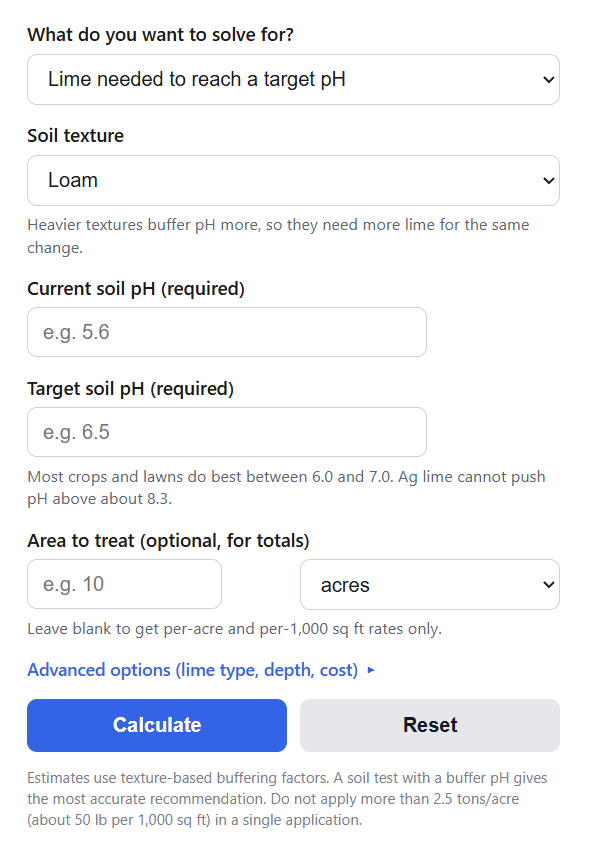
Calculate how much lime you need to raise soil pH to your target, based on soil texture, area, incorporation depth, and lime quality (CCE).
Lime Requirement Formula
LR = (pH_t - pH_c) * F * (D / 7)
AR = LR / (CCE / 100)
- LR is the lime requirement in tons of pure calcium carbonate per acre
- pH_t is the target soil pH
- pH_c is the current soil pH from your soil test
- F is the soil texture buffering factor in tons per acre per pH unit
- D is the incorporation depth in inches (7 inches is the standard tillage layer)
- AR is the actual product rate after adjusting for lime quality
- CCE is the calcium carbonate equivalent of your liming material in percent
The calculator’s default mode applies these two equations in sequence: it multiplies the pH deficit by the texture factor, scales the result for your incorporation depth, then divides by the CCE fraction so the answer reflects the actual bagged or bulk product you will spread. It also converts the rate to pounds per 1,000 square feet for lawns and kilograms per hectare for metric users, and multiplies by your area to get total tons, 40 lb bag counts, and cost.
The second mode works the formula in reverse. Enter a planned application rate and the calculator converts it to pure calcium carbonate, divides by the texture factor, and predicts the pH you will end up with:
pH_new = pH_c + (AR * (CCE / 100)) / (F * (D / 7))
The predicted pH is capped at 8.3 because carbonate lime stops dissolving near that point, so extra tonnage beyond the cap has no further effect on pH.
Texture Factors and Liming Material Strength
The texture factor F is the approximate amount of pure calcium carbonate needed to raise the pH of a 7 inch soil layer by one full unit. Fine-textured and high organic matter soils hold more reserve acidity, so they need more lime for the same change.
| Soil texture | F (tons/acre per pH unit) | Lime to go from pH 5.5 to 6.5 |
|---|---|---|
| Sand | 1.0 | 1.0 ton/acre |
| Sandy loam | 1.5 | 1.5 tons/acre |
| Loam | 2.0 | 2.0 tons/acre |
| Silt loam | 2.5 | 2.5 tons/acre |
| Clay loam | 3.0 | 3.0 tons/acre |
| Clay | 3.5 | 3.5 tons/acre |
| Organic / muck | 4.5 | 4.5 tons/acre |
Not all liming materials are equally strong. The calculator adjusts rates using the CCE from the product tag, and the table below shows typical values, including fast-acting materials and wood ash that most lime charts leave out. A CCE above 100 percent means the material neutralizes more acidity per pound than pure calcium carbonate, so you need less of it.
| Material | Typical CCE | Notes |
|---|---|---|
| Calcitic ag lime | 85 to 100% | Standard bulk lime; speed depends on grind fineness |
| Dolomitic lime | 95 to 108% | Also supplies magnesium; best where soil Mg is low |
| Pelletized lime | 95 to 100% | Finely ground lime in easy-spreading pellets; costs more per ton |
| Hydrated lime | 120 to 135% | Very fast acting; caustic, easy to overshoot pH |
| Burned lime (quicklime) | 150 to 179% | Strongest material; difficult to handle and spread evenly |
| Wood ash | 40 to 50% | Roughly half as strong as lime; also adds potassium |
Lime Requirement Example Problems
Example 1: A loam garden soil tests at pH 5.6 and you want to reach 6.5 with calcitic ag lime (CCE 90 percent) tilled 7 inches deep. The pH deficit is 0.9 units. LR = 0.9 x 2.0 x (7/7) = 1.8 tons of pure calcium carbonate per acre. Adjusting for lime quality, AR = 1.8 / 0.90 = 2.0 tons of product per acre, which is about 92 lb per 1,000 square feet. For a 10 acre field you would need 20 tons.
Example 2: You plan to spread 1.5 tons/acre of an 80 percent CCE lime on a sandy loam that tests at pH 5.8, incorporated 7 inches. The effective calcium carbonate is 1.5 x 0.80 = 1.2 tons/acre. The predicted pH rise is 1.2 / 1.5 = 0.8 units, so the soil should finish near pH 6.6.
Lime Requirement Frequently Asked Questions
How long does lime take to change soil pH? Most of the pH change from finely ground, incorporated lime develops within 3 to 6 months, and the full effect can take up to a year. Coarser lime and surface applications without tillage react more slowly because the carbonate must dissolve and move down through the profile. Test the soil again 6 to 12 months after applying before deciding whether a second application is needed.
Should I use calcitic or dolomitic lime? Both neutralize acidity at nearly the same rate per ton of CCE. Choose dolomitic lime when your soil test shows low magnesium, since it supplies magnesium carbonate along with calcium carbonate. If magnesium is already adequate or high, calcitic lime is the better choice because adding more magnesium can tighten soil structure on some clay soils.
Is there a maximum amount of lime I can apply at once? A common guideline is no more than 2.5 tons/acre, or about 50 lb per 1,000 square feet on lawns, in a single application. If the calculator recommends more, split the total into two passes 6 to 12 months apart and retest between them. Over-applying in one pass can spike surface pH, tie up micronutrients like iron, manganese, and zinc, and waste material that leaches or runs off before reacting.