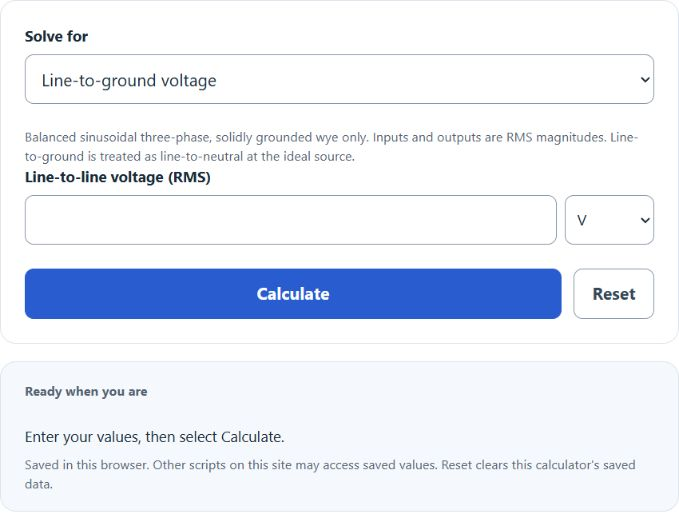
Calculate RMS line-to-line or line-to-ground voltage for an ideal balanced, solidly grounded-wye three-phase system in V, kV or MV. This is not a general ground-voltage conversion for delta, ungrounded, faulted or unbalanced systems.
- All Physics Calculators
- Electricity, Magnetism, & Electronics Unit Converters
- Line to Line Voltage Calculator
- Line to Phase Voltage Calculator
Line to Ground Voltage Formula
The following formula applies to an ideal balanced, solidly grounded-wye three-phase system using RMS magnitudes.
Variables:
- VL-G is the line to ground voltage
- VL-L is the line voltage (voltage between two phases)
For this grounded-wye model, divide the line-to-line RMS voltage by the square root of3 to calculate line-to-ground RMS voltage. Grounding and system configuration must be known; line-to-line voltage alone is insufficient in general.
| Line-to-Line Voltage VL-L (V) | Line-to-Ground Voltage VL-G (V) |
|---|---|
| 208 | 120.089 |
| 220 | 127.017 |
| 230 | 132.791 |
| 240 | 138.564 |
| 380 | 219.393 |
| 400 | 230.940 |
| 415 | 239.600 |
| 440 | 254.034 |
| 460 | 265.581 |
| 480 | 277.128 |
| 575 | 331.976 |
| 600 | 346.410 |
| 2300 | 1327.906 |
| 3300 | 1905.256 |
| 4160 | 2401.777 |
| 4800 | 2771.281 |
| 6600 | 3810.512 |
| 12470 | 7199.558 |
| 13800 | 7967.434 |
| 34500 | 19918.584 |
| * Rounded to 3 decimals. Balanced solidly grounded-wye RMS relation: VL-G = VL-L ÷ √3 and VL-L = √3 × VL-G. All values shown in volts (V). | |
What is Line to Ground Voltage?
Line-to-ground voltage is measured between a phase conductor and ground. At an ideal solidly grounded-wye source, it equals line-to-neutral voltage, which is line-to-line voltage divided by √3 for balanced sinusoidal phases. Delta and ungrounded systems have different ground-voltage behavior. This calculator does not assess wiring, faults or safe isolation.
How to Calculate Line to Ground Voltage?
The following steps outline how to calculate the Line to Ground Voltage.
- First, confirm a balanced, solidly grounded-wye system, then determine the RMS line-to-line voltage (VL-L) in volts.
- Next, use the formula VL-G = VL-L / √3.
- Finally, calculate the Line to Ground Voltage (VL-G).
- After inserting the variable and calculating the result, check your answer with the calculator above.
Example Problem :
Use the following variable as an example problem to test your knowledge.
line voltage (VL-L) = 400 volts