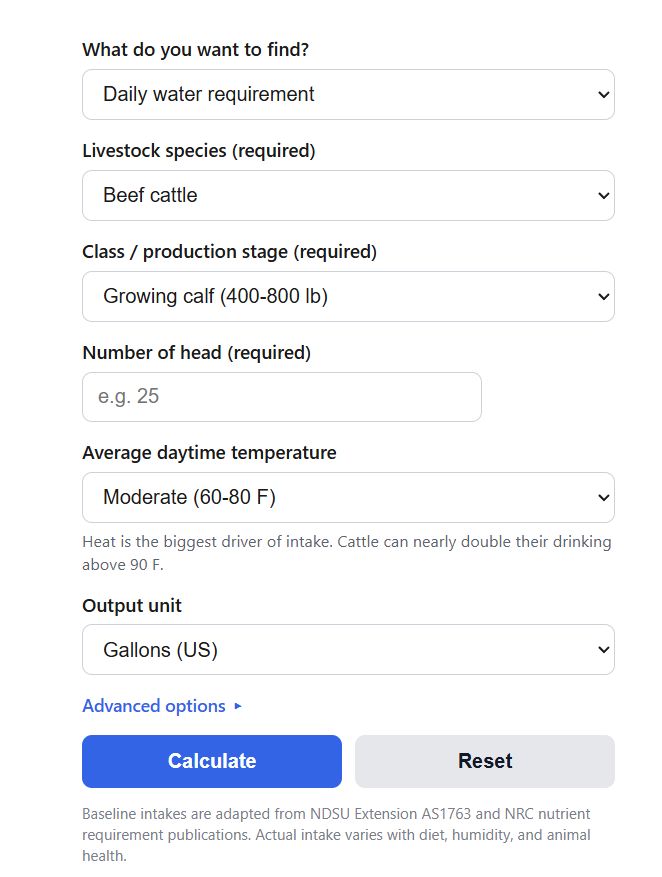
Calculate the daily water requirement for cattle, horses, sheep, goats, pigs, and poultry based on herd size, production stage, and temperature, plus storage tank size and how long a tank will last.
Livestock Water Requirement Formula
W = B * T * N
S = W * (1 + b/100) * d
R = C / (W * (1 + b/100))
- W is the total daily water requirement for the herd (gallons/day)
- B is the baseline intake for the species and production stage (gallons/head/day)
- T is the temperature factor (0.85 below 60 F, 1.0 at 60-80 F, 1.35 at 80-95 F, 1.75 above 95 F)
- N is the number of head
- S is the recommended storage size (gallons) for d days of reserve
- b is the waste and evaporation buffer (%)
- R is the number of days a tank of capacity C will last
The calculator uses these formulas in three modes. The daily requirement mode multiplies the baseline intake for your species and production stage by the temperature factor and herd size to give per head, daily, weekly, and 30 day totals. The storage size mode extends the daily total by your chosen days of reserve plus a buffer for spillage and evaporation. The tank duration mode inverts the calculation to tell you how long an existing tank or trough will keep the herd supplied.
Daily Water Intake by Species and Temperature
The baseline intakes below are adapted from NDSU Extension publication AS1763 and NRC nutrient requirement tables. They assume moderate weather around 60 to 80 F.
| Species and class | Gallons per head per day |
|---|---|
| Beef, growing calf (400-800 lb) | 5.3-9.2 |
| Beef, lactating cow | 14.5-17.9 |
| Dairy, milking cow (50-100 lb milk) | 23-41 |
| Horse, mature | 8-13 |
| Sheep, lactating ewe | 2-3 |
| Goat, lactating doe | 2-4 |
| Pig, finishing (100-250 lb) | 2-3 |
| Pig, lactating sow | 5-8 |
| Laying hen (per bird) | 0.06-0.09 |
Temperature is the single biggest driver of drinking water demand. The table below shows NRC estimated intake for beef cattle at increasing air temperatures, which is where the calculator’s temperature factors come from. Size your storage and pumping capacity for the hottest week of your year, not the annual average.
| Air temperature | Growing 600 lb | Finishing 1,000 lb | Lactating cow |
|---|---|---|---|
| 40 F | 5.3 gal | 8.7 gal | 11.4 gal |
| 60 F | 6.6 gal | 10.8 gal | 14.5 gal |
| 70 F | 7.8 gal | 12.6 gal | 16.9 gal |
| 90 F | 12.7 gal | 20.6 gal | 16.2 gal |
Example Problems
Example 1: You run 25 lactating beef cows with calves at side and the forecast calls for 85 F afternoons. The baseline intake for a lactating cow is 16.9 gallons per day. At 80 to 95 F the temperature factor is 1.35, so each cow needs 16.9 * 1.35 = 22.82 gallons per day. For the herd, 22.82 * 25 = 570.4 gallons per day, or about 3,993 gallons per week. With a 10% buffer for spillage and evaporation, plan on roughly 627 gallons per day.
Example 2: You have 100 feeder lambs on pasture in moderate weather with a 1,000 gallon water tank. Each lamb drinks about 1.3 gallons per day, so the flock needs 130 gallons per day, or 143 gallons per day with a 10% buffer. The tank will last 1,000 / 143 = about 7 days, so a weekly refill schedule is cutting it close and leaves no margin for a heat wave.
FAQ
How much does hot weather increase livestock water needs? A lot more than most storage plans assume. NRC data shows a 600 lb growing steer moving from 6.6 gallons per day at 60 F to 12.7 gallons at 90 F, nearly double. Poultry intake can also double above 90 F. If your water system is sized on average annual demand, it can fail exactly when animals are under the most heat stress, so always check the hot weather number before summer.
How do I calculate water for a mixed herd? Run the calculator once per species and add the daily totals together. For example, 20 beef cows at 16.9 gallons and 5 horses at 8.2 gallons in moderate weather gives 338 + 41 = 379 gallons per day. When sizing shared storage, apply the days of reserve and buffer to the combined total rather than to each group separately.
Do animals on pasture need the full calculated amount? Not always. Lush green forage can be 60 to 80% water, so animals grazing spring pasture often drink noticeably less than the table values, while animals on dry hay or grain drink at the high end. Treat the calculated value as the supply you must be able to deliver, then expect actual consumption to swing with the season, the feed, and lactation status.