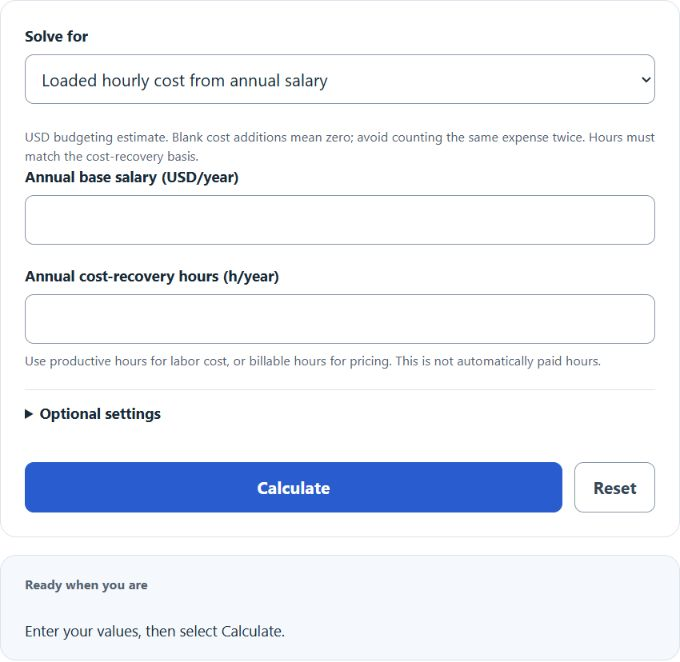
Calculate loaded hourly labor cost, a margin-based billable rate, or affordable salary from payroll burden, benefits, overhead, and productive hours.
Loaded Labor Rate Formula
The following formula is used to calculate the loaded labor rate.
Variables:
- LLR is the loaded labor rate ($ per hour)
- BP is base pay (USD/hour); p is employer payroll burden as a percentage of base pay (blank means 0%).
- B is the benefits ($ per hour)
- O is the overhead ($ per hour)
In the hourly-components mode, add base pay, employer payroll burden, benefits and allocated overhead on the same hourly basis. The annual-salary modes divide the entered annual total by your productive or billable cost-recovery hours. Do not double-count expenses. Billable pricing uses cost ÷ (1 − target margin); margin is a share of revenue, not a markup on cost. All monetary inputs use USD without currency conversion.
What is a Loaded Labor Rate?
The loaded labor rate is the total hourly cost to employ a worker, including base salary, benefits, and overhead. This rate is often used in project costing and budgeting to estimate the true cost of labor. It provides a more accurate picture of employment costs than just the hourly wage or salary.
How to Calculate Loaded Labor Rate?
The following steps outline how to calculate the Loaded Labor Rate.
- First, determine the base pay (BP) of the employee in dollars per hour.
- Next, determine the hourly cost of benefits (B) for the employee.
- Next, determine the hourly overhead cost (O) associated with the employee.
- Use LLR = BP × (1 + p/100) + B + O; the example below uses p = 0% and totals $40.00/hour.
- Finally, calculate the Loaded Labor Rate (LLR) in dollars per hour.
- After inserting the variables and calculating the result, check your answer with the calculator above.
Example Problem :
Use the following variables as an example problem to test your knowledge.
Base Pay (BP) = $25.00 per hour
Benefits (B) = $5.00 per hour
Overhead (O) = $10.00 per hour