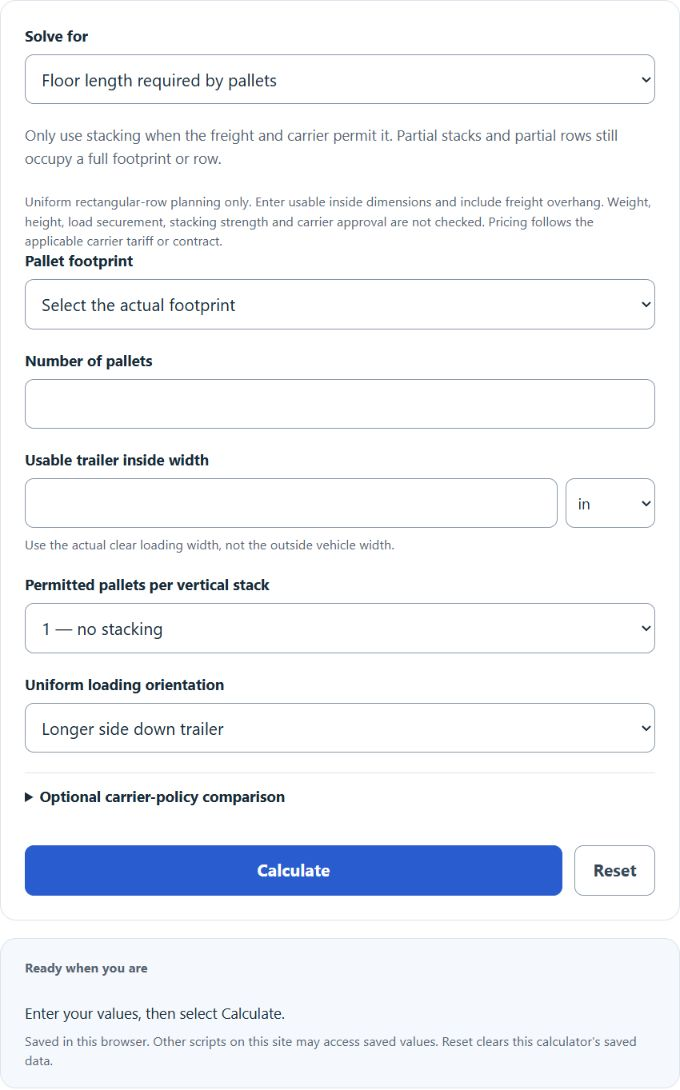
Estimate occupied trailer floor length or uniform-row pallet capacity from actual usable dimensions and permitted stacking. Optionally compare a supplied carrier policy; physical floor length does not by itself determine billable length or freight charges.
LTL Linear Feet Formula
Linear feet measure how much trailer floor length your freight uses. Standard pallets load two across a dry van, so the calculator counts rows of pallets and multiplies by the length of the side that runs down the trailer:
LF = ceil(ceil(P / H) / R) * L / 12
Pallets that fit across the trailer come from the trailer width and the shorter pallet side:
R = floor(W / S)
When you know the space and want to fill it, the calculator turns the formula around to return a pallet count:
P = floor(LF * 12 / L) * R * H
Variables:
- LF is the linear feet of trailer floor the shipment occupies
- P is the number of pallets in the shipment
- R is how many pallets fit side by side in one row
- L is the pallet length loaded down the trailer, in inches (the longer side)
- S is the shorter pallet side that sits across the trailer, in inches
- W is the actual usable inside trailer width, in inches; outside vehicle width is not cargo clearance
- H is the stack height, meaning how many pallets are stacked on top of each other
- 12 converts inches of trailer length into feet
For a 48 by 40 inch pallet loaded 48 inches down the trailer, two fit across when actual usable width is at least 80 inches before needed clearances. Each row then uses 4 linear feet. Stacking reduces physical footprints only when the freight, height, weight, securement and carrier permit it; tariffs may count every handling unit as floor-loaded regardless of stackability.
Some carrier tariffs impose capacity-load or linear-foot minimums. Trigger lengths, loading assumptions, rounding, rates and exclusions vary by carrier, geography and contract. The example below assumes 1,000 lb per policy foot; it is not a universal LTL rule.
Deemed Weight = LF * 1000
When a specific tariff uses this model, the greater of actual weight and modeled deemed weight may form part of its minimum-charge calculation. Other conditions and rates still apply; confirm the current tariff or obtain a quote.
Linear Feet and the Linear Foot Rule by the Numbers
This table shows physical floor length for 48 by 40 inch pallets, two across in uniform rows, single or double stacked when permitted. Whole-foot planning displays are rounded upward; carrier billing rules must be checked separately.
| Pallets | Rows (2 across) | Single stack | Double stacked |
|---|---|---|---|
| 2 | 1 | 4 ft | 4 ft |
| 4 | 2 | 8 ft | 4 ft |
| 6 | 3 | 12 ft | 8 ft |
| 8 | 4 | 16 ft | 8 ft |
| 10 | 5 | 20 ft | 12 ft |
| 12 | 6 | 24 ft | 12 ft |
| 14 | 7 | 28 ft | 16 ft |
The second table illustrates only an assumed 1,000 lb per policy-foot model. These values are arithmetic examples and do not establish a carrier’s trigger, billable floor length, eligibility or final charge.
| Linear feet occupied | Deemed weight (1,000 lb/ft) | Share of a 53 ft trailer |
|---|---|---|
| 10 ft | 10,000 lb | 19% |
| 12 ft | 12,000 lb | 23% |
| 16 ft | 16,000 lb | 30% |
| 20 ft | 20,000 lb | 38% |
| 24 ft | 24,000 lb | 45% |
| 28 ft | 28,000 lb | 53% |
Example Problems
Example 1: Find the linear feet for a pallet shipment.
Ten non-stackable 48 by 40 inch pallets loaded two across occupy five rows. Each row is 48 inches deep, so 5 × 48 / 12 = 20 linear feet. If a specific applicable policy triggers at 10 feet and uses 1,000 lb per foot on that basis, modeled deemed weight is 20,000 lb. This conditional example is not a carrier quote.
Example 2: Find how many pallets fit a set space.
A broker offers you 24 linear feet of partial truckload space. That is 24 times 12, or 288 inches of trailer length. Each 48 inch row uses 288 divided by 48, or 6 rows, and each row holds 2 pallets, so 12 pallets fit on the floor. If the freight double stacks, the same 24 feet holds 24 pallets.
Frequently Asked Questions
How do you calculate linear feet for LTL freight?
Count your pallets, divide by how many fit across the trailer (two for standard 48 by 40 inch pallets), and round up to a whole number of rows. Multiply the rows by the pallet length that runs down the trailer, usually 48 inches, then divide by 12 to convert to feet. Ten pallets give five rows, which is 240 inches, or 20 linear feet. If the freight can be safely stacked, divide the floor pallet count by the stack height first.
What is the linear foot rule and when does it apply?
A carrier may apply a capacity-load or linear-foot minimum when a shipment meets its tariff conditions. There is no universal trigger or pounds-per-foot factor. For example, FedEx’s published U.S. and Intra-Canada capacity rules differ, and some rules count freight as floor-loaded even if stackable. Use the current applicable tariff or contract, including loading orientation, rounding and exceptions.
How many pallets fit in a 53-foot trailer?
In an ideal 53-foot usable length, 48 by 40 inch pallets loaded two across in 13 complete 4-foot rows give 26 floor positions, assuming sufficient usable width. Permitted double stacking would give 52 pallets geometrically. Actual inside length, clearances, overhang, height, weight, securement and mixed loading can change capacity; this calculator compares only uniform orientations.