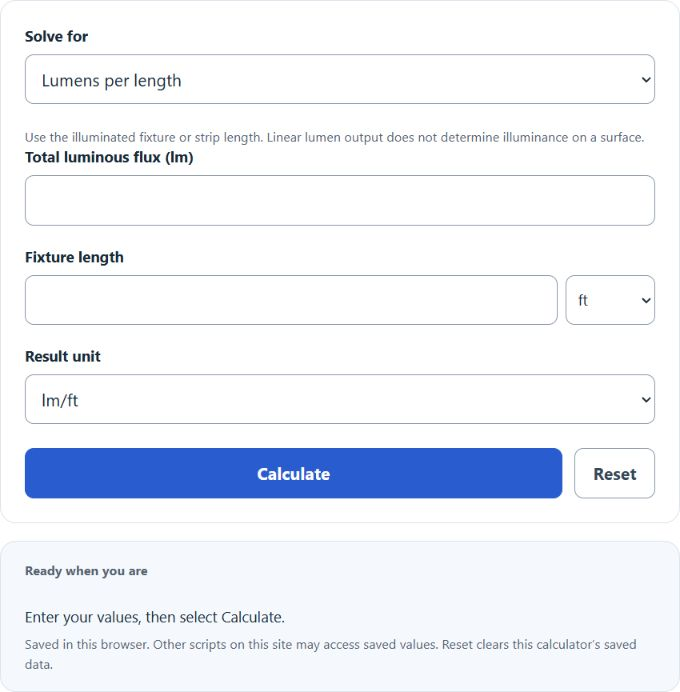
Choose total lumens, fixture length, or lumens per length and enter the two required values. Convert between ft or m and lm/ft or lm/m.
Lumens Per Foot Formula
Lumens per foot (lm/ft) measures how much light output is distributed across each foot of a linear light source. It is especially useful for LED strips, linear fixtures, under-cabinet lights, cove lighting, display runs, and any installation where brightness is spread across a length instead of coming from a single lamp.
In this formula:
- LPF = lumens per foot
- TL = total lumens produced by the light source
- L = total fixture or strip length in feet
If you need to solve for a different value, the equation can be rearranged as follows:
How to Use the Calculator
- Enter the total lumens of the fixture, strip, or lighting run.
- Enter the installed length of that light source in feet or meters.
- Choose your output unit; the calculator converts mixed input units:
- Feet for lm/ft
- Meters for lm/m
- The calculator divides total light output by total length to determine the linear brightness.
Unit Conversions
If you need to compare metric and imperial product specs, convert the linear output carefully:
This matters because some manufacturers list LED strips in lumens per meter, while others list them in lumens per foot.
Example
If a lighting run produces 1,200 lumens across a total length of 10 feet, then:
Expressed in metric units, that same linear output would be:
What the Result Tells You
- Higher lm/ft means more light is packed into each foot of fixture length.
- Lower lm/ft may still be desirable for accent lighting, indirect lighting, and low-glare installations.
- lm/ft is a source-output metric, not a room-brightness metric. It tells you how bright the fixture run is, not how much light reaches a desk, floor, or wall.
- Two products with the same lm/ft can still appear different due to diffuser type, beam spread, mounting height, color temperature, or CRI.
Common Use Cases
| Application | Why Lumens per Foot Matters |
|---|---|
| Under-cabinet lighting | Helps compare strip options for task visibility across a countertop run. |
| Cove and indirect lighting | Shows how much output is available per foot for ceiling wash or ambient glow. |
| Shelving and displays | Makes it easier to match brightness across multiple shelves or display bays. |
| Workshop or utility lighting | Useful for estimating whether a linear fixture provides enough output across the full span. |
| Architectural linear fixtures | Allows side-by-side comparison of products with different lengths and total lumen ratings. |
Reverse Planning
If you know the target brightness per foot and the length of the run, you can estimate the total lumens needed before selecting a fixture:
For example, if you want 250 lm/ft across a 16 ft run, the required total output is:
Common Mistakes to Avoid
- Using room length instead of fixture length. The formula should use the actual illuminated run, not the size of the room.
- Entering per-foot output as total lumens. If a strip is rated at 400 lm/ft and is 12 ft long, total lumens are found by multiplying the two values.
- Mixing feet and meters. Convert mixed length and linear-output units before multiplying; this calculator performs that conversion.
- Ignoring dimming or installation losses. Real-world brightness may be lower when fixtures are dimmed, diffused, recessed, or powered below maximum output.
Lumens per Foot vs. Other Lighting Metrics
- Lumens (lm): total light output of the entire fixture or lamp.
- Lumens per foot (lm/ft): light output distributed along each foot of fixture length.
- Lux or foot-candles: light arriving on a surface, which depends on distance, aiming, spacing, and reflection.
- Lumens per watt (lm/W): efficiency, not linear brightness.
Use this calculator when you need to compare linear lighting products, size a lighting run, or convert a total lumen rating into a more useful per-foot value for design and planning.