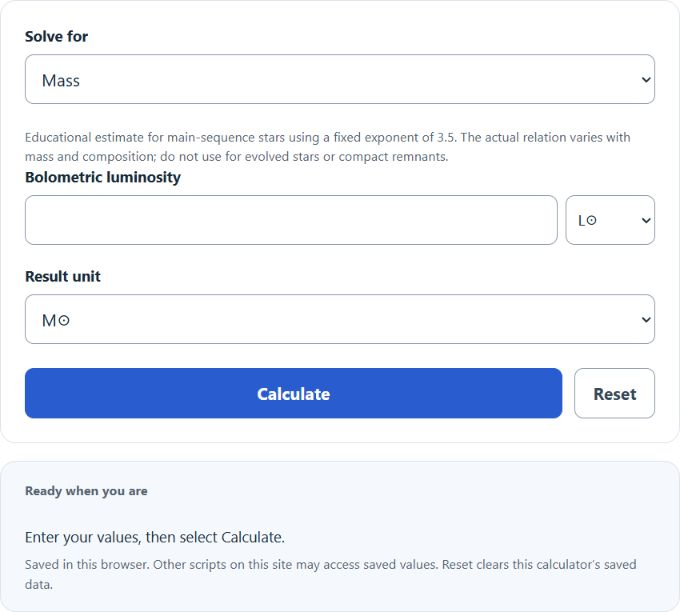
Estimate main-sequence stellar luminosity or mass using a fixed 3.5-power approximation, with solar, watts, kg, and lb units.
Related Calculators
- Equilibrium Temperature Calculator
- Wavelength Color Calculator
- Tidal Force Calculator
- Visual Angle Calculator
- All Physics Calculators
Luminosity To Mass Formula
The calculator uses an approximate main-sequence mass-luminosity relation with a fixed exponent of 3.5. The exponent varies with stellar mass and composition; luminosity and mass in this formula are expressed relative to the Sun.
- L = luminosity in solar luminosities, L☉
- M = mass in solar masses, M☉
- L☉ = luminosity of the Sun
- M☉ = mass of the Sun
Choose the quantity to solve. Mass in solar masses is raised to the power of 3.5 to estimate luminosity; luminosity in solar luminosities is raised to the power of 1/3.5 to estimate mass.
For unit handling, the calculator converts the entered value to solar units before applying the formula. It uses nominal 1 L☉ = 3.828 × 1026 W, approximately 1 M☉ = 1.9885 × 1030 kg, and exactly 1 lb = 0.45359237 kg.
Solar Unit Conversions Used
| Quantity | Solar unit | Equivalent value |
|---|---|---|
| Luminosity | 1 L☉ | 3.828 × 1026 W |
| Mass | 1 M☉ | 1.9885 × 1030 kg |
| Mass | 1 M☉ | approximately 4.3839 × 1030 lb |
Approximate Main-Sequence Luminosity by Mass
| Mass | Estimated luminosity using L = M3.5 | Meaning |
|---|---|---|
| 0.5 M☉ | 0.0884 L☉ | Much dimmer than the Sun |
| 1 M☉ | 1 L☉ | Same as the Sun |
| 2 M☉ | 11.3137 L☉ | Far brighter than the Sun |
| 5 M☉ | 279.5085 L☉ | Very luminous main-sequence star |
Example Problems
Example 1: Find luminosity from mass
Suppose a main-sequence star has a mass of 2 M☉.
The estimated luminosity is 11.3137 L☉.
Example 2: Find mass from luminosity
Suppose a star has a luminosity of 100 L☉.
The estimated mass is 3.7276 M☉.
FAQ
What type of star does this luminosity to mass formula apply to?
This formula is an approximation for main-sequence stars. It is not reliable for white dwarfs, neutron stars, red giants, supergiants, or stars that are not in the main-sequence stage.
Why does a small mass change make such a large luminosity change?
Luminosity scales with mass to the power of 3.5 in this model. That means a star with twice the Sun’s mass is not twice as luminous. It is about 11.3 times as luminous. Massive stars burn fuel much faster and produce much more light.
Why are solar units used?
Solar units make the formula simple. When mass is measured in M☉ and luminosity is measured in L☉, the Sun has M = 1 and L = 1, so the relation becomes L = M3.5 without additional constants.