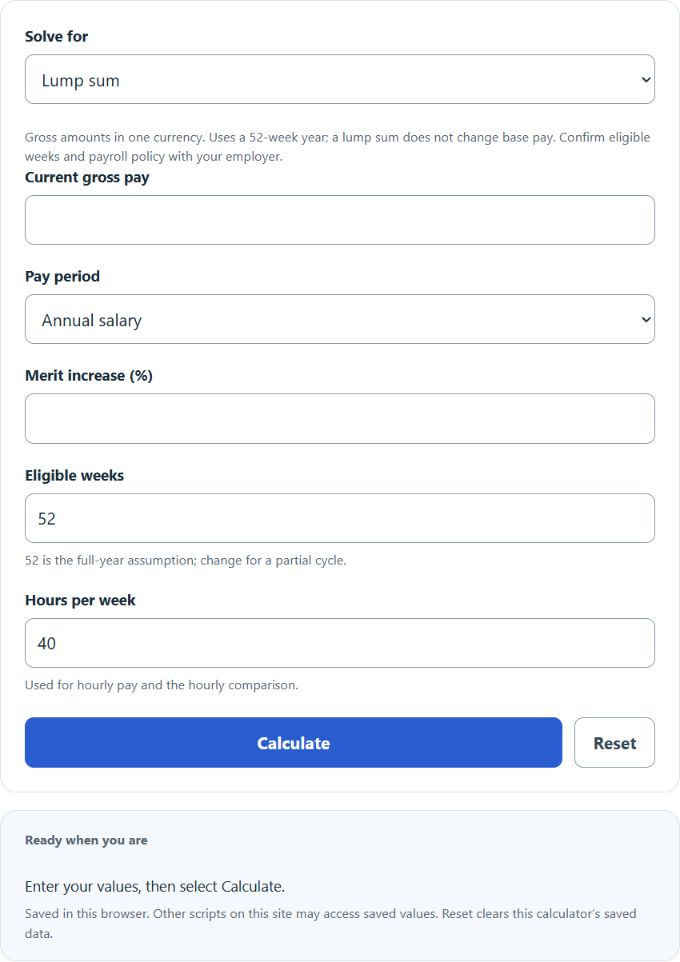
Calculate lump-sum merit increases from current pay, merit percentage, eligible weeks and hours per week, or find the merit increase percentage.
Lump Sum Merit Increase Formula
A lump sum merit increase pays the value of a raise as a one-time amount instead of adding it to base pay. The calculator uses two formulas depending on the quantity you choose to solve.
Lump sum mode (you know the merit percentage):
Find merit percentage mode (you know the lump sum dollar amount):
- Lump Sum: the one-time payout, in dollars.
- Weekly Pay: your current pay converted to a weekly rate. Hourly inputs use hourly × hours per week. Annual inputs divide by 52.
- Eligible Weeks: the number of weeks the merit covers. This calculator assumes 52 weeks for a full year; employer eligibility rules may differ.
- Merit %: the equivalent annual raise rate the lump sum represents.
The Lump sum mode takes your current pay, merit percent, and eligible weeks and returns the payout plus the annualized, monthly, and weekly equivalents. The Merit percentage mode works backward from a known dollar amount to tell you what percent raise that payout reflects. Both modes also build a pay-period breakdown so you can see what the same merit would look like added to base pay.
Reference Tables
These illustrative percentages show arithmetic examples, not performance ratings or recommended awards.
| Merit % | Interpretation | Lump on $65,000 (52 wks) |
|---|---|---|
| 1.0% | Illustrative 1% award | $650 |
| 2.0% | Illustrative 2% award | $1,300 |
| 3.0% | Illustrative 3% award | $1,950 |
| 4.0% | Illustrative 4% award | $2,600 |
| 5.0%+ | Illustrative 5% or higher award | $3,250+ |
Eligible weeks change the payout when a merit cycle is shorter than a year, such as a partial-year hire or a delayed effective date.
| Reason for partial cycle | Illustrative eligible weeks |
|---|---|
| Full annual cycle | 52 |
| Hired mid-year (6 months in) | 26 |
| Hired in last quarter | 13 |
| Promotion or off-cycle award (3 months) | 13 |
| Leave-adjusted partial year | Pro-rated by weeks worked |
Examples and FAQ
Example 1. You earn $65,000 per year and your manager approves a 3% lump sum merit for a full 52-week cycle. Weekly pay is $65,000 ÷ 52 = $1,250. Lump sum = $1,250 × 52 × 0.03 = $1,950.
Example 2. You were hired 26 weeks ago at $30/hour, 40 hours per week, and HR is paying a 4% prorated merit. Weekly pay is $30 × 40 = $1,200. Lump sum = $1,200 × 26 × 0.04 = $1,248.
Why pay a lump sum instead of raising base pay? Employers use lump sums when an employee is at the top of a salary range, when the budget cannot absorb a permanent base increase, or when performance does not justify a long-term raise. The employee gets cash now but their base, and future raises calculated from that base, do not change.
Is a lump sum merit taxed differently than a raise? In the United States, a lump sum generally remains wage income. Employers may use supplemental-wage withholding methods; withholding is not the final tax liability. Rates and methods depend on the payment and applicable rules. See IRS Publication 15. This calculator reports gross amounts and does not estimate tax.
Why does a lump sum cost less long-term than the same percent base raise? A 3% base raise compounds. Future raises and salary-linked benefits may use the higher base, depending on the employer’s plan. A lump sum pays once and resets.
What does “eligible weeks” mean on my offer letter? It is the number of weeks of pay the merit applies to. This calculator models a full year as 52 weeks. If your effective date covers only part of the cycle, HR pro-rates by the weeks you were eligible.