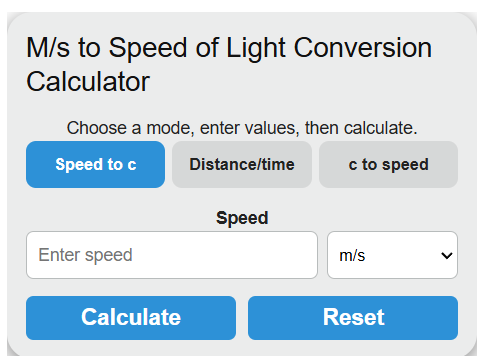
Convert speed in m/s, km/s, mph, knots or from distance and time into fractions of light speed, and back to regular units for quick reference.
M/s to Speed of Light Formula
- fraction_of_c = the speed expressed as a multiple of the speed of light (c)
- v = the speed in meters per second (m/s)
- c = 299,792,458 m/s, the speed of light in vacuum
To get a percentage of c, multiply the fraction by 100. To go the other direction, multiply the c amount by 299,792,458 to get m/s.
Distance and time mode uses v = d / t first, converting d to meters and t to seconds, then applies the same formula above.
The value of c used here is exact by definition of the meter. The formula assumes motion in vacuum and ignores relativistic effects on the moving object itself; it is a unit conversion, not a relativity calculation.
The three calculator modes map to the formulas like this:
- Speed to c: converts your input speed to m/s, then divides by c.
- Distance/time: computes v = d / t in m/s, then divides by c.
- c to speed: takes a c value (or % of c), multiplies by 299,792,458, then converts to your chosen unit.
Reference Tables
Use these to sanity check a result or to estimate a fraction of c without running the numbers.
| Speed | m/s | Fraction of c |
|---|---|---|
| Walking (1.4 m/s) | 1.4 | 4.67e-9 |
| Highway (30 m/s) | 30 | 1.00e-7 |
| Speed of sound (343 m/s) | 343 | 1.14e-6 |
| Airliner (250 m/s) | 250 | 8.34e-7 |
| ISS orbital (7,660 m/s) | 7,660 | 2.56e-5 |
| Earth around Sun (29,780 m/s) | 29,780 | 9.93e-5 |
| Voyager 1 (17,000 m/s) | 17,000 | 5.67e-5 |
| Parker Solar Probe peak (~192,000 m/s) | 192,000 | 6.40e-4 |
| Fraction of c | m/s | km/h |
|---|---|---|
| 0.0001 c | 29,979 | 107,925 |
| 0.001 c | 299,792 | 1,079,252 |
| 0.01 c | 2,997,925 | 10,792,529 |
| 0.1 c | 29,979,246 | 107,925,285 |
| 0.5 c | 149,896,229 | 539,626,425 |
| 1 c | 299,792,458 | 1,079,252,849 |
Example Problems and FAQ
Example 1. A particle moves at 15,000,000 m/s. Divide by c: 15,000,000 / 299,792,458 = 0.05003 c, or about 5% of light speed.
Example 2. A probe covers 600,000 km in 30 seconds. Convert to m/s: 600,000,000 / 30 = 20,000,000 m/s. Then 20,000,000 / 299,792,458 = 0.0667 c.
Example 3. You want 0.25 c in m/s. Multiply: 0.25 × 299,792,458 = 74,948,114.5 m/s.
Why 299,792,458 m/s exactly? Since 1983 the meter has been defined from the speed of light, so c is fixed at this value by definition rather than measured.
Can a normal object exceed c? No. Anything with mass requires infinite energy to reach c, so the calculator will flag results at or above 1 c as physically unreachable for massive objects.
Does this account for time dilation? No. The result is a unit conversion of speed only. Relativistic effects like length contraction and time dilation need separate Lorentz factor calculations.
Is c the same in air or glass? Light slows in a medium, but the constant c refers to vacuum. Use the vacuum value here unless a problem specifically asks for phase velocity in a material.
How do I convert mph to a fraction of c? Convert mph to m/s by multiplying by 0.44704, then divide by 299,792,458. The mph option in the Speed to c tab does this for you.