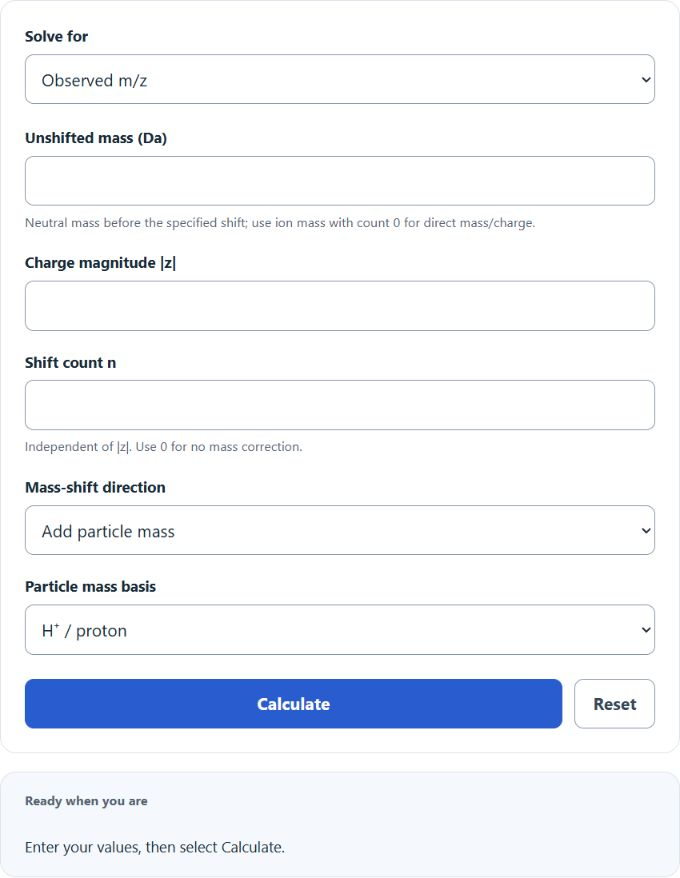
Calculate m/z or neutral mass using charge, signed adduct shifts, stoichiometry, custom particle mass, approximate isotope spacing, and a charge ladder.
Related Calculators
- mg/mL To mol/L Calculator
- Density To Molarity Calculator
- mol/dm3 To g/dm3 Calculator
- Relative Retention Time (RRT) Calculator
- All Chemistry Calculators
M/Z Value Formula
For an ion mass already including its charge-related mass changes, use the following numerical ratio. The calculator also supports a specified signed shift from an unshifted mass.
Variables:
- M is the mass of the ion (daltons, Da)
- |Z| is the positive magnitude of the ion charge in elementary-charge units
To calculate the m/z value, divide the ion mass in Da by the positive charge magnitude. For the calculator’s direct ion-mass example, select shift count 0; otherwise it applies m/z = (M + n × Δ) / |Z|.
What is an M/Z Value?
The m/z value is a dimensionless quantity that represents the mass-to-charge ratio of an ion. It is a fundamental parameter in mass spectrometry, which is a technique used to measure the masses of particles, the elemental composition of a sample, and the chemical structures of molecules. The m/z value helps in identifying and quantifying molecules in a sample.
How to Calculate M/Z Value?
The following steps outline how to calculate the m/z value.
- First, determine the mass of the ion (M) in daltons (Da).
- Next, determine the positive charge magnitude |Z| in elementary-charge units.
- Next, gather the formula from above: m/z = M / |Z|.
- Finally, calculate the m/z value.
- After inserting the variables and calculating the result, check your answer with the calculator above.
Example Problem :
Use the following variables as an example problem to test your knowledge.
Mass of the ion (M) = 196 Da
Charge magnitude |Z| = 2; with ion mass 196 Da and shift count 0, m/z = 196 / 2 = 98.