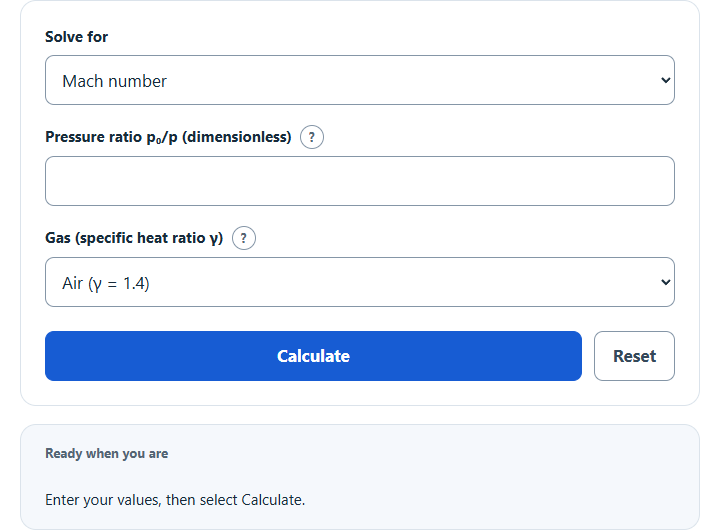
Calculate Mach number from the total-to-static pressure ratio p₀/p, or the pressure ratio from Mach number, for air (γ = 1.4) or any specific heat ratio.
Mach Number Pressure Ratio Formula
The following formula is used to calculate the pressure ratio for a given Mach number and specific heat ratio.
Variables:
- PR is the total (stagnation) to static absolute pressure ratio p₀/p (at least 1)
- γ (gamma) is the specific heat ratio cp/cv (greater than 1)
- M is the nonnegative Mach number
To calculate the pressure ratio, use the formula above, which involves the specific heat ratio and the Mach number.
What is Mach Number Pressure Ratio?
The Mach number pressure ratio is a dimensionless quantity used in fluid dynamics and aerodynamics to describe the ratio of total (stagnation) pressure to static pressure at the same flow condition under isentropic deceleration. It is particularly useful in the study of compressible flows, such as those encountered in high-speed aircraft and rocket engines. The Mach number itself is a measure of the speed of an object moving through a fluid, expressed as a ratio of the object’s speed to the speed of sound in that fluid. The specific heat ratio, also known as the adiabatic index, is a property of the fluid that affects how pressure and temperature change during compression and expansion processes.
How to Calculate Mach Number Pressure Ratio?
The following steps outline how to calculate the Mach number pressure ratio.
- Select the pressure-ratio solve mode and determine the Mach number (M ≥ 0).
- Next, determine the specific heat ratio (γ).
- Next, calculate the pressure ratio using the formula PR = (1 + ((γ – 1) / 2) * M²)^(γ / (γ – 1)).
- Finally, calculate the Mach number pressure ratio.
- After inserting the values and calculating the result, check your answer with the calculator above.
Example Problem :
Use the following variables as an example problem to test your knowledge.
Mach number (M) = 2
Specific heat ratio (γ) = 1.4