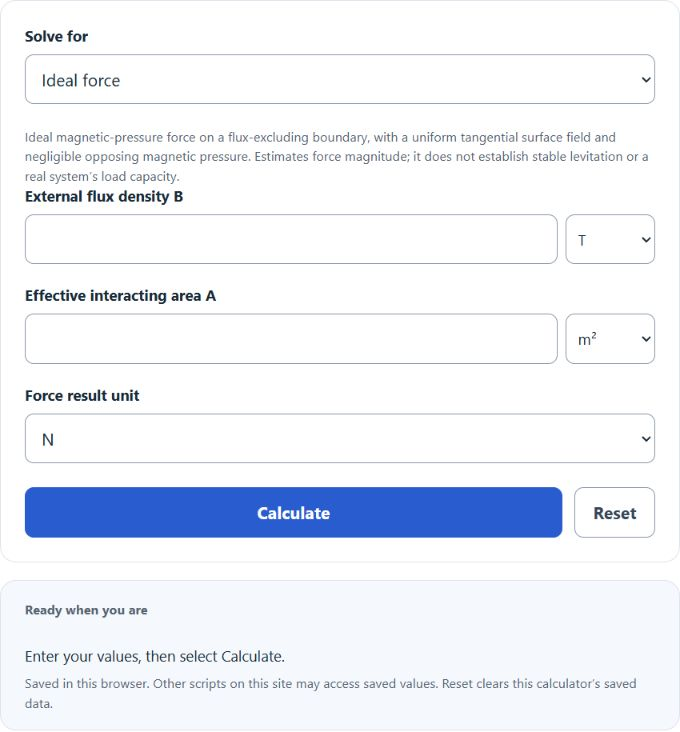
Select ideal magnetic-pressure force, external flux density, or effective area as the missing value, then enter the other two with units.
Understanding the Magnetic Levitation Force Calculator
This calculator estimates magnetic levitation force using an idealized magnetic-pressure model. It is best used for quick theoretical checks when the external magnetic field is approximately uniform and tangent to an ideal flux-excluding boundary across a known effective area; the pressure force acts normal to that surface, away from the field-filled region, with negligible opposing magnetic pressure. Use the actual field immediately outside the loaded surface, including distortion by the body. It is not a universal maglev design equation, because many real levitation systems depend on field gradients, coil geometry, air gaps, control stability, and material-specific behavior.
Magnetic Levitation Force Formula
| Symbol | Meaning | Common Unit |
|---|---|---|
| F | Magnetic levitation force | newton (N) |
| B | Magnetic flux density / magnetic field | tesla (T) |
| A | Effective area exposed to the field | square meter (m²) |
| μ0 | Permeability of free space | H/m |
The formula shows two important relationships:
- Force increases linearly with area.
- Force increases with the square of the magnetic field, so field strength has the largest effect.
How to Use the Calculator
- Enter the magnetic field value in tesla or gauss.
- Enter the effective area in m², ft², or cm².
- Select the missing value, enter the two known quantities and units, then click Calculate.
- Compare the result to the weight of the object you want to support.
For static force balance in this ideal model, the upward magnetic force must equal the downward weight. Stability requires a separate analysis.
If the calculated magnetic force is less than the object’s weight, levitation is not possible under this simplified model. If it is greater, levitation may be possible in principle, but a real system still needs stability, guidance, and thermal control.
Unit Conversions You May Need
Example
Suppose the magnetic field is 4.5 T and the effective area is 2.5 m².
To express that same force as an equivalent supported mass under Earth gravity:
This very large result highlights why the calculator should be interpreted as an idealized estimate. High fields spread over large areas can produce enormous theoretical forces on paper, but practical systems are limited by magnet design, materials, structure, cooling, and control requirements.
Key Assumptions and Limits
- The magnetic field is treated as roughly uniform over the full area.
- The area entered should be the effective area actually interacting with the field, not just the total physical size of the object.
- The model does not include edge effects, leakage flux, or fringing.
- The model does not account for coil current limits, core saturation, heating, or mechanical constraints.
- It does not predict whether levitation will be stable; it only estimates force magnitude.
- Real maglev systems often rely on feedback control or field-gradient effects not represented here.
Common Input Mistakes
- Mixing tesla and gauss: 5,000 G is 0.5 T, not 5,000 T.
- Using the wrong area: only the area effectively exposed to the relevant field should be entered.
- Assuming force alone guarantees levitation: balance is only one part of the problem; stability matters just as much.
- Ignoring scale effects: doubling field strength increases force by four times, which can make input errors dramatically change the result.
Frequently Asked Questions
Is this calculator valid for every maglev setup?
No. It is most appropriate for idealized magnetic-pressure situations. Electromagnetic suspension, electrodynamic suspension, and superconducting levitation systems can require more detailed force models.
Why does the force increase so quickly when I raise the magnetic field?
Because force depends on the square of the magnetic field. Small increases in field strength create much larger changes in predicted force than similar percentage changes in area.
What area should I enter?
Use the portion of the surface that is effectively exposed to the magnetic field producing the levitation force. If only part of the object sits inside the active field region, only that portion should be used.
Can I use the result to size a real levitation system?
It is useful for screening and back-of-the-envelope analysis, but real design work needs electromagnetic modeling, thermal limits, structural checks, and stability analysis.