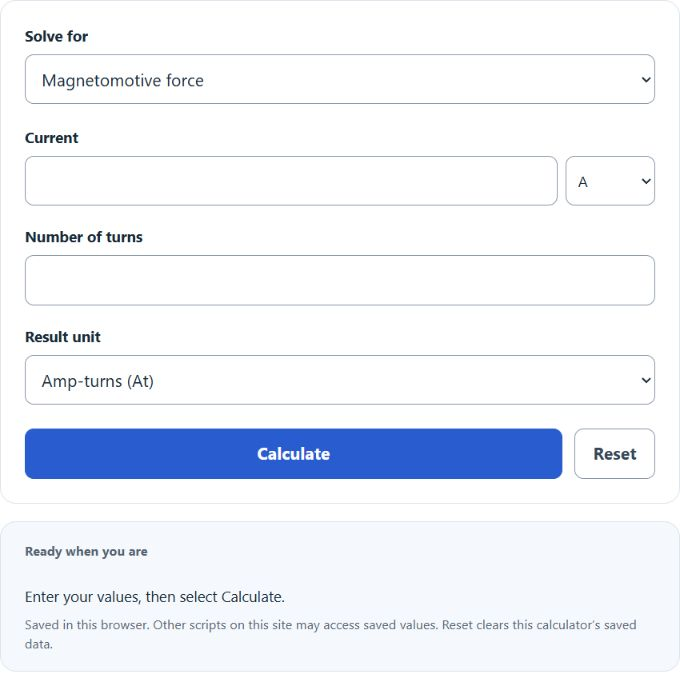
Choose magnetomotive force, current, or number of turns, enter the two known values, and select Calculate. Current and magnetomotive-force units convert when changed.
Magnetomotive Force Formula
The magnetomotive force calculator uses the relationship between current, coil turns, and magnetomotive force:
To solve for current:
To solve for number of turns:
- MMF = magnetomotive force, measured in amp-turns (At)
- I = current through the coil, measured in amps (A)
- N = number of turns in the coil
If you enter current and number of turns, the calculator finds magnetomotive force by multiplying them. If you enter magnetomotive force and turns, it divides by turns to find current. If you enter magnetomotive force and current, it divides by current to find the number of turns.
The calculator also converts current units between A, kA, and mA, and converts magnetomotive force units between At, kAt, and mAt before applying the formula.
Current and Magnetomotive Force Unit Conversions
Use these conversions to check whether your input units match the expected scale.
| Quantity | Unit | Equivalent base unit |
|---|---|---|
| Current | 1 kA | 1000 A |
| Current | 1 mA | 0.001 A |
| Magnetomotive force | 1 kAt | 1000 At |
| Magnetomotive force | 1 mAt | 0.001 At |
Typical Magnetomotive Force Results
| Current | Turns | MMF |
|---|---|---|
| 0.5 A | 100 turns | 50 At |
| 1 A | 250 turns | 250 At |
| 2 A | 500 turns | 1000 At, or 1 kAt |
Example Calculations
Example 1: Calculate magnetomotive force
You have a coil with a current of 3 A and 150 turns.
The magnetomotive force is 450 At.
Example 2: Calculate current
You need 800 At of magnetomotive force from a 200-turn coil.
The required current is 4 A.
FAQ
What is magnetomotive force?
Magnetomotive force is the magnetic driving force produced by current flowing through a coil. It is similar in idea to voltage in an electric circuit, but it applies to a magnetic circuit. Its common unit is the amp-turn (At).
Why does increasing the number of turns increase MMF?
Each turn of the coil contributes to the magnetic effect of the current. Because MMF equals current multiplied by turns, doubling the number of turns doubles the MMF if the current stays the same.
Can the number of turns be a decimal?
In a real coil, the number of turns is usually a whole number. The calculator may return a decimal when solving algebraically. In practice, you would usually round to a practical whole number and then recheck the MMF with the rounded value.