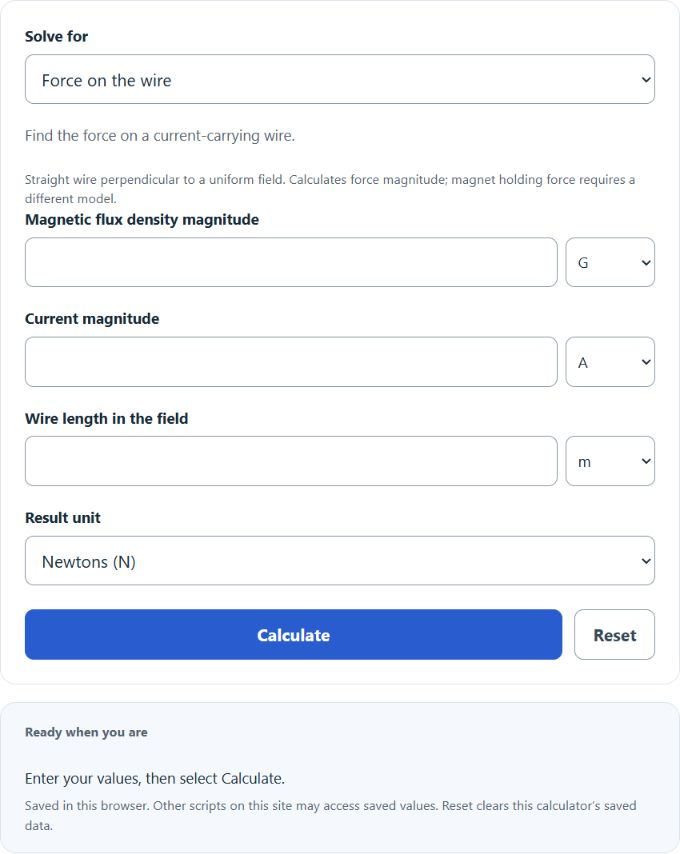
Calculate magnetic force on a straight wire or find magnetic flux density, current, wire length, or force using F = B × I × L with unit conversions.
- Materials Properties Unit Converters
- All Force Calculators
- Magnetic Flux Calculator
- All Physics Calculators
- Magnetomotive Force Calculator
- Wire Pull Force Calculator
Gauss to Pull Force Formula
The following equation is used to estimate the magnetic force on a straight current-carrying wire segment in a (uniform) magnetic field. This uses the standard wire-force relationship and assumes the wire is perpendicular to the field (sin θ = 1).
- Where F is the force on the wire (N)
- G is the magnetic flux density in gauss (G), where 1 G = 10−4 T
- I is the current (amps, A)
- L is the length of wire in the magnetic field (m)
To calculate the force (in newtons), convert gauss to tesla by multiplying by 10−4, then multiply by the current and the length of wire in the field (assuming sin θ = 1). Note: this is not the same as the attraction (“pull force”) between a permanent magnet and a piece of ferromagnetic material, which depends on geometry and field gradients.
| Gauss (G) | Force (N) |
|---|---|
| 50 | 0.025 |
| 100 | 0.050 |
| 200 | 0.100 |
| 300 | 0.150 |
| 400 | 0.200 |
| 500 | 0.250 |
| 600 | 0.300 |
| 800 | 0.400 |
| 1,000 | 0.500 |
| 1,500 | 0.750 |
| 2,000 | 1.000 |
| 2,500 | 1.250 |
| 3,000 | 1.500 |
| 3,500 | 1.750 |
| 4,000 | 2.000 |
| 5,000 | 2.500 |
| 6,000 | 3.000 |
| 8,000 | 4.000 |
| 10,000 | 5.000 |
| 12,000 | 6.000 |
| *Formula per calculator (wire force): F (N) = (G × 10−4) × I (A) × L (m). Table assumes I = 10 A and L = 0.5 m (and sin θ = 1), so F = 0.0005 × G. | |
What is a Gauss?
Definition:
A gauss (G) is the CGS unit of magnetic flux density (magnetic field), also called B. It is named after Carl Friedrich Gauss for his contributions to the study and measurement of magnetism. In SI units, 1 G = 10−4 tesla (T).
In the CGS system, 1 gauss is equal to 1 maxwell per square centimeter (1 G = 1 Mx/cm²). The maxwell (Mx) is the CGS unit of magnetic flux, where 1 Mx = 10−8 weber (Wb). Equivalently, a uniform magnetic flux density of 1 G passing perpendicularly through an area of 1 cm² corresponds to a magnetic flux of 1 Mx.
How to Calculate Pull Force from Gauss?
Example Problem:
The following example outlines the steps and information needed to calculate the magnetic force on a straight wire from gauss (assumes the wire is perpendicular to the magnetic field, so sin θ = 1).
First, determine the magnetic flux density. In this example, the magnetic flux density is 400 gauss.
Next, determine the current. The current is measured to be 120 amps.
Next, determine the length of wire in the magnetic field. In this example, the length is 5 meters.
Finally, calculate the force using the formula above:
F = (G × 0.0001) × I × L
F = (400 × 0.0001) × 120 × 5
F = 24 N