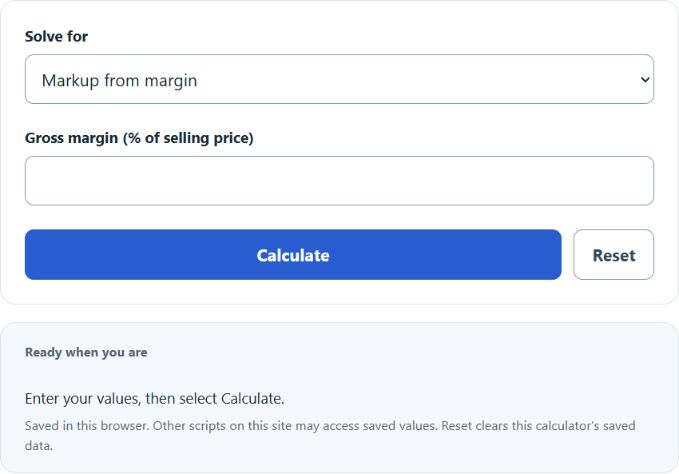
Convert gross margin percentage to markup percentage, or markup back to margin. The two percentages use different bases: margin uses selling price, while markup uses cost.
Gross margin and markup both compare gross profit with another amount, but they use different denominators. Margin divides profit by selling price; markup divides profit by cost.
How to Use This Calculator
- Choose margin-to-markup or markup-to-margin.
- Enter the known nonnegative percentage.
- Calculate the equivalent percentage.
- Use the $100 illustration to verify the relationship.
After a successful calculation, the inputs and result remain saved in this browser. Select Reset to clear the stored values and restore the calculator defaults.
How the Margin to Markup Calculator Works
Because of that denominator difference, a 50% markup is only a 33.33% margin. Converting correctly prevents pricing targets from being understated.
The primary relationship is Markup % = margin % ÷ (100 − margin %) × 100. Calculations retain full available precision internally; displayed values are rounded for readability.
Formula Variables and Input Guide
Select a direction and enter the known percentage.
| Variable or term | Meaning | Unit or note |
|---|---|---|
| C | Cost | currency |
| P | Selling price | currency |
| Profit | P − C | currency |
| Margin | Profit ÷ P | percent |
| Markup | Profit ÷ C | percent |
Choosing the Right Inputs
Decide whether the known percentage is gross margin or markup. Margin divides gross profit by selling price; markup divides the same profit by cost. Enter the percentage number shown in the records, not a decimal fraction. A margin must remain below 100% for a positive-cost item, while markup can exceed 100%.
Use product cost and selling price on a consistent basis. Freight-in, discounts, rebates, commissions, and variable fulfillment costs may or may not be included in an organization’s definition of cost. This conversion concerns gross profit on one consistent cost basis; it does not turn operating margin, contribution margin, or net margin into product markup.
Practical Uses
- Translating a margin target into a pricing markup.
- Checking whether quoted margin and markup are consistent.
- Building price lists from product costs.
- Explaining gross-profit percentages to a sales team.
Markup and margin reference
| Markup | Margin |
|---|---|
| 10% | 9.09% |
| 25% | 20% |
| 50% | 33.33% |
| 66.67% | 40% |
| 100% | 50% |
Understanding Your Results
The converted percentage appears with a simple $100-basis illustration.
Neither percentage is net profit. Operating expenses, payment fees, returns, tax, overhead, and other costs can reduce overall profitability.
Worked Example
A 40% margin corresponds to 40 ÷ 60 = 66.667% markup.
A product costing $60 and selling for $100 earns $40 gross profit. Margin is $40 ÷ $100 = 40%, while markup is $40 ÷ $60 = 66.67%.
Checking the Result by Hand
For a margin input m, imagine a $100 selling price: profit is $100 × m/100 and cost is $100 minus profit. Markup is profit divided by that cost. For a markup input u, start with $100 cost, add $100 × u/100 profit, and divide profit by the resulting selling price to verify margin.
Convert the answer back in the opposite direction. A 40% margin should become about 66.6667% markup, and that markup should return 40% margin. A 50% markup should not return 50% margin.
Common Mistakes to Avoid
- Using margin and markup as synonyms.
- Dividing by price when calculating markup.
- Trying to convert a 100% margin, which implies zero cost.
- Treating gross margin as company-wide net margin.
Assumptions and Limitations
This is gross margin based on price and cost. It does not include operating expenses, tax, returns, or other profitability measures.
Frequently Asked Questions
Is 50% markup a 50% margin?
No. A 50% markup corresponds to a 33.33% margin.
What markup gives a 40% margin?
About 66.67% markup.
Can margin reach 100%?
Only with zero cost, where markup is undefined or infinite.
Does this include expenses?
It includes only cost and selling price in the gross-profit relationship.
Sources