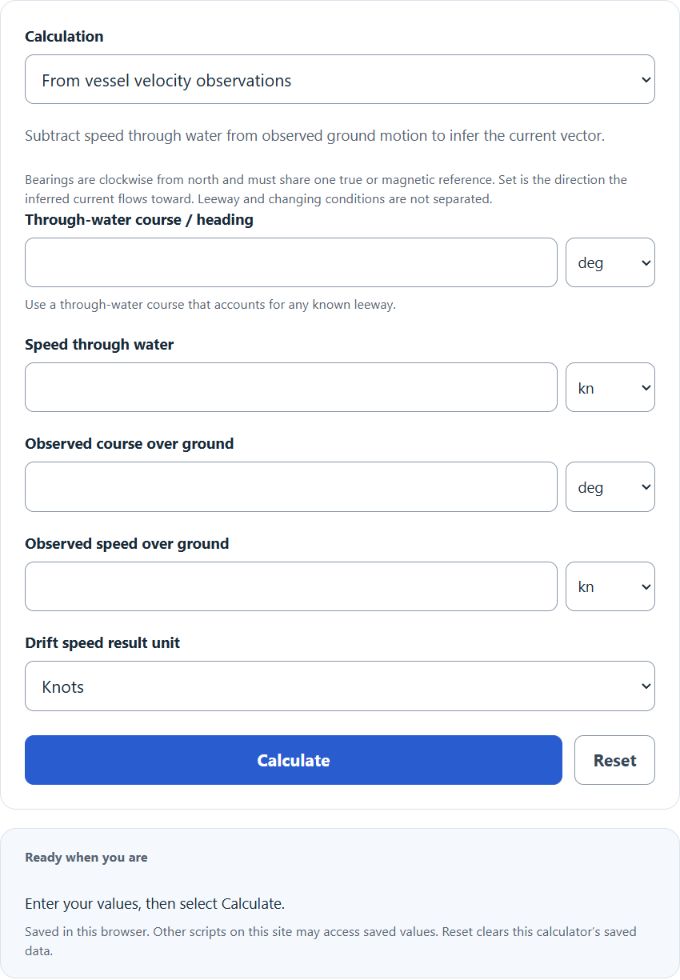
Infer a current’s set and drift from a vessel’s estimated motion through water and observed motion over ground. Set is the direction the current flows toward; drift is its speed.
Vector calculation
For speed V and bearing β measured clockwise from north, east velocity = V sin(β) and north velocity = V cos(β). Current vector = ground vector − through-water vector.
Drift = √(east² + north²). Set is atan2(east, north), wrapped to 0°–360°. Displacement mode obtains the ground vector by dividing observed signed east/north displacement by elapsed time.
Example
A vessel makes 5 kn east through the water but moves 7 kn east over ground. Subtraction gives 2 kn of current toward 90°. Alternatively, 12 nautical miles east in two hours gives 6 kn over ground; with 5 kn east through water, inferred current is 1 kn east.
Frequently asked questions
Is current set a “from” direction?
No. It is a toward direction. A current set of 90° flows east, unlike the usual meteorological convention for wind direction.
Which bearing reference should I use?
Use one reference for both vectors: either both true or both magnetic. Through-water course should account for any known leeway rather than silently treating heading as identical to water track.
What happens when drift is zero?
Direction is undefined and is displayed that way. The inferred vector also includes unaccounted leeway, measurement error and changing conditions. Signed local displacement is supported; direct latitude/longitude and long-route geodesic conversion are outside this tool.
References