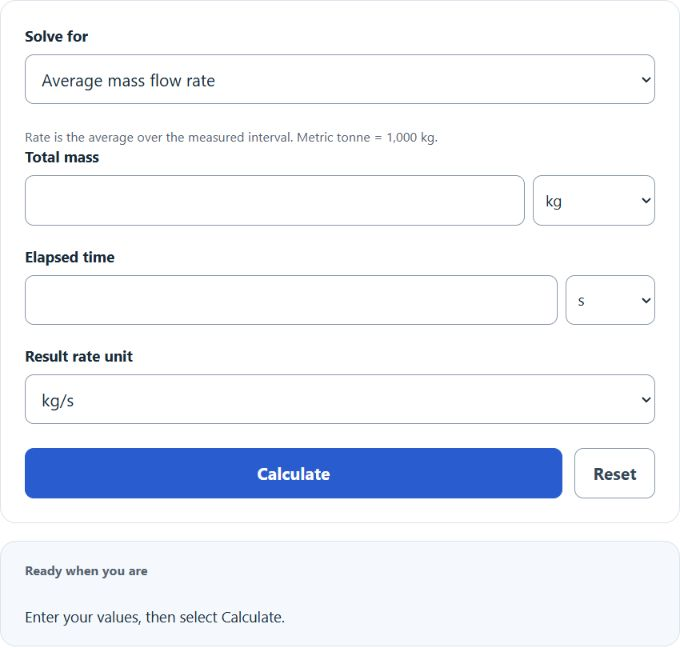
Choose mass flow rate, total mass, or elapsed time, then enter the two known values and select the result unit. Tonnes in this calculator are metric (1,000 kg).
Mass Flow Rate Formula
Mass flow rate measures how much material passes through a system during a given amount of time. This calculator is most useful when you know the total mass moved and the elapsed time, such as in batching, filling, conveying, pumping, dosing, or production tracking.
| Quantity | Meaning | Common Units |
|---|---|---|
| Mass flow rate | Amount of mass transferred per unit of time | kg/s, kg/min, lb/s, lb/hr, ton/hr |
| Total mass | Total amount of material moved during the interval | kg, g, lb, ton |
| Time | Length of the transfer interval | s, min, hr |
If you need to solve for a different variable, use the rearranged forms below.
How to Calculate Mass Flow Rate
- Measure the total mass transferred.
- Measure the total time required for that transfer.
- Divide mass by time.
- Report the result in the unit that matches your application, such as kg/s or lb/hr.
This result is an average mass flow rate over the time period entered. If the process speeds up or slows down during the interval, the instantaneous rate may vary even though the average rate is correct.
Example Calculations
Example 1: Finding the Rate
A process moves 500 kg of material in 30 seconds.
Example 2: Finding Total Mass
A feeder runs at 4 kg/s for 60 seconds.
Example 3: Finding Time
A hopper must discharge 900 kg at a rate of 25 kg/min.
Unit Guidance
- Keep units consistent. If mass is entered in kilograms and time in seconds, the result is in kg/s.
- Select the correct units. The calculator converts the selected mass, time, and rate units automatically; its tonne is metric (1,000 kg).
- Match the output to the process. Fast systems are often reported in kg/s, while production systems may be easier to read in kg/hr or ton/hr.
- Avoid zero time. A time value of zero makes the calculation undefined.
Related Flow Relationships
In many fluid systems, mass flow rate is not measured directly. Instead, it is derived from density and volumetric flow rate.
When flow area and average velocity are known, volumetric flow rate can be expressed through geometry and speed.
| Input Set | Best Use Case |
|---|---|
| Total mass and time | Batch transfers, weighing operations, filling tests, production totals |
| Density and volumetric flow rate | Liquids and gases when flow meters report volume per time |
| Density, area, and velocity | Pipes, ducts, nozzles, and open-channel approximations |
Common Applications
- Checking pump, feeder, or conveyor throughput
- Estimating chemical dosing and ingredient addition rates
- Tracking fuel, air, steam, water, or slurry usage
- Comparing equipment output against design capacity
- Calculating production rates in manufacturing and process systems
- Verifying test stand or laboratory transfer performance
Common Mistakes to Avoid
- Mixing mass units and time units without converting them first
- Using partial-batch mass data when total transferred mass is required
- Assuming an average rate is the same as a real-time instantaneous rate
- Ignoring density changes when converting from volumetric flow to mass flow
- Rounding too early when small timing differences matter
Mass Flow Rate FAQ
What is the difference between mass flow rate and volumetric flow rate?
Mass flow rate describes how much mass moves per unit time, while volumetric flow rate describes how much volume moves per unit time. Two fluids can have the same volumetric flow rate but different mass flow rates if their densities are different.
When should I use this calculator?
Use this calculator when you know the total mass moved over a measured time interval and want the average transfer rate. It is especially useful for batch operations, timed tests, and production checks.
Is mass flow rate always constant?
No. Some systems operate at a nearly steady rate, while others pulse, ramp, or fluctuate. This calculator gives the average value over the selected interval.
Why does density matter in some mass flow calculations?
Density is required whenever you start with volumetric flow instead of directly measured mass. It provides the link between a volume-based measurement and a mass-based result.
What does a result like 16.67 kg/s mean?
It means the system is transferring material at an average rate of 16.67 kilograms every second over the time period used in the calculation.